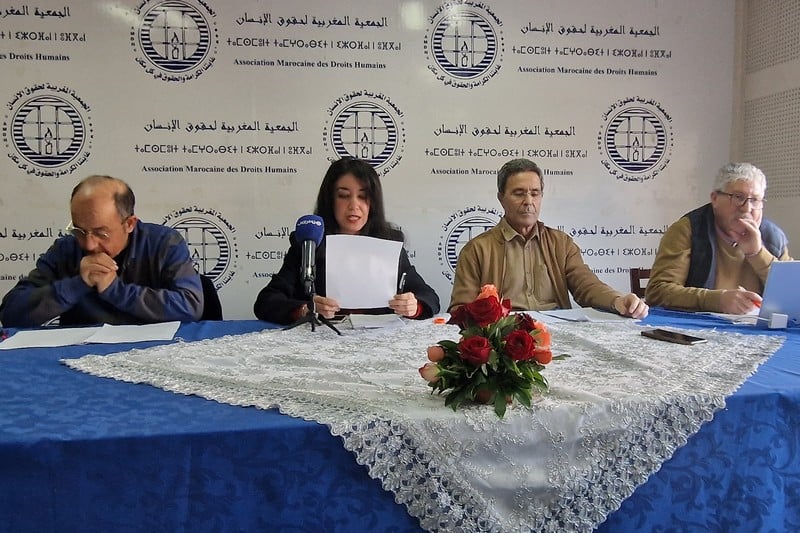
Moroccan human rights organizations warned of the repercussions of the Finance Law that Parliament approved on Thursday, considering that a number of its provisions “will further weaken the purchasing power of Moroccan citizens.”
Representatives of the Moroccan Anti-Bribery Association (Transparency Morocco), the Moroccan Association for Human Rights, and the Association Space said, in a press conference in which they presented their reading of the 2024 Finance Law, that the symposium came “to sound the alarm,” criticizing the public authorities’ continued preparation of financial laws “in a solitary and unilateral manner.”
Lack of fiscal justice
Abdelkebir Meloudi, a member of the central office of the Moroccan Association for Human Rights, said that the three associations are “sounding the alarm, because we expect the number of poor people to increase next year, in light of the government’s intention to dismantle the subsidies fund, and its continued reliance on indirect tax revenues paid by the middle class.”
Although the government has established a number of social programs, such as direct social support, Meloudi believes that the burden of financing these programs will be borne by the middle class, whose contributions from indirect taxes represent 75% of tax revenues.
“The dismantling of the clearing fund, the subsequent increase of prices of a number of basic goods such as butane gas and electricity will impoverish Morocco’s middle class.”
The three associations criticized the continued “absence of fiscal justice,” as Meloudi pointed out that reducing tax on large companies from 30% to 20%, and raising the tax on small companies from 10% to 20%, “means that the bill lacks fiscal justice.”
The same speaker stopped at exempting farmers whose turnover is less than 5 million dirhams from the tax, while wage earners and employees pay the income tax, saying: “75 percent of the income tax is paid by wage earners, while farmers who earn tens of millions are exempt from the tax. This shows that there is no tax justice.”
The same spokesman pointed out that there is “major tax evasion,” noting that only 2% of companies pay 80% of the state’s total tax revenue, which means that 98% of companies pay only 20%, attributing this to “a significant deficiency in monitoring and control.”
Meloudi stated that consumers are the social group that will be most affected by the 2024 finance bill tax measures.
“Despite raising tax on some items such as medicines and school supplies, increasing the tax on basic consumer items such as electricity from 14% to 20% and transportation, will weaken the purchasing power of citizens,” said the activist.
Weak social support
Ahmed Bernoussi from “Transparency Morocco” spoke about government programs related to social protection, considering that “it is not possible to talk about comprehensive health coverage in light of patients continuing to pay for treatments and medication.”
The Moroccan Association for Human Rights, Transparency and Associative Space, said in a memorandum of demands they addressed to the Head of government, heads of parliamentary groups and representatives of unions that statistics provided by the government indicate that the health coverage rate has reached 90% since implementation, whereas it stood at 34% 10 years ago.
The memorandum states that this transition is not realistic.
The same source pointed out that the independent and unemployed “do not exceed 300,000 members of the registration, that is, 70% of the target group, and not 70% of Moroccans as the government claims.”
Bernoussi considered that “the success of the universal health coverage system is not feasible in light of the weak budget allocated to the sector, which represents a mere 6% of the general budget, while the minimum percentage set by the World Health Organization is 9%.”
In addition, the activist points to the human ressource shortage in the health system, Morocco only has 7 doctors for every 10,000 people, while the global average is 15 doctors for every 10,000 people.
Regarding direct social support, the three human rights associations considered that it “involves several risks, given the meager amounts approved, and increasing pressure on the middle class, which suffers significantly as a result of inflation, high prices, and indirect taxes, especially since they will not benefit from the support as they are not eligible.”
Abderahim Chafii, representative of the collective space, said that the principle of development “is a comprehensive principle, as the right to health does not only mean the right to access treatment, but rather to have a state of psychological, social and economic well-being, especially since 53% of Moroccans suffer from of psychological and mental disorders, and this may be due to the crises that society is experiencing.”
The activist criticized “public authorities’ bet on weakening institutions as an element to strengthen the state,” considering that “this will lead to adverse results, because weakening public institutions leads to weakening the state, not strengthening it, and that would lead to unrest, because the state will not be able to create a social state without strong public institutions.”







add your comment
Terms of publication : Not to offend the writer, people, sacred things, or attack religions or the divine self, and refrain from racist incitement and insults.