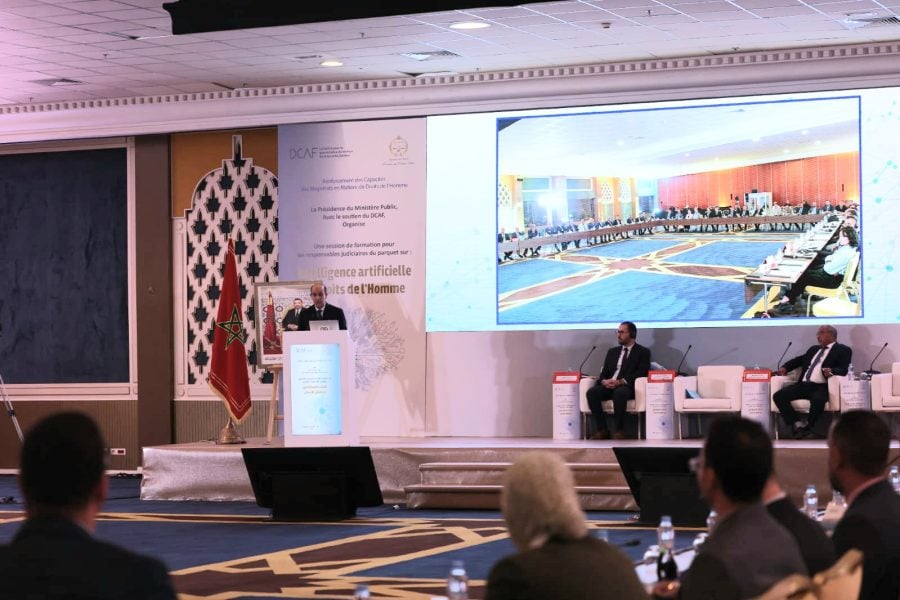
The Presidency of the Public Prosecutor’s Office is holding a training session in Fez on Monday and Tuesday, in partnership with the Geneva Centre for Security Sector Governance (DCAF) for judicial officials in public prosecution offices under the theme ”Artificial Intelligence and Human Rights”.
This training session is part of the program of strengthening the capacities of Public Prosecution judges in the field of human rights, launched by the presidency of the Public Prosecutor’s Office in 2020, and implementing its 2026-2028 strategic plan, notably its second strategic pillar, which focuses on reinforcing the protection of rights and freedom.
According to the organizers, this training tackles ”The use of Artificial Intelligence in combating crime and protecting human rights. In this regard, rapid development of technologies based on AI opens up new prospects to strengthen efforts in the prevention, detection, and investigation of offenses. However, the growing use of these technologies by legal and criminal justice institutions calls for ensuring their compliance with the Rule of Law and international human rights standards”.
These principles and standards are based on UNESCO’s Recommendation on the Ethics of Artificial Intelligence (2021), the Organization for Economic Co-operation and Development (OECD) Principles on Artificial Intelligence (2019), the Council of Europe Framework Convention on Artificial Intelligence and Human Rights, Democracy and the Rule of Law (2024), and international human rights instruments.
The session aims to strengthen prosecution judicial officials’ knowledge and skills regarding the opportunities offered by AI in combating crime, while reinforcing an approach based on human rights, transparency, and accountability, according to the same source.
It relies on a practical interactive approach that draws on international expertise to promote the exchange of comparative experience and best practices in this field.
Particular attention will be given to the protection of personal data, respect for privacy, safeguarding individuals’ physical integrity, procedural safeguards, human supervision, and mechanisms for responsibility and accountability.






add your comment
Terms of publication : Not to offend the writer, people, sacred things, or attack religions or the divine self, and refrain from racist incitement and insults.