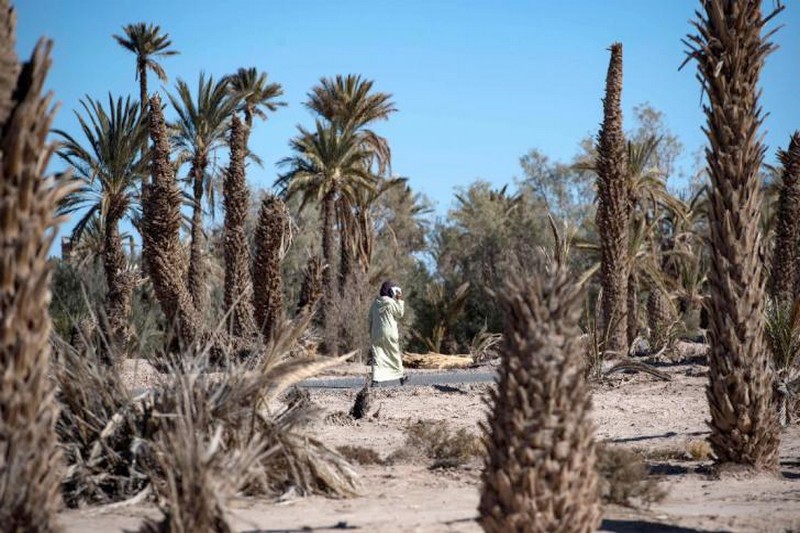
Published in Nature Journal, a study called “Detecting desertification in the ancient oases of southern Morocco” offered a comprehensive understanding of the long-term processes that led to the earlier phases of desertification in ancient southern Moroccan oases.
The study underlined that existing maps do not accurately show the extent of degraded land or the traditional water systems which underpinned cultivation.
“Desertification which occurred prior to the later twentieth century is poorly represented, if at all,” said the same source.
Using Google Earth Engine, a random forest algorithm, and satellite data, the scientists demonstrated a new open-source machine learning workflow for identifying desertification. This workflow classified five different types of land cover, including a class for desertified areas.
The bare soils of former fields are distinguishable from other bare desert soil classes in satellite images due to a notably smooth, bright look, color, and texture. However, oases that were abandoned for agriculture before the 1970s and 1980s are not traceable using vegetation-index time-series, explained the study.
The Khettara system, which is an underground tunnel that carries water for drinking as well as irrigation, was the focus of the results. This old-fashioned ancestral way of draining water through galleries is constructed with a gradual gradient of between one and two percent.
The Khettara itself, with its subsurface channel and vertical access shafts, the outlet where the water emerges, and the main canal that subsequently transports the water to use areas via a network of branch and distributary canals are the three separate components that make Khettara systems.
The study’s fieldwork revealed that many of the canals in actively cultivated regions are difficult or impossible to fully digitize using only remote sensing techniques due to the intricate network of canals inside the Skoura oasis. Yet, it offered an examination of the Khettara and of the Skoura Oasis, to determine how accurate it’s new research methods are.
The study concluded that most desertification-showing tools tend to be misleading and inaccurate, calling for more thorough investigations into the causes of desertification.







add your comment
Terms of publication : Not to offend the writer, people, sacred things, or attack religions or the divine self, and refrain from racist incitement and insults.