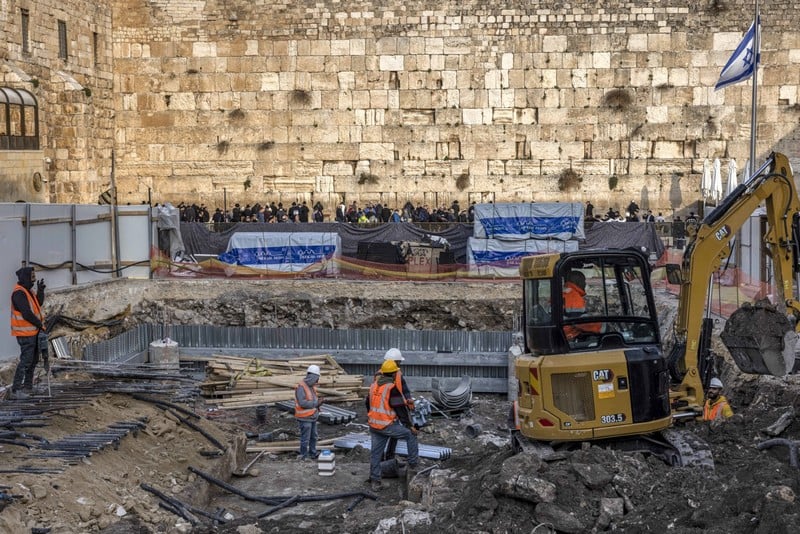
In the heart of Jerusalem’s Old City lies an area with a rich yet tragic history. For over 700 years, the Moroccan Quarter stood adjacent to the Western Wall, housing generations of North African Muslims who made the pilgrimage to live and worship in the holy city. This historic neighborhood was ruthlessly demolished by Israeli authorities immediately following the Six Day War in 1967, displacing hundreds of Palestinian families in an attempt to create a plaza for Jewish prayer at the Western Wall.
In our historical readings, we have come across the Crusades, specifically the era of Saladin, and the life of the Almohad King of Morocco, Yaqub al-Mansur. When Saladin was engaged in the Crusades and besieged by the Franks in Acre, he thought to seek help from Yaqub al-Mansur, the king of the Almohad dynasty that ruled the lands of North Africa (Morocco, Algeria, Tunisia, Libya) and al-Andalus at the time. Saladin sent an envoy asking for some of al-Mansur’s naval fleet, as the Muslims in the Levant lacked naval power to confront the massive naval attacks from Europe. In early 1192, al-Mansur received Saladin’s envoy in Fes requesting naval support to prevent the Franks from supplying their forces in the Levant. Al-Mansur responded by sending Saladin 180 ships and preventing the invaders from reaching the Levantine coast.
After the Crusades ended and Jerusalem was liberated, these Moroccans decided to return to their homeland. But Saladin insisted that they settle in Jerusalem and implored them to inhabit the city. Everyone was surprised by this request, as Saladin had allowed the Levantines, Iraqis, and Egyptians to return home. Here he said his famous quote: “I have settled here those who stand firm on land and strike hard at sea, and those who are more trustworthy to safeguard the Aqsa Mosque and this city.”
The Moroccan Quarter, also known as the Maghrebi Quarter, was endowed in 1193 by Saladin’s son, Al-Malik al-Afdal, as a religious complex for the Moroccans. The waqf (religious endowment) comprised a mosque, madrasa, and lodgings for Maghrebi residents.
The Moroccan Sultan Ali bin Othman Al-Marini endowed a huge sum of 16,500 dinars to purchase a waqf in Jerusalem and the two holy mosques in Mecca and Medina in 1337 CE. This endowment reflects the historical interest of Moroccan rulers in Jerusalem and their support for a Moroccan presence there.
Over the centuries, the Quarter evolved into a thriving hub of homes, shops and religious institutions, with a population of over 650 Palestinians at its peak. Families in the Quarter made their livelihoods as artisans, producing handmade crafts and baked goods sold in the markets of the Old City.
The Quarter was named after its predominant inhabitants, Muslims from Morocco, Algeria, Tunisia and Libya who were under the rule of Marrakesh and settled around the Western Wall. For North African pilgrims, living in the Moroccan Quarter’s narrow alleys—just meters from the Al-Aqsa Mosque and the Dome of the Rock—was considered a great blessing. Sufi orders also established themselves in the neighborhood, with the 14th century Sufi saint Abu Medien al-Ghuz founding a lodge and school there. By the early 20th century, the Quarter contained some 110 houses, two mosques, two zawiyas (small mosques), and several madrasas.
Despite its significance, the Moroccan Quarter faced the threat of demolition almost since the beginning of Zionist immigration to Palestine. In the late 19th century, Zionist groups eyed the neighborhood as an ideal enlarged prayer space for Jews at the Western Wall. The first attempt came in 1875, when a Jerusalem rabbi tried unsuccessfully to buy the Quarter. Further efforts were made in 1887, 1895 and 1910. British Mandate authorities rejected these early proposals, noting the Moroccan Quarter was an established waqf.
As Jewish immigration increased in the 1920s and 30s, however, Zionist leaders pressed harder for control of the Western Wall and the demolition of the Quarter. In 1928, the Jewish National Fund commissioned a “Western Wall Scheme” which envisaged clearing the Moroccan Quarter entirely to create a wide Western Wall plaza. While this plan did not materialize, tensions continued to rise. On August 15, 1929, Zionist demonstrations at the Wall sparked the 1929 Palestine riots, resulting in the deaths of 133 Jews and 116 Arabs.
In the lead-up to the 1947 UN Partition Plan for Palestine, which proposed the internationalization of Jerusalem, the Jewish Agency renewed its demand for the Moroccan Quarter’s demolition. The 1948 war put these plans on hold, but after the Six Day War in 1967, when Israel captured East Jerusalem and the Old City, the Quarter’s fate was sealed. Citing “urban planning needs”, Israeli authorities issued evacuation orders to all residents of the Moroccan Quarter on June 10, 1967. Less than 24 hours later, over 650 people were made homeless as Israeli bulldozers razed the Quarter completely. Centuries of living heritage were reduced to rubble in just three days.
Where the Moroccan Quarter once stood, Israeli authorities rapidly created the Western Wall Plaza to accommodate mass Jewish prayer. The site was landscaped and prepared for public use within weeks. A wooden ramp was constructed where the main street of the Moroccan Quarter had been, allowing direct access from the Plaza to the Western Wall.
The creation of the Plaza quadrupled the capacity at the Wall, allowing up to 50,000 worshippers to pray side-by-side. It was also designed to host national ceremonies, with an area set aside for swearing-in ceremonies for Israeli soldiers. While Palestinians saw it as the heartbreaking erasure of their neighborhood, for Israelis the Plaza was a symbolic acquisition, a step towards claiming Jerusalem as their united capital.
Some argue that the demolition was politically motivated, intended to assert Israeli sovereignty over the area rather than address any security threat. They contend that rapidly rebuilding the area as a Jewish religious site was meant to preclude any future Palestinian attempts to rebuild or make claims on the land where the Moroccan Quarter once stood. However, these motivations behind the demolition remain open to interpretation and debate among scholars.
For the exiled residents of the Moroccan Quarter, the loss of their community was devastating. Most ended up as refugees in the Muslim Quarter nearby. The Waqf lost a significant asset that had helped fund its charitable works for centuries. Dozens of small family businesses were crushed. Centuries of social bonds and heritage were erased.
The most sacred Muslim spaces of the Al-Aqsa Mosque and the Dome of the Rock were now encircled by Jewish places of worship and Israeli national ceremonies. Palestinian access to Al-Aqsa was severely restricted, and remains so today. The demolition thus profoundly altered the geography, demography and experience of Jerusalem’s Old City for Palestinians.
In the over 60 years since its destruction, the Moroccan Quarter has slowly faded from public memory. Yet its fate remains a powerful symbol of the dispossession and erasure of Palestinian heritage in Jerusalem. The neighborhood’s centuries-old alleys may be long gone, but the resonance of this loss cannot be bulldozed away. For Palestinians, the Moroccan Quarter remains an enduring testament to the vulnerability of heritage, memory and identity in the face of occupation. Its demolition scarred the heart of the Old City, leaving an absence that endures at the center of Palestinian life in Jerusalem.


add your comment
Terms of publication : Not to offend the writer, people, sacred things, or attack religions or the divine self, and refrain from racist incitement and insults.