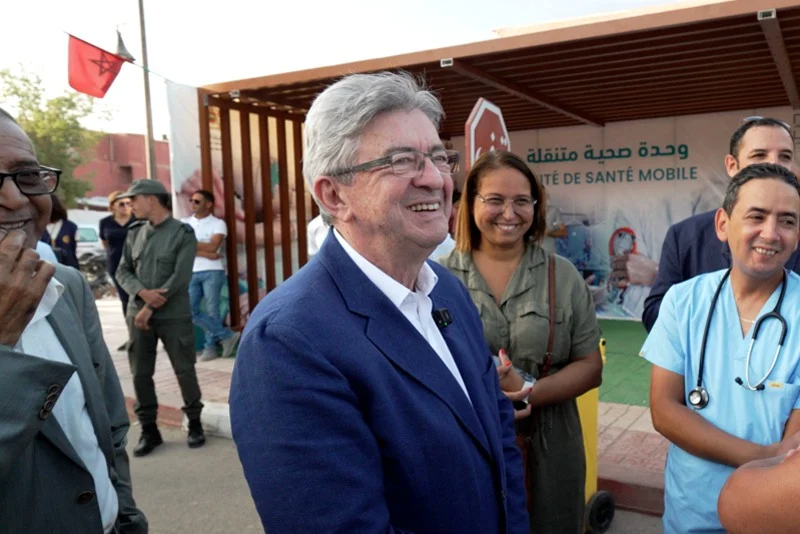
Jean-Luc Mélenchon, a French left-wing leader and founder of the “La France insoumise (LFI) party, conducted a state visit to the Kingdom of Morocco earlier this week despite the ongoing diplomatic crisis between Rabat and Paris.
The visit, which had been planned for nearly a year now, was marked by several activities, including a field visit to Amizmir, a promotion of his latest book, and meetings with leaders of Moroccan political parties
Day 1: Field visit to Amizmiz
Mélenchon kicked off on Wednesday 4 his visit to the region of Marrakech, as he went to the earthquake-stricken province of Al-Haouz, Amizmiz to support the resumption of classes in temporary tents and interact with local residents, officials, and association representatives.
He recounted, “I am impressed by a person who is making a great effort, and I admire the level of organization and dynamic cohesion I witness, combining the spontaneous enthusiasm of the residents with the work of the local authorities,” adding, “one thing is certain, the main strength of Morocco lies in its people, who have shown qualities of resilience and solidarity, which have somewhat faded in the context of modern civilization.”
During his visit, Mélenchon underscored that the French media coverage during the tragic seismic event deepened the problems between Morocco and France, despite this period should have been a time to get rid of anything malicious and negative.
The French politician emphasized the importance of differentiating between the government policies of the two countries and the Moroccan and French people. This call comes in the context of tensions in the relations between Rabat and Paris.
Mélenchon expressed his impression of how Morocco quickly overcame the repercussions of the earthquake. He described French media coverage of the seismic event as lacking respect for others and engaging in exaggerated sensationalist discourse. He said that France needs to learn from Morocco’s handling of the COVID-19 crisis and the devastating earthquake.
Talking about the Moroccan Sahara issue, Mélencon acknowledged the emotional significance it holds for the Moroccan people. He noted that the recognition of Morocco’s sovereignty by the United States, Spain, and Israel has altered the perception of this issue.
In an effort to dispel any doubt regarding his support for the Polisario Front, he called Moroccan diplomacy “effective” and emphasized that the LFI party has no institutional ties to any other parties than the Moroccan democratic parties.
The French politician expressed his hope that his country took into account these stances and understood the current circumstances, highlighting “We rely on the decisions of the United Nations, and Morocco has put forward an important proposal on the UN table, which should be taken into account, within the framework of realistic politics.”
Day 2: University Hassan II University, Casablanca
Mélenchon moved on Thursday 5 to Casablanca, where he delivered a lecture at The Faculty of Law, Economics, and Social Sciences Ain Chock, Hassan II University.
In his opening remarks, he shed light on the swift and disciplined response of the Moroccan people in times of crisis.
“I would like to express my admiration to all those who instantly mobilized, taking the queue with discipline to donate their blood, the others to rush to the spot, each coming with their knowledge in perfect discipline of action,” said Mélenchon.
The French politician declared, “I do not distance myself for a moment from the tragedy that struck you,” then invited the audience to observe a minute of silence in solidarity with the Al-Haouz earthquake.
He also called for France to rid itself of arrogance and turn the page on looking down on others which has led to media backlash and accusations of disdaining France.
During the conference, Mélenchon took the opportunity to promote his latest book entitled “Do Better! Towards the Citizen’s Revolution.” The book delves into the issue of climate and ecology, with an emphasis on water management.
He also discussed the immortality and self-destructive nature of capitalism today due to overpopulation. He emphasized the need to abandon capitalism to protect the ecosystem.
Mélenchon also highlighted the significance of cities and networks in contemporary society and perceived migration as an opportunity for cultural exchange and learning.
Day 3: Meeting with Aziz Akhannouch in Rabat
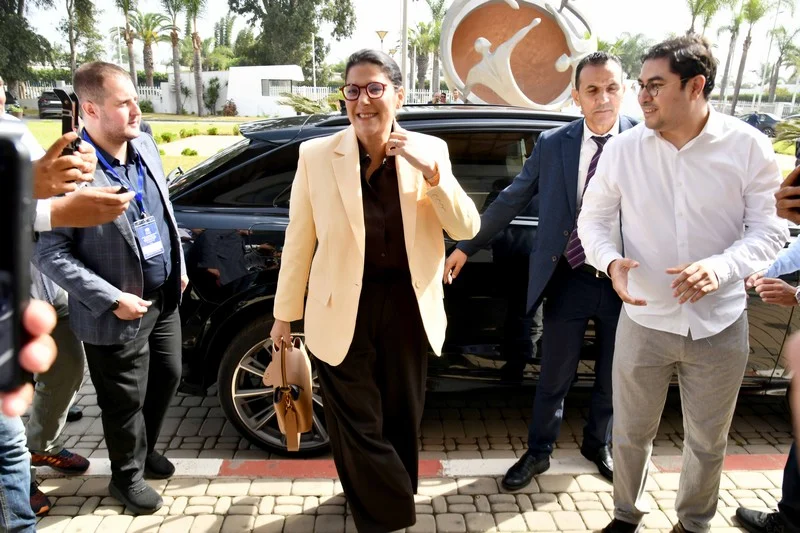
Aziz Akhannouch, Head of the National Rally of Independents (RNI), welcomed on Friday 6 Mélenchon, who was accompanied by French parliamentarian Farida Amrani and Gabriel Amard, in Rabat.
During the meeting, Mélenchon reiterated his admiration for the way Morocco handled the aftermath of the Al-Haouz earthquake and commended the effort of the Kingdom, under the leadership of King Mohammed VI, particularly in the areas of energy diversity and renewable energy.
The French politician also noted that “Morocco is a unique example in managing energy, water stress, education, healthcare, and social protection.”
On his part, Akhannouch displayed the structured projects implemented by the Kingdom, including social protection workshops.
The meeting was attended by leading members of the RNI party, such as Rachid Talbi Alami, Mohammed Oujjar, Mustapha Baitas, and Zineb Chahim.
On the same day, Mélenchon delivered another lecture at Mohammed V University where he met various Moroccan political leaders, including Nabil Benabdellah, the Secretary-General of the Party of Progress and Socialism (PPS).
However, Mélenchon refused to meet with Benabdallah in the presence of the press, which had been invited before, at the headquarters of the Moroccan Socialist Party.
Benabdallah justified the sudden decision by stating that Mélenchon hadn’t provided a clear reason.
Yet, sources from PPS told Hespress that Mélenchon became concerned about the potential repercussions regarding his statements on Franco-Moroccan relations, which have been widely circulated, noting “these statements could cause him problems in Paris.
Day 4: Visit to the city of his childhood, Tangier
Mélenchon concluded his journey in Morocco by visiting Tangier, the city where he was born.
It is expected that the French Politician will hold meetings with the Moroccan Minister of Equipment and Water, Nizar Baraka.

add your comment
Terms of publication : Not to offend the writer, people, sacred things, or attack religions or the divine self, and refrain from racist incitement and insults.