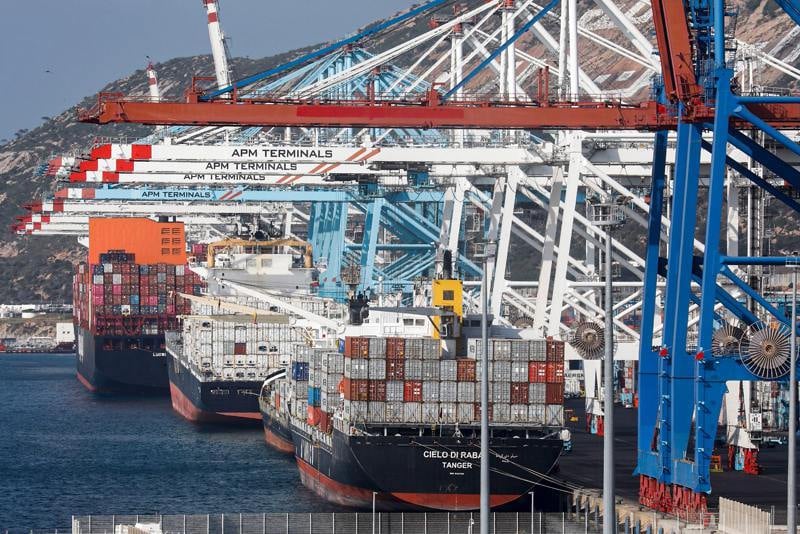
Morocco was Spain’s third largest market outside the European Union in 2022, as Spanish customs recorded a new historical record of exports to Morocco.
Exports from Spain to Morocco reached a value of 11,748 million euros, up 23.6% from the year before, when they were worth 9,500 million euros.
In 2021, bilateral trade between both kingdoms had already “exceeded levels prior to COVID-19.”
Spanish exports to Morocco are up to 12.4% higher than those recorded in 2019.
Worldwide, Morocco has been among the top 10 customers of Spain, occupying ninth place in 2022, this year coming in right behind the United States and the United Kingdom.
“With 3% of total exports, Morocco is our third market among non-EU countries, just behind the United States and the United Kingdom and ahead of China, which receives 2.1% of Spanish exports,” said the Economic and Commercial Office of Spain in Rabat.
In 2022, Spain’s imports from Morocco represented a value of 8 692 million euros. Whereas in 2021, Morocco ranked as Spain’s 13th supplier, representing 1.9% of sources of total import volume.
In terms of products traded between Spain and Morocco, exports to the southern neighbor are mainly fuels and lubricants (17.4%), automotive equipment, components and accessories (13%), textiles for clothing (9.3%) and electronic equipment (4.5%).
For its part, Morocco has exported to Spain electronic equipment in the first place (21.9%), women’s clothing products (18.3%), automotive equipment, components and accessories (8.3%), as well as marine products (frozen, dried or preserved shellfish, 7.3%).
The Spanish Customs indicates that in 2022, 18,673 Spanish companies have exported goods to Morocco, 5.8% more than in 2021.
Of these, 6,274 companies (33.6%) were regular exporters over the past three years, showing a sharp increase in the number of Spanish companies entering the Moroccan market.
In Morocco, the latest data from the Changes Office from January to September 2022 show that Spain was the leading foreign supplier of goods and services, with a market share of 14% of imports.
China (10.4%), France (10.36%), the United States (7.36%) and Saudi Arabia (6.41%) make up the remaining main trade partners.
Spain has been Morocco’s main trade client, receiving 19.9% of its total exports. France stands out as the second destination of Moroccan exports, with 19%.
India comes third with 6.27%, followed by Brazil (5.11%), then Italy (4.17%) which completes the top 5 destinations of Moroccan production. The United Kingdom is ranked sixth, slightly ahead of Germany, in eighth place.
As for the rate of coverage of trade, on the Spanish side, the trend has remained continuously downward, from 2017 to 2020, “reflecting a growing balance of bilateral trade and giving an idea of a certain complementarity of trade flows between the two countries,” according to Spanish Customs.
In 2017, this rate was 127.55%, then it dropped to 122.86% in 2018, to 122.55% in 2019, and finally to 116% in 2020.
In the last two years, 2021 and 2022, “Spanish exports to Morocco have grown at a faster rate” than imports.
The trend of the coverage rate is therefore reversed, evolving to 130.12% in 2021 and 135% in 2022.
At the level of the European Union (EU), Spain also retains its place as leader in trade with Morocco.
According to the latest Eurostat data for 2022, EU exports to the kingdom reached 30,509 million euros, 21.44% more than in 2021.
EU imports from Morocco have also reached 20,501 million euros, 13.92% more than the year before. Of this overall volume of EU exports to Morocco, Spain is ranked first (January-November 2022), with 38% of the total, followed by France (19.2%), Italy (8.9%), Germany (8.7%) and the Netherlands (5.6%).
Regarding EU imports from Morocco, Spain also retains its first place, for the ninth consecutive year, taking more than a third (39.6%) during the same period. France follows in second place (28.3%), ahead of Italy (7.9%), Germany (4.8%) and Belgium (4.5%).
The Economic and Trade Office of Spain in Rabat believes that these figures are explained by the geographical proximity between the main partners, in addition to the quality of bilateral economic relations.








add your comment
Terms of publication : Not to offend the writer, people, sacred things, or attack religions or the divine self, and refrain from racist incitement and insults.