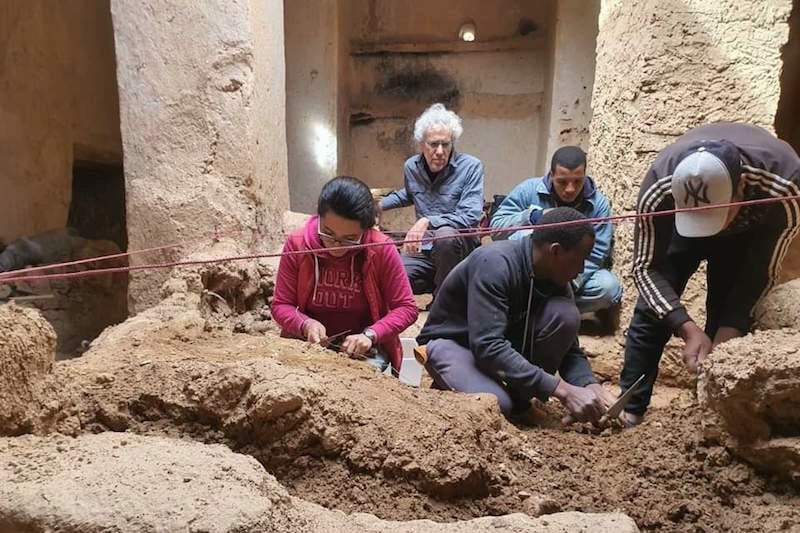
A historic synagogue in the Tata region is taking center-stage among experts in archeology, after the supervising team of researchers have confirmed that “extremely important” documents in Hebrew and other archaeological finds were discovered during excavations.
Carried out by a Moroccan research team that also includes researchers from other nationalities, under the supervision of the young researcher Professor Mabrouk, the National Institute of Archeology and Heritage said that these finds at the “Tagadert Jewish Synagogue” “do not only date the Jewish component in southern Morocco and the local history of the region, but add to the history of Morocco at large, based on the found material and archaeological evidence.”
Mabrouk, a research professor at the National Institute of Archeology and Heritage in Rabat, said that these are “the first excavations about Moroccan Jews that took place in the country in a Jewish site, with a very accurate archaeological and scientific and practical study in the excavations, to bring out the archaeological finds intact, especially the Hebrew manuscripts, which are considered of important scientific and historical value.”
In a statement to Hespress AR, the archeologist said: “We found old purchase and sale contracts, marriage contracts, amulets, the Torah, and many pieces, in addition to other finds related to the furnishing of the temple.”
Among the finds discovered were also “some artifacts in the temple, related to the Hebrew component of Morocco, and some unknown old coins, which we are still looking at, in addition to money from the era of Mohammad IV and Hassan I, and others that we estimate date back to before the 15th century.
The archeologist and head of the team says that the excavation team “is working to preserve the original structures and design of the monument historically, so that it can be restored in a manner that preserves its authenticity; We do not only excavate, excavate, and extract materials, but also restore the temple to its origin so that people can visit it in its original components,” which could attract “economic and tourism activity for the region.”
“The finds, including manuscripts and archaeological tools, are very important from a historical point of view, as many agree that local history enriches national and regional history, this could influence general history and contributing to writing Morocco’s anew.”
The author highlighted the importance of this discovery, “especially in the relationship of southern Morocco with countries south of the Sahara, with Aqa and Tamdount in the Tata region, which were among the most important commercial stations during the Idrisid era, and in which we discovered the first mosque in southern Morocco.”
“This discovery is part of rewriting the multicultural history of Morocco: Mediterranean, Amazigh, Andalusian, Arab, Islamic, Jewish and even Christian, given the Kingdom’s location, and the Hebrew component is part of the history and identity of Morocco. Previous studies of archaeological research did not include a Jewish temple or a Moroccan navigator.”

add your comment
Terms of publication : Not to offend the writer, people, sacred things, or attack religions or the divine self, and refrain from racist incitement and insults.