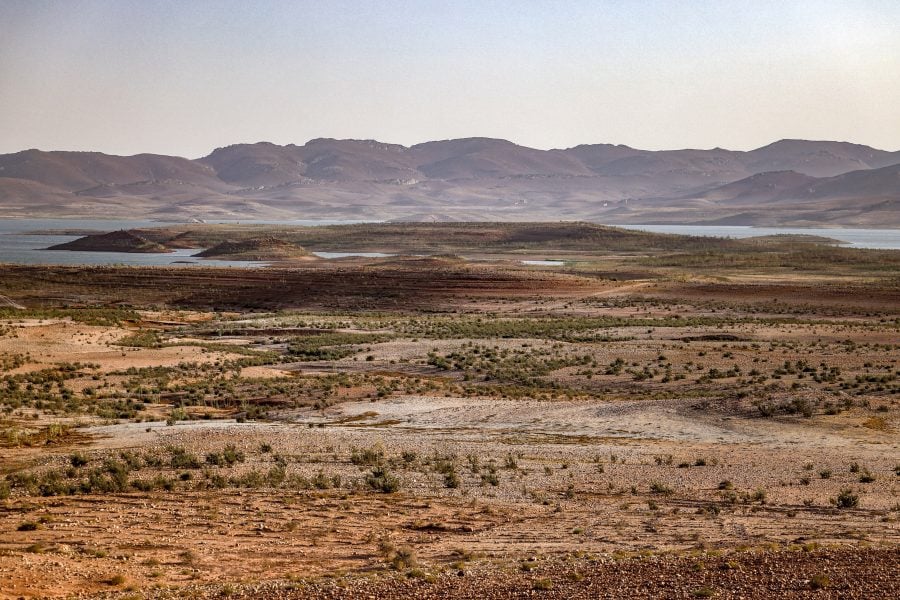
Moroccan citizens’ share of cropland does not exceed 0.2 hectares, which is equivalent to only 40% of the per capita share in America.
The World Bank monitored major land challenges, listed in its recent report on land governance and management in Morocco and the Middle East and North Africa region.
The report titled “Land Matters: Can Better Governance and Managing Scarcity Prevent a Looming Crisis in the Middle East and North Africa,” monitored the weakness of the country’s land titling process and the absence of governance in land management.
The report stated that the process began in Morocco since the late 1960s to convert communal rural lands into individual private lands (ownership), and then commented: “However, this process has achieved, so far, little success.
Because of the problems of institutional coordination, the difficulties of dealing with joint ownership, and the exclusion of women from benefiting from this process.”
“Laws derived from customs and ‘Shari’a,’ and based on what was issued during the colonial period and the post-independence period, led to the creation of legal pluralism governing the acquisition of land and the organization and management of its affairs.”
Because of all these layers, it has become very complicated to recognize, register and access land ownership, especially for agricultural land and land under various customary tenure systems.
The World Bank report indicates that “one of the main effects of this complexity in the legal frameworks is that it may lead to overlaps or gaps in legislation, confuse citizens’ understanding of the law, and make its enforcement extremely difficult,”
It explains that “Legislation effectiveness depends on the extent to which official land laws are applied and interpreted in Morocco on location, ownership, and local control over land issues,” giving the example: “In the country’s rural Middle Atlas region, some village councils may apply customary rules for land acquisition and use that contravene official government policy. In irrigated agricultural areas, the official law is likely to be enforced.”
The same source explained that “the movement has achieved many remarkable legislative reforms in favor of women; Such as the official recognition of women as beneficiaries of compensation, after the transfer of communal land.”
On the other hand, the report referred to government initiatives related to infrastructure, in the framework of partnership with actors in the private sector, for example, “the reclassification of endowment lands by the Ministry of Endowments and Islamic Affairs as property.”
“This change in tenure, driven by political and economic interests to allow the implementation of development projects, has disrupted land rights and uses.”
“In general, governments do not provide the necessary land for their economy,” the document stated.
In Morocco, “urban development has long relied on the provision of land by public authorities, often in unsuitable locations.”
When public lands are mobilized, the allotment often does not follow market principles, i.e. land is not transferred at market value; Which means (generating a redistribution of rent and wealth to the beneficiaries of these allocations), or not transferring it to the more productive users who are willing to pay more for it.
And the same document continued: “Policy makers often justify the practice of allocating land at a value below market value, claiming that by doing so they ensure the cost of land for low and middle-income groups and equal access to it, yet there is no follow-up on the extent to which these outcomes are achieved on the ground.”
With regard to real estate taxes, the report said that Morocco, after Israel, in the Middle East, “is the country that reaps the largest revenues from real estate taxes, but it does not exceed 1.6 percent of the gross domestic product.”
Some of the reasons for these low levels are due to the many exemptions introduced to appease vested interests or avoid social discontent, which ultimately defeats the purpose of the tax.
Morocco, for example, applies a 75 percent reduction in the value of prime residences and a five-year exemption for newly constructed real estate.







add your comment
Terms of publication : Not to offend the writer, people, sacred things, or attack religions or the divine self, and refrain from racist incitement and insults.