
A new exhibition of archaeological treasures in the Rabat National Zoo retraces the history of Morocco’s emblematic Atlas lion, tracing it back to thousands of years in the Kingdom.
The exhibition, which opened on Friday, displays bones of the Atlas Lion dating back 110,000 years, and a history of its ancestors in Morocco dating back more than two million years.

Abdeljalil Bouzoukar, Director of the National Institute of Archeology and Heritage, Mehdi Bensaïd, Minister of Youth, Culture and Communication, and Leila Benali, Minister of Energy Transition and Sustainable Development all attended the opening ceremony in the capital.
The two ministers signed a framework agreement on the protection and valuation of the country’s geological heritage on the occasion.
The opening of the exhibition started with archaeologist Bouzoukar delivering a speech on the types of archaeological finds of the Atlas lions in Morocco and their history, in historical sources and in scientific research, and their last recorded appearance in the wild (in 1942), up to their present in the Rabat Zoo.
In his presentation, Bouzoukar thanked Moroccan institutions and American and European universities, with which the National Institute of Archeology and Heritage collaborates on this topic, and other areas of interest in prehistoric Morocco.
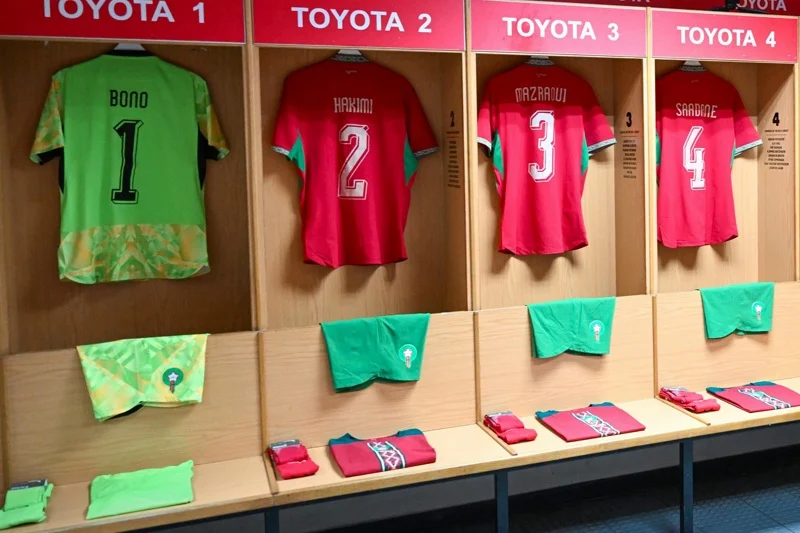
The officials and speakers in the event also took the opportunity to highlight the national football team and congratulate its achievements, as the selection bears the name of this emblematic Moroccan lions.

The Minister of Youth, Culture and Communication said that this meeting, organized by the Ministry of Culture in coordination with the National Institute of Archeology, Heritage and the Zoo, presents “the recent discovery of Moroccan researchers about the Atlas Lions,” and sheds light on “the history of these lions, and the role they played in the region for thousands of years.”

While the director of the National Institute of Archeology and Heritage said that there is “an accumulation of discoveries by Moroccan researchers, mainly from the institute and also belonging to European and international universities, an accumulation that enabled us to learn about the Atlas Lion, and its history that extends to more than two million years.”
Bouzukar added, in his statement to Hespress AR: “This is a very important historical depth, and it should also be noted that at levels dating back 400,000 years, many fossil bone remains were discovered in many locations in northern, central and southern Morocco, and this means that the geographical spread of the Atlas Lion was wider than we thought before, in the sense that it had the ability to adapt to multiple and different climates.”
He continued, saying: “This discovery indicates the existence of continuity in history, which ended tragically in 1942, but it is not as tragic as we think, as evidenced by the lions in the National Zoo, which constitutes not only symbolic importance for Moroccans, but also for a large part of the population.”









Why do we always adopt a reactive position instead of an offensive one? Do we really need to wait until some psychopath quasi-country starts hijacking our heritage, and it is only then that we realize the importance or value of what is ours?
I fully understand our right to defend and protect our heritage. However, adopting a reactive standpoint rather than an offensive stance gives the impression or makes us come across as if we genuinely don’t own what we claim as ours.
I think our public policymakers should consider developing a compressive proactive policy framework to protect Morocco’s material and immaterial heritage to avoid such situations where our public officials go on a reactive public show.
We should be more PROACTIVE..