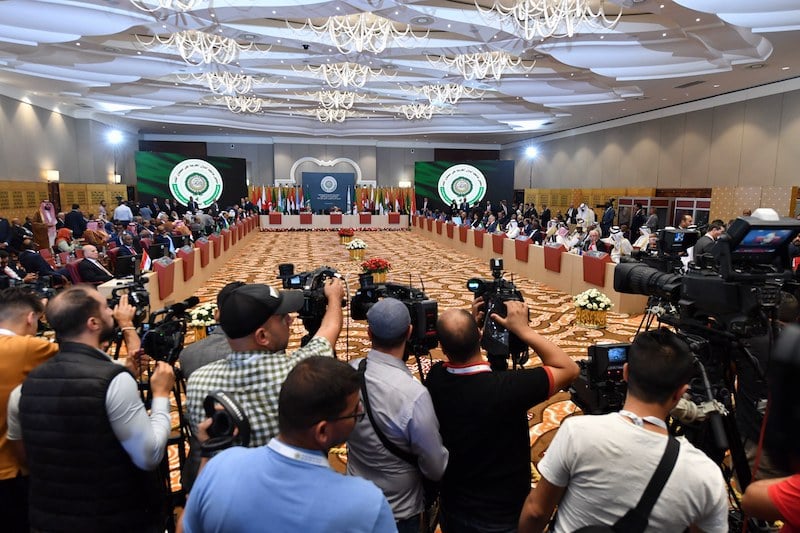
True to the expectations that preceded it, The Algeria-hosted Arab league summit ended with a testimony to the League’s fragmentation and dysfunction, little accomplishments, and a flop in the number of leaders who actually showed up.
Algeria attempted to pass in its final declaration on the Summit as being ‘successful’ and exhibiting “a spirit of brotherhood and compromise,”but this could not be farther from the truth.
An irritated Egypt
Cracks in ‘the brotherhood’ had begun to show even prior to the meeting. Algeria invited the Tripoli-based GNU government to represent Libya in the meeting, in an apparent collision with Egypt, which refuses to deal with the GNU and supports its rival government.
Although Egypt’s Abdelfatah Sisi sat down for a speech given by the Libyan Presidential Council on Libya, the actual declaration on Libya contained a single line that called for ‘solidarity with the Libyan people and supporting efforts aimed at ending the crisis.”
The implicit tension between Algeria and Egypt was further influenced by the absolute silence on the Nile river conflict involving Egypt and Ethiopia and the newly formed closeness between Addis Ababa and Algiers that would have likely rubbed off Sissi the wrong way.
Assad stays in the shelf
Syria was shelved in the summit despite initial pressure from Algiers to end Assad’s suspension at the summit. When mentioned, Syria, as the Arab League Secretary-General Ahmed Aboul Gheit put it “still requires a pioneering Arab effort.” Consensus on Syria was limited to vague language and ‘support for a political solution.”
Morocco made the underdog
Aside from the purposeful isolation of the Moroccan Minister, his accompanying team, and Moroccan journalists during the summit, the Morocco-Algeria rift was entirely absent from discussions, but the league still affirmed language that called for the preservation of the territorial integrity of Arab nations – despite Algerian attempts to integrate wording such as “according to internationally recognized borders,” which Morocco opposed.
A little victory for the Moroccan delegation was its success to redraft a text on a project to reform the League, which Algeria had submitted during the beginning of the preparatory work. Morocco, which opposed the text, was able to convince member states to rewrite it.
Despite multiple attempts by Morocco and its allies to condemn Iran’s interference in the Sahara on the summit’s agenda, Iran was not once mentioned in the final declaration, but the text still referenced condemnation of “foreign interference” which also likely referred to Turkey.
Palestine, star of the show
Palestine occupied the larger chunk of discussion and space in the summit and its declaration with expressions of support for Plestinians, condemnation for Israel and promises to pressure the UN for a Palestinian membership.
The 22 member states, however did not discuss the recent allying of a number of nations with Israel, nor did they touch on Benjamin Netanyahu’s return to power in one of the most right wing coalitions in Israeli history.
Talks also included discussions on food shortages affecting Arab countries, climate change, and the detrimental effects of the Russia-Ukraine war.






the Arab league could be one the most influencing powers in the international scene, but unfortunately,this power is wasted in an inappropriate way.