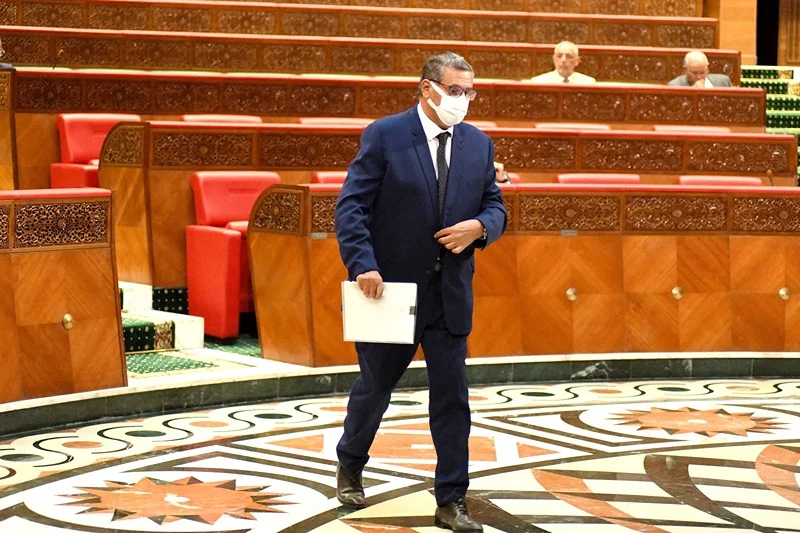
Head of Government Aziz Akhannouch outlined the next financial law for the year 2023 in a guideline note setting the social and economic priorities of the 2023 Finance Bill.
The government will work on the generalization of family allowances, according to the established schedule following the directives of the royal speech of July 30, 2022.
Nearly 7 million children from vulnerable and poor families and 3 million households without children will benefit from direct family allowances.
The social register project will be the main mechanism for granting aid.
A second phase of the social protection project, which concerns the indemnity on the loss of employment and the retirement pension for the active people, will be launched.
The government should therefore start a fair implementation of the pension reform starting from 2023.
The health sector is expected to experience the application of law and reforms that were presented to the Council of Ministers last July.
This will include approving a law on the health service which will give a special frame of reference to workers in the health sector who will no longer have the same status as civil servants.
The agreement on increasing the number of health personnel will also be implemented starting from 2023.
The MAD 3 billion budget aims to increase the number of health sector personnel by 2030, from 68,000 in 2022 to more than 90,000 in 2025 with the objective of reaching an average of 24 health professionals per 10,000 inhabitants in 2025, then 45 per 10,000 inhabitants by 2030 instead of the current 17.4 per 10,000 inhabitants.
The Head of Government mentions the reduction of expenses for the acquisition of vehicles, construction, and the development of administrative headquarters. The management of each institution will have to send proposals in this regard to the Ministry of Economy and Finance by the end of August.
In terms of investments, priority is given to projects that are already in progress, particularly those which have been the subject of conventions signed by King Mohammed VI, and to agreements concluded with international institutions or donor countries.
The government will endeavor to operate the ‘economic recovery’, as promised. It aims to encourage investment through the implementation of the ‘Investment Chart’, which provides support measures for investment, particularly for exports, Visionary Small and Medium Enterprises (VSME), and strategic projects.
Implementing the framework law on tax reform is also an important question, alongside the acceleration of projects to simplify administrative procedures and the reform of the Moroccan administration in general, which aims to be digitalized by 2030.
The executive will also tackle the problem of drinking water and the drying up of groundwater, by developing structural solutions for water supply such as water desalination plants, the democratization of the transformation of wastewater for use for irrigation purposes, and more.




add your comment
Terms of publication : Not to offend the writer, people, sacred things, or attack religions or the divine self, and refrain from racist incitement and insults.