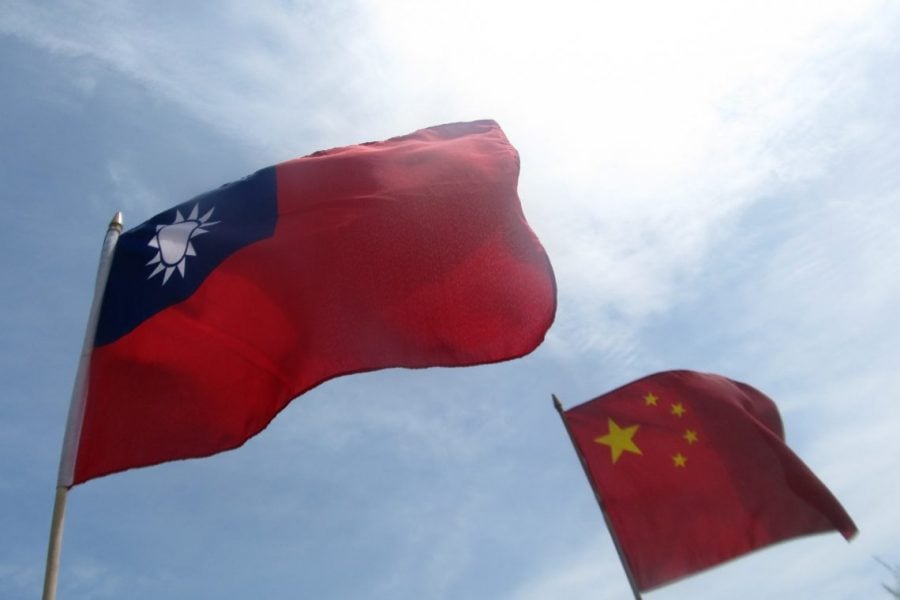
China announced it will be performing military drills near Taiwan this Wednesday, in the midst of tense diplomatic relations, according to an official of the People’s Republic of China.
Tan Kefei, the spokesperson for the Ministry of National Defense said: “These are necessary actions taken targeting the collusion between Taiwan and the United States, and conforming to the need of safeguarding national sovereignty and territorial integrity.” He added on Thursday that “the Taiwan question is purely of China’s internal affairs, and Japan must refrain from making any irresponsible remarks or interference,” reported Chinese Xinhua News Agency.
Chinese foreign ministry spokesperson Wang Wenbin also affirmed earlier this week that “China has no room for compromise or concession on issues touching its core interests of sovereignty and territorial integrity.”
Such strong responses regarding Taiwan came after US President Joe Biden affirmed he and his administration are ready to militarily defend Taiwan if China were to invade, at the Quad Summit in Japan this Monday.
The US president’s statement exacerbated long existing tensions between the island and its powerful neighbor, prompting Chinese diplomacy to respond immediately.
As the international community’s fears of military escalation mount, especially after China’s support of Russia’s invasion of Ukraine, most governments have remained comfortably neutral on the decades-long China-Taiwan conflict, eased by the ambiguity of Taiwan’s official status.
Since discord surrounding Taiwan is dominating headlines this week, here is a brief background on the China-Taiwan issue:
Currently the nation of “China” is represented by two separate authorities: the Republic of China (referred to as Taiwan or ROC) and the People’s Republic of China (PRC).
Japan had colonized the island for half a century until the end of World War II. Following Japan’s defeat, China’s Nationalist party, known as the Kuomintang (KMT), ruled China throughout the Republican Era, from 1928 to 1949, and controlled the majority of the Chinese mainland.
The party fled to Taiwan on 7 December 1949, following its defeat in the Chinese Civil War, and has since remained the most prominent political party in Taiwan.
Since then, the Kuomintang has ruled the island for much of its history, but China maintains that “reunification” is inevitable, as it considers Taiwan an integral part of the PRC.
China has put diplomatic pressure on other countries to discourage them from officially recognizing Taiwan, or making any declaration that could imply support for the island’s independence.
A country must be recognized by all five permanent members of the UN security council (the United Kingdom, France, Russia, the United States, and China), in order to gain a member state status within the international organization.
However, Chin uses its position within the council to block any attempt by Taiwan to ascend to full member status through its veto. As a result, Taiwan currently is not in the UN, and is classified as a “territory.”
As of this day, only 13 countries recognize Taiwan as a sovereign country: Belize, Guatemala, Haiti, Holy See, Honduras, Marshall Islands, Nauru, Palau, Paraguay, Saint Kitts, and Nevis, Saint Lucia, Saint Vincent and the Grenadines, and Tuvalu.




add your comment
Terms of publication : Not to offend the writer, people, sacred things, or attack religions or the divine self, and refrain from racist incitement and insults.