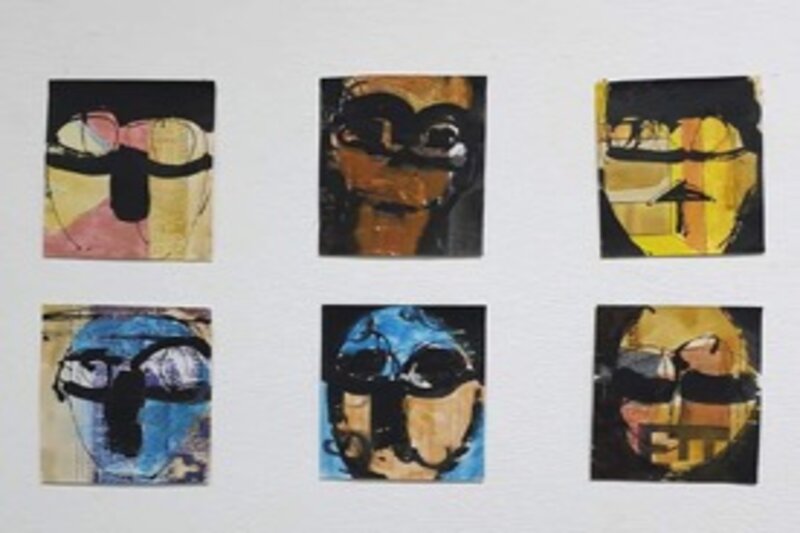
The perspective of the plastic artist Abdelkarim Elazhar is what informs his vision, and regulates the nature of rhythm, colors, shapes, and possible spaces for artistic work.
In his artistic experience, which extends to more than thirty years, he moved forward without making an absolute break with his past, or what could be considered past, in terms of time only. Yet he always leaves a visible link between the former and the later, either in his working tools, or in specific elements, or in the nature of the vision itself, Which, for example, used to approach time in its chronological sense, through the different clocks that measure time, that is, with the meaning of time in terms of rhythm, in its reflection on the human nature, on the pace of work, and the concept of becoming, which is made evident in this experience with time from which Al-Azhar will move to another without making any radical breaks.
I am concerned here with the last experience that he devoted to faces, because, in essence, they do not conceptually differ from clocks, although the working tools, in the experience of faces, consist of dyes, spaces, and shapes, which are different from what we find in the previous experience, despite the existence of a link between them that resembles fine spider silk.
In his last exhibition which he chose to call “Looking at the Dear Face”, (1) Al-Azhar’s plastic narrative, this time, is a narrative that relies on the chromatic narration, the narration of space, and the elements of imagery or composition. No face resembles another, and no face has the form, the configuration, or the space of another; and no face has, in fact, the status of “dear”; conversely, they are faces that echo and identify with each other as much as they differ; in effect, differences emerge in certain details that are crucial in distinguishing one face from another.
These details are what mostly makes this exhibition a plastic narrative that is not linear, nor successive; it actually reflects the fragmentation and the disintegration suggested by the posters, and I would not say paintings or works as, first, the whole exhibition is one work, that is a narrative, and second, the posters do not have frames, and the work is put directly on paper; absorbing the walls and being absorbed by them. These posters call each and none of them is self-independent.
There is always a narrative sequence, that is not controlled by a voice, but by eyes. The faces of Abdelkarim Elazhar do not have mouths; they are dumb, unable to speak, but the eyes are wide open and awake. They contemplate us as much as they invite us to look at them in search of meanings that they imply or the symbols and the messages they carry or intend to convey.
The eyes replace the speech with the gaze, and this is what justifies the name given to this exhibition, and makes the gaze a kind of speech, a discourse, and a message. It is the strong moment of crossing into them that enables one to know the events and the meanings they can unfold.
There are no bodies, but only faces; some of them are faces with necks, held upright as if trying to reach a remote point, or calling from a distance to tell about what we do not see. Some of them are faces without necks, separated from the body. As long as the necks connect the bodies to the faces and the faces are the echo of these bodies, some of these faces bear the changing marks of time as represented by the clock.
This is a reference to that delicate fine line that Abdelkarim Elazhar continues to preserve. But its presence has a different meaning this time, as related to the artistic context as a whole and not to one particular poster or face. The artist’s hand does not deny its past, that is why the past of writing and art, which is a past that time does not rule, is a past that does not pass and is never used up.
There is no support for these faces. They carry themselves by themselves, as a drawing, a signal and a sign, or if we like, as an icon. Whoever contemplates these faces individually, will notice that in their shapes and sizes, and even in the colors that inform them, there is no repetition in them, and this confirms the element of becoming in this artwork, as well as the meaning of narrativity.
The turning point in these faces is the introduction of scraps of paper and typographical writing, or electoral posters, lurking in the background, with some of their symbols and slogans that are used by certain political parties in their electoral campaigns. These data mark a shift in the faces from neutrality to an explicit stance, or to what can be considered as parody and black irony, that is, an artistic critique of politics. This, in my view, is a breakthrough in the relationship of culture and art to politics.
Artwork is no longer an echo, as it was before. Rather, the artwork is the voice, the context, and the frame. Emptying the ideological and the political from its direct dimensions, and reframing it within an aesthetic context which strips it of its topicality, to place it in the sphere of eternal beauty, and in what it is characterized by, namely its astonishment, despite the sharpness of criticism, ridicule and resentment that seem clear in these mutations. The support here, then, are these new elements that Elazhar employed to expose politics through art and beauty.
Whoever pays attention to the aspects of the work in its entirety, in its comprehensiveness, will inevitably notice the blackness that seeps into it completely, either in the form of strokes or smears, or in the form of a background for the face and the frame, or in defining some features, and this blackness, or darkness, is what Elazhar uses to hoax other colors and pigments to appear and stand out, so the black becomes here, like the color that helps to highlight its opposite, on the one hand, and to reveal the darkness that prevails in faces without words, faces that read their viewers, and the darkness that is in them is just a reflection of what the faces read and see in those viewers .
There is a lot that can be explored in the last artwork of Abdelkarim Elazhar, for his work is rich in possibilities, fraught with reading and interpretation possibilities, but what can be considered as the “dear” in these faces and among them, remains the element that is always out of reach, inaccessible and vanishing, what cannot be seized, for Abdelkarim Elazhar knew how to erase the traces of his crossing, even though he was walking in a land that no one could cross without leaving a trace.


add your comment
Terms of publication : Not to offend the writer, people, sacred things, or attack religions or the divine self, and refrain from racist incitement and insults.