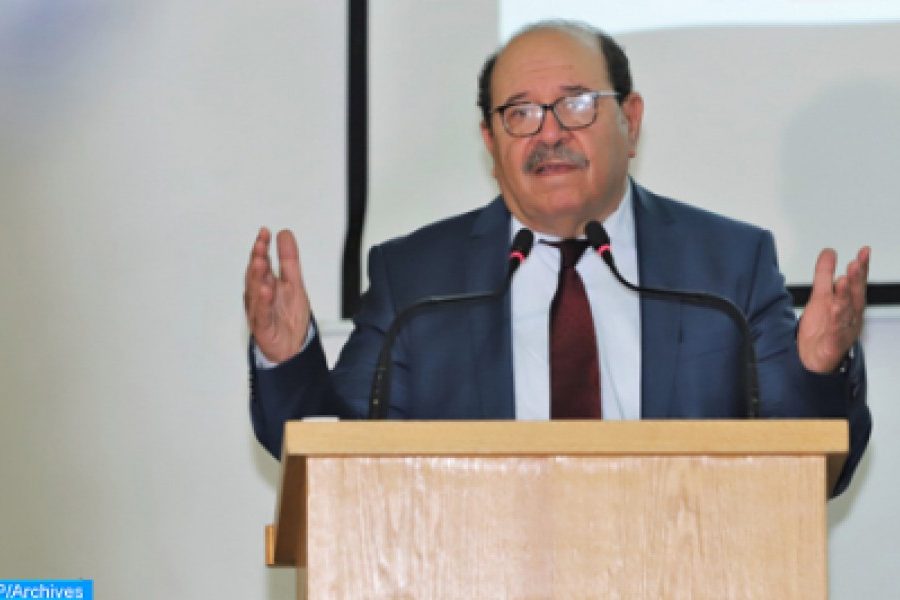
The Algerian army, which suffers from the “hero syndrome”, is driven by the “doctrine of hostility towards Morocco” despite the Kingdom’s past contributions to Algeria and its outstretched hand today as evidenced by history, said the Secretary-General of the Council of the Moroccan Community Abroad (CCME), Abdellah Boussouf.
In an article under the title “Algerian nationalism between the hero syndrome and the doctrine of hostility towards Morocco,” Boussouf tackled the common history between the Moroccan and Algerian peoples as well as the common struggle for the liberation of sister Algeria since the battle of Isly in 1840, and the Moroccan resistance fighters’ support for the Algerian resistance.
Moroccans remember with bitterness the causes of the Sands War in the 1960s, the Algerian attempts to destabilize Morocco, the purchase of consciences within the African Organization and the expulsion of 350,000 Moroccans from Algeria on the eve of Eid Al-Adha in 1975 in response to the Green March, he said.
Moroccans also remember, according to Boussouf, how Algeria adopted the ‘polisario’ as a “bastard child that it feeds with the gas and oil of the Algerian people.” They also recall how the Algerian army spent billions of dollars to stir up the public opinion within international organizations and bodies against Morocco’s territorial and national integrity and to buy weapons from African mercenaries to enlist the polisario in a proxy war of attrition against Morocco.
Despite all this, HM the King has reached out, in His 2019 Throne Speech, to Algerian leaders in order to draft a new page whose keywords are the societal development of the two brotherly peoples and the rebirth of the Arab Maghreb.
However, “the Mouradia Palace regime continues to show hostility, rancor and insensitivity towards its western neighbor,” the CCME official observed.
According to Boussouf, anyone who consults and compares the history of the two countries “would be surprised” at the details that make the abysmal gap between the two countries and would conclude that the Algerian army suffers from the “hero syndrome.”
Throughout history, Morocco’s eastern borders were the last stop for all invaders and could not be crossed by the most powerful empires, like the Ottoman Empire or the Fatimid Caliphate and then by the French armies that occupied, as of 1830, a part of the Ottoman Empire that would later be called Algeria in 1962.
Neighboring Algeria has seen several settlers and occupiers while Morocco was a state established for centuries. To circumvent this historical complex, the Algerian army found its answer in “Emir Abdelkader” and turned his character into “a historical hero” while obscuring some truths about this Algerian hero who called Morocco home by asking for protection after each military defeat.
The protection of Emir Abdelkader cost Morocco a lot of money and blood as Moroccans took part in the “battle of Isli” in 1840 while the country was not sufficiently prepared, which dragged Morocco into a circle of war credits and fines. The “Algerian hero” chose to live in his “luxurious” exile with his companions and relatives, first in France’s Palaces and then in other locations leaving the Algerian people to face their fate alone against the French occupier.
The Algerian army’s admiration for the “symbolic hero” pushed it to weave stories of mythical glories about “Emir Abdelkader” while many historical studies have shown that he did not live the constraints of exile, but rather shared the joys of French Kings and officials and was a privileged guest in their palaces.
Among the many historical realities obscured by Algerian writers of the Military History, Boussouf mentioned the power of Emir Abdelkader which did not encompass all of present-day Algeria. In fact, only certain regions of the Northeast were under his control.
While Morocco struggles day-in-day-out against poverty, unemployment and ignorance, improves social and economic development programs, defends its national and territorial unwavering values, promotes democracy and good governance, and works hard to protect its sovereign land, air and sea borders, the military regime in El Mouradia Palace draws its legitimacy only from continuous attempts to isolate Morocco from its regional environment and to involve it in incidental conflicts, Boussouf added.
Moreover, all attempts to cross Morocco’s southern borders in pursuit of access to the Atlantic Ocean remained for a long time impossible even for the most powerful empires, he concluded.


add your comment
Terms of publication : Not to offend the writer, people, sacred things, or attack religions or the divine self, and refrain from racist incitement and insults.