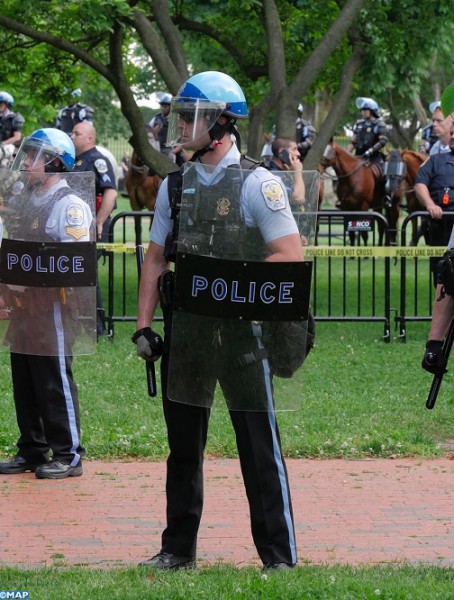
Last week marked the start of the jury trial of Officer Derek Chauvin, the police officer charged with the murder of George Floyd after he passed a counterfeit $20 bill, only a minor misdemeanor under state law, in the city of Minneapolis, Minnesota in May 2020.
Chauvin is on trial for second- and third-degree murder and second-degree manslaughter for having restrained Floyd, kneeling on his neck for nine minutes and 29 seconds as the black man begged for his life, cried out for breath, and ultimately went limp.
The trial of this police officer is not your typical criminal case. Most criminal trials are not live-streamed in real time. The vast majority of criminal cases in the US don’t even go to trial. They are typically settled by the accused agreeing to a plea bargain in which he or she pleads “guilty” and receives a lesser sentence than what would be imposed if convicted.
Most criminal defendants do not have expensive private counsel funded by the police union representing them because they simply cannot afford it. Instead, they rely on public defenders paid by the state. Although many are good lawyers, they are usually overworked, underpaid, have too large a caseload and too few resources to investigate and find exculpatory evidence.
But this case is not just about Officer Chauvin and George Floyd. This is a case about justice in America.
The killing of George Floyd became one of the symbols of the Black Lives Matter movement in 2020, in its demand for justice for Floyd, for other black men and boys killed unnecessarily by police, and for righting the wrongs of 400 hundred years of the legacy of slavery and racism in America.
In an interview with CNN on Thursday, Dr. Cornel West, Professor of Public Philosophy at Harvard University, said this is a defining moment for America. “Do we really have what it takes [as a country] to acknowledge the rich humanity of black folk, to treat us fairly, to treat us like human beings? Because if not, you’re going to lose your democracy.”
The prosecution’s opening arguments were persuasive and the prosecution witnesses’ testimony agonizing and heartbreaking.
The most compelling was the video taken by a young eyewitness, a minor at the time, who filmed the scene on her cell phone. It showed Officer Chauvin kneeling with his knee on the neck of Floyd, already subdued in handcuffs and face down on the ground, for more than 9 minutes.
It showed Floyd repeating as the officer knelt on him, “I can’t breathe.” It showed numerous witnesses, including a fire department first responder not then in uniform, shouting and begging the officer to get off of Floyd, pointing out that Floyd was not resisting arrest and that Floyd was unresponsive with blood dripping from his nose.
But Chauvin did not “let up or get up,” a phrase used repeatedly by the prosecution in its opening argument.
The defense countered that the officers were fearful. Attorney Glenn Kirchner, a former thirty-year veteran federal prosecutor, said he couldn’t imagine an argument that they were afraid of bystanders “yelling at them to stop killing a restrained, handcuffed, unarmed, defenseless man” playing well with the jury.
In their testimony, these eyewitnesses cried as they recounted the horrible scene of a man being killed before their very eyes.
Bystander Donald Williams, a black martial arts expert, believed he was witnessing yet another case of unwarranted police violence on a black man. He testified that he had “called the police on the police” — even though police were already at the scene. He said he felt he had to call 911 because the officers weren’t listening to him and he was witnessing “a murder.”
Other bystanders also called the police on the police. And so did a police dispatcher, the first witness for the prosecution.
Jena Scurry testified on Monday March 29, that the restraint had been going on for so long she initially thought the “cameras had frozen.” As she watched what was happening through a city security camera, her “gut instinct” told her that “something was going wrong.”
She called Sergeant David Pleoger, now retired but a supervisor in the city’s 3rd Precinct on May 25, 2020, to say that “she’d seen something while viewing a camera that she thought was concerning,” according to Pleoger, who testified on Thursday April 1. He called Chauvin after receiving the call from Scurry.
Sergeant Pleoger testified that Chauvin should have stopped kneeling on Floyd’s neck after he “was no longer offering up any resistance to the officers” when he was on the ground and in handcuffs.
Another senior officer Police Lt. Zimmerman, who leads the homicide division in the Minneapolis police department, testified on Friday that a knee on the neck is “deadly force.” He said that Chauvin’s use of force should “absolutely” have stopped when Floyd was no longer resisting.
The trial isn’t over yet. The case resumes Monday morning and it is expected to last for about three more weeks.




add your comment
Terms of publication : Not to offend the writer, people, sacred things, or attack religions or the divine self, and refrain from racist incitement and insults.