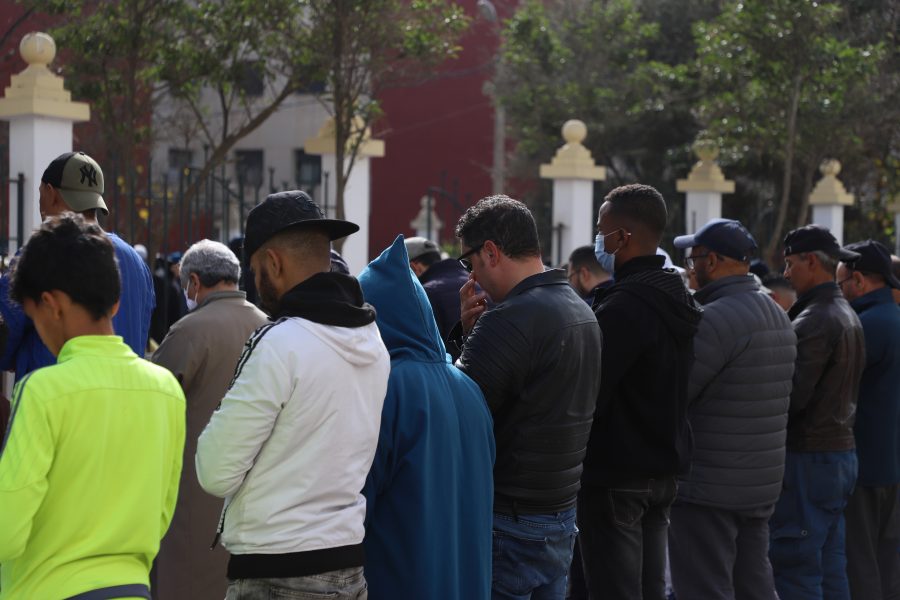
Nabil, a 28-year-old accountant in Rabat left his 40 minute-long lunch break to join the thousands of Moroccans performing this Friday Duhr prayer in mosques across the country, to “plead for God’s mercy in hopes of more rainfall.”
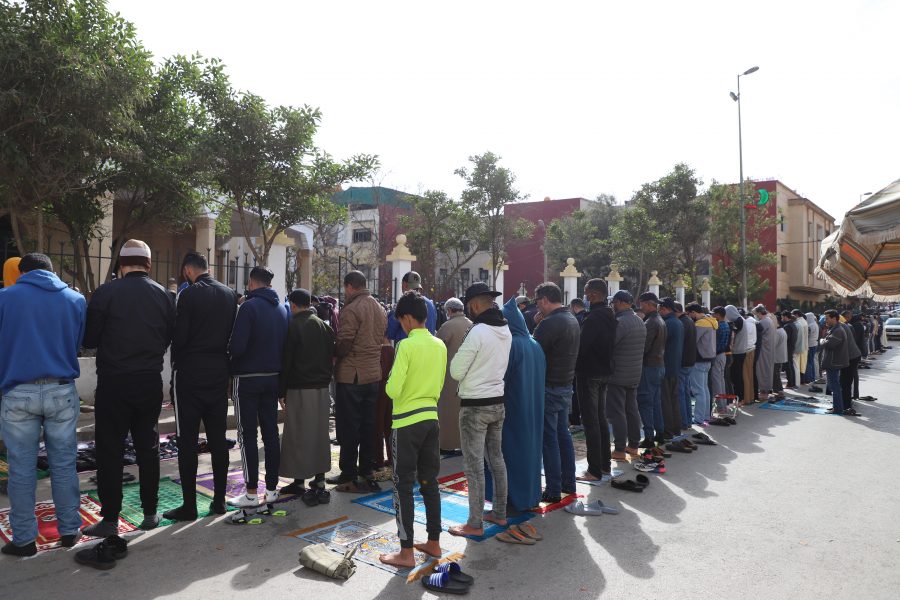
The Moroccan capital’s administrative district, in the city center, was flocked with mosque-goers, prayer mats in hand, who responded to King Mohammed VI’s call for a “rain prayer,” as Morocco continues to suffer from drought and weak precipitation.
Rabat’s Sunna Mosque was packed full of believers, in addition to the dozens that gathered in its vicinity, its surrounding park and sidewalks, raising their hands and lowering their heads with the hopes of “a merciful gift,” as the Imam on the speakers prayed for “waters for the land and cattle.”
The rain prayer is customary in the majority of Muslim countries, and derives its origins from sacred texts, where Prophet Mohammed recommended an extra prayer “every time the rain is scarce.”
In unison, policemen in uniform standing next to men in suits, others in traditional jellabas, bowed and prayed for “the grace of God,” as Morocco’s heavy reliance on rainfall exacerbates worries this season.
Pressure on agriculture
Despite recent rains and farmers’ “premature” optimism early this year, the fate of the current agricultural season is still dependent on the regularity of rainfall in the months to come.
As expected, the rain was almost generalized on the national territory during autumn’s latest weeks, according to the special meteorological bulletin of the Moroccan General Directorate of Meteorology (DGM).
But farmers across the country are still anxious as to what a sustained drought may entail for agricultural production after the country recorded a 60% rainfall deficit this season compared to last year.
Referring to the current situation of the main major dams in the kingdom as of this January 2022, the national filling rate barely reaches 37.2%, with a reserve of 5,802 Mm3 against 49.3% during the same period in 2020, or 7684 Mm3.
The situation of the Kingdom’s dams continues to exert pressure on irrigation water mobilized from dams in irrigated areas, in addition to the reported decline in groundwater levels.
As a result, apart from the Loukkos, Sebou, and Bouregrag-Chaouia basins, which are filled to 64.74%, 53.55%, and 52.28% respectively, other basins are showing filling rates below 35%.
The most worrying deficits are recorded in the region of Souss-Massa, up to 14.29%, Oum Rabii to 15.62%, and Guir Ziz Rheris in Errachidia to 17.10%.
Rachid Aouriz, a Moroccan economist and scholar, says that the effects of low precipitation go beyond the agricultural sector. In an interview with Hespress EN, the economist explained that “precipitations are an essential factor for the wellbeing of the Moroccan economy as a whole.”
In a statement to Hespress EN, Aouriz said that in addition to the cultural and psychological impact of droughts, lack of rainfall exacerbates both unemployment and informal economic activity in Morocco.
The expert highlighted the social segment most active in the agricultural sector as predominantly made up of “seasonal workers,” who after the end of harvesting seasons, usually “look for other jobs in construction or the service industry, specifically in tourism.”
In light of the current COVID-19 pandemic, both the tourism and construction sectors have suffered significantly. Investments in construction have dropped, as construction permit applications recorded a staggering 48.1% drop in 2020, according to a recent report from the High Commissioner for Planning (HCP).
The workers who usually work in tourism during the summer, agriculture autumn and winter, and construction during spring, will now “have to resort to informal commercial activities to be able to make a living,” says the expert.
The modernization of the domestic agricultural sector is also impeded by “damaging and inadequate” agricultural strategies, such as “allowing the farming of certain fruits and vegetables that consume considerable amounts of water in regions that are highly prone to droughts and water scarcity,” says Aouriz.
Little Government effort
The government’s efforts and long-term diversification strategy for the national economy have not reduced the country’s considerable reliance on agricultural outputs, both for domestic consumption and for export.
According to Aouriz, the Moroccan government should simultaneously “develop the ‘know-how’ in the water security domain, by investing in scientific research and the development of new technologies that can ensure the needs of the country at the lowest possible cost.”
The desalination of seawater has long been the most viable and logical solution to a country with over 2,945 km of coastline, and the Moroccan executive has launched multiple desalination stations in the south.
But the cost of desalinated seawater to farmers was found to be up to 8 times more expensive than other water sources.
Rainwater, therefore, remains crucial to Morocco’s economy and mid-pandemic relaunch, as citizens collectively hold their breaths for the “divine intervention” they prayed for this holy Friday.






add your comment
Terms of publication : Not to offend the writer, people, sacred things, or attack religions or the divine self, and refrain from racist incitement and insults.