If the US and Europe don’t pursue investments in Morocco’s carbon-neutral fertilizer industry, the North African country could change the geopolitics of global food security, according to a report by the Middle East Institute.
“The matter is urgent both for Morocco and the international community,” wrote professor of International relations and the political economy of the MENA Michael Tanchum.
He said that in absent US and European investments, Morocco could turn its interest towards other regional and global actors, shifting the geopolitics of an already sensitive global concern: food security.
The Covid-19 pandemic unraveled just how global food systems were vulnerable after seemingly having been kept stable from 2014 to 2019.
The early years of the 2020s pushed millions of people into hunger and sent food prices to the highest they have been in a decade.
Landmark reports are increasingly alarming if we do not address the stark food insecurity, the world would be significantly challenged in moving forward.
With a world population that is projected to reach 9 billion by 2050 and require 70 percent more food than we produce today, the challenge is serious
‘Gatekeeper of global food supply chains’
The picture is dramatically different from the 1920s when the phosphates mining industry emerged, creating
enormous increases in crop yields that have driven the world’s population boom over the past 100 years, climbing from about 1.8 billion to the current 7.9 billion people.
Morocco has a stronghold on over 70% of the global reserves of phosphates – without it, humanity would not be able to feed itself.
There is no way to manufacture phosphates. It is the single raw material that can be used to manufacture synthetic fertilizers and sustain global food security.
Initially Morocco supplied foreign manufacturers raw phosphates, the equivalent of exporting crude oil, instead of
the refined and much more expensive petrolium.
A shift made by the Office Chérifien des Phosphates (OCP) during the 1980s and 1990s with the manufacturing of a diverse range of fertilizers, proved very rewarding for the country that in recent years raised its economy and international positioning.
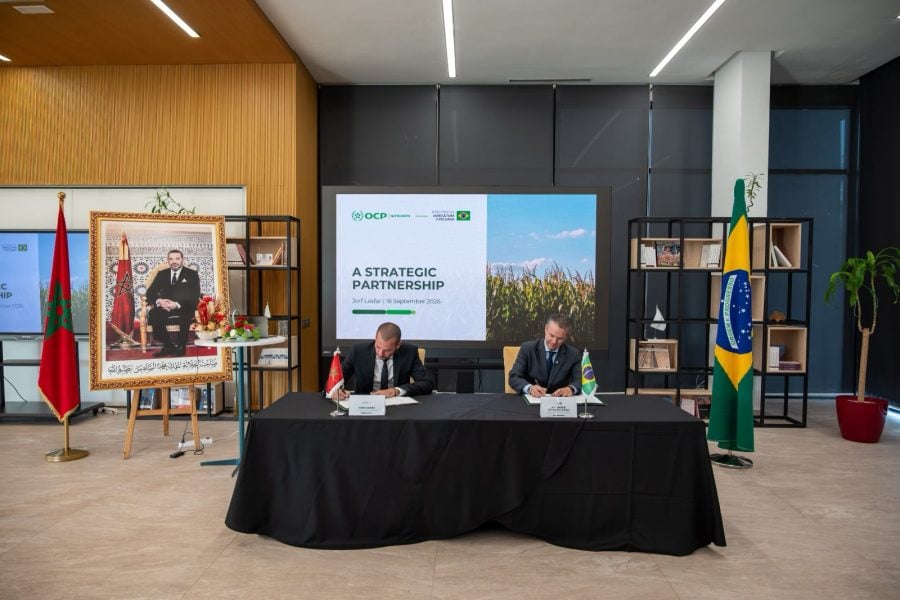
“The success of the OCP Africa’s Agribooster program has contributed to the geopolitical turnaround, with Morocco emerging as a key partner in the AU’s efforts to ensure adequate food supplies for hundreds of millions of people across the continent,” said the report.
One such agreement is signed with Nigeria, where Africa’s largest natural gas reserves are found. A $1.4 billion ammonia and fertilizer plant deal between the OCP and Nigeria is aimed, in part, “to provide Morocco
with the natural gas from which fertilizer’s other fundamental component, nitrogen, is produced, commonly in the form of ammonia,” wrote the researcher.
In the same line, the OCP is involved in grey ammonia development projects in Nigeria, Ghana and Ethiopia.
Green transition and challenges
Grey ammonia is produced by energy-intensive methods that contribute heavily to carbon emissions. Ammonia ranks as the second most produced chemical globally, with production accounting for 2% of the world’s fossil fuel use.
OCP imports 1.5 to 2 million tons of ammonia per year.
“The future of Morocco’s role as a gatekeeper of global food supply chains will ultimately depend on its success at home in achieving energy transition to increase the sustainability of its fertilizer industry,” wrote Tanchum.
In 2020, OCP covered 89% of its energy needs by cogeneration and renewable energy sources. The company has set an intermediate target to cover 100% of its energy needs by 2030 with co-generation and renewables, said the report.
But the report says that “ultimately, the sustainability of Morocco’s fertilizer industry will require considerable capital expenditures to develop its embryonic green hydrogen sector and the additional power generation capacity from renewable energy sources that it need.”
“The kingdom requires additional multibillion-dollar infrastructure investments to achieve a sustainable, carbon-neutral fertilizer industry. Such investments provide the United States and Europe an opportunity to raise the level of their strategic engagement with Morocco.”






add your comment
Terms of publication : Not to offend the writer, people, sacred things, or attack religions or the divine self, and refrain from racist incitement and insults.