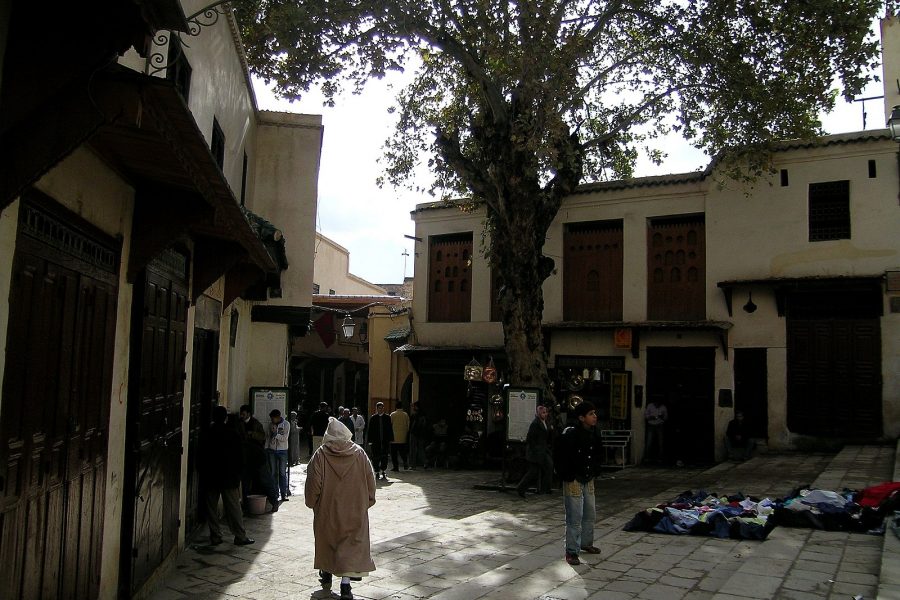
In the old city of Fes, where the knocks of crafters on the bronze rhyme with the voices of Rssif’s visitors, the historical place, Seffarine, struggles to bandage its wounds.
Place Seffarine is a small square in the medina of Fes, Morocco. It is located on the south side of the Quaraouiyine Mosque, close to the Bou Khrareb River which runs through the heart of the medina carrying with it abandoned garbage and unpleasant smells.
As the symphony of Fes starts fading between the ups and downs of the turning alleyways, under a huge crafted bow leading to an outdoor haul, the Bennani’s bookshop is situated.
“This decoration is fake, it doesn’t represent the old soul of the city. You as a new visitor you may like it, but we who witnessed the city aging year after year, it’s hard for us accepting this fake decoration,” said Mohammed Bennani the bookshop owner as he criticized the new decoration leading to his shop, which was accomplished within the framework of the restoration project of Fes.
The restoration project of Fes started in 2013 with 285.5 million as a financial budget, dedicated to the restoration and rehabilitation of 27 places and other buildings including five Places and three hotels.
Many organizations are involved in the royal project, including the Agency for the Development and Rehabilitation of the City of Fez and the Follow-up and Evaluation Committee headed by the Wali of the region.
In Bennani’s bookshop, where the lost times of Proust sit next to Mathnawi of Rumi, students of Quaraouiyine University have been coming for decades to find their different studies materials, from Fiqh to linguistics sources.
The 70 years old man said that he was one of the first people who encouraged the project of restoration before getting disappointing in the process that excluded the perspective of shop owners.
“Hundreds of millions have been spent on this shop, but look at the damage in the walls,” Bennani said as he lifted the art piece that was hiding the pilling wall.
Besides the historical anger towards the restoration, Bennani said he is the victim of the bureaucratic rabbit hole. After he gave up his shop’s property to the authorities at the start of the project to benefit from the restoration, Bennani is required now to pay rent every month while he still didn’t receive his compensation due to the complicated procedures, according to his statements.
“After 8 years of starting the restoration project of the old city in Fes, many shop owners are still out of their shops in the area, as the authorities are following different policies to push the crafters to bow to the industrialism’s winds,” said Bennani as he rushed to respond his client’s request.
After easing the quarantine restrictions, Abdellah, the exalted tea maker of Fes, was happy to get back to his cafeteria, a big pot for boiling water, and his Sizouat, the small pots where he mixes different ingredients to make his infamous tea.
However, the decision of closing his shop for restoration puffed his hopes of pursuing a stable activity after the quarantine.
Abdellah received an amount of money that counts for MAD1500, for each month his shop is closed, which is MAD50 (less than USD6 ) per day, a poor consumption that cannot afford the basic needs of the Moroccan citizen.
“It started in 2018, but apparently it is taking a long time. All that we hope for now is that they finish the restoration project soon, so we can go back to our shops,” he added smiling, “I am facing all that by hope and faith.”
Following the closure of his shop, the 65 years old tea maker found shelter in a small shop upon an old building in Seffarine. People from different cities and places still manage to find “Abdellah tower,” climbing the odd stares, to taste his infamous hot tea and listen to his conversations, two arts that he masters perfectly after 36 years old of experience.
The majority of the shop owners who were near Abdellah’s old place are nowhere to be found in Sefarrine, leaving behind them just the wooden closed doors that witnessed centuries of making leather shoes, crafting hair brushes from “Gern,” or fabricating bronze tools.
The square was historically the main market of the city’s coppersmiths who gave the square its name. Their workshops have been established in Fes since at least the 16th century when the diplomat al-Hasan ibn Muhammad al-Wazzan al-Fasi noted their presence in his writings.
Mohammed Hamdouni, a professor researcher in the anthropology of habitants recalled in a certain pride the chronicle of the old city in Fes, the history that was made between its narrow paths, the art that its crafters master, and the erasing’s identity danger that it is facing.
“This process of taking the shop owners away from their houses and their shops, while adding the bizarre new decoration that does not much the soul of the city is leading to industrializing the market of Fassi art and craft until it ends up producing products that lacks authenticity and quality.”
Hamdouni, who cares much about the authentic soul that distinguishes Fes, suggests keeping the artists in their shops and encouraging them to keep the tradition of the art that they “seasoned” in decades of experience and creativity.
“The crafters of Fes are artists and they deserve to be treated as artists. Their arts are not just authentic but also sustainable. The factor of sustainability we had it here since always here and we must not lose it.” He added as he adjusts the black traditional Selham covering his shoulders.





add your comment
Terms of publication : Not to offend the writer, people, sacred things, or attack religions or the divine self, and refrain from racist incitement and insults.