“Writers get sick during the autumn,” said Mahmoud Darwish laughing, in one of his last interviews before his death, in 2008.
The famous Palestinian poet and writer was referring to the period of guessing, waiting and hoping that authors experience before the announcement of the Nobel prize winners in October each year.
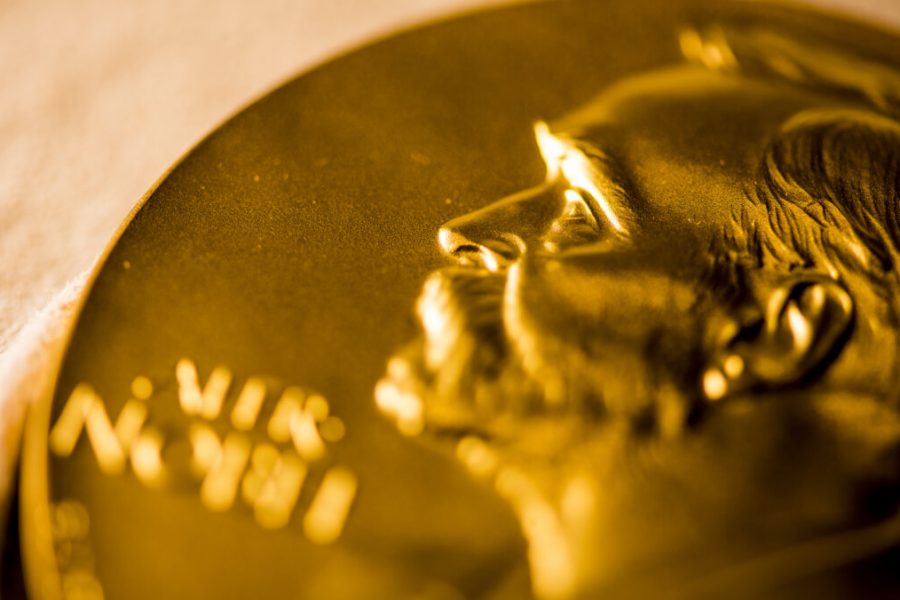
The prize was the child of guilt and regret of 19th-century Swedish chemist, Alfred Nobel, who didn’t want to be remembered for what made his fortune: dynamite. So he created one of the world’s most prestigious annual international prizes, the Nobel Prize.
He left a fund in his will for the creation of the eponymous prizes, first awarded in 1901. It included a grant for the person who accomplished “the most or the best work for fraternity among nations, for the abolition or reduction of standing armies and for the promotion of peace congresses.”
While controversy still surrounds the prize’s announcement each year, the award always held an important status in academics’ hearts and shelves.
More than 1,000 years after its creation, just eleven Arabs managed, until now, to join the exclusive list of Nobel Prize winners, six of which won in the peace category, two in science and one in literature.
Nobel prize for science: Ardem Patapoutian and Ahmed Zewail
Ardem Patapoutian (2021)
This year, the Nobel Prize in and medicine has been awarded to David Julius and Ardem Patapoutian for their discoveries of receptors for temperature and touch.
The Lebanese American Ardem Patapoutian is the second Arab person to win The Nobel Prize in a science category.
Born in an Armenian family in Beirut, Lebanon, Patapoutian attended the American University of Beirut for a year before immigrating to the United States in 1986.
He received a Bachelor degree in cell and developmental biology from the University of California, Los Angeles in 1990 and a Ph.D. in biology from the California Institute of Technology after six years.
Patapoutian and Julius received the accolade for describing the mechanics of how humans perceive hot, cold, touch and pressure through nerve impulses, discoveries that will be vital to the development of treatments for chronic pain and other conditions, said Professor David Paterson, president of The Physiological Society in the United Kingdom, according to CNN.
Ahmed Zewail (1999)
Before Patapoutian, Ahmed Zewail, the Egyptian-born chemist made history when he won Nobel Prize for Chemistry in 1999, as the first Arab and Egyptian to win the prestigious prize in a science category.
After receiving his Bachelor’s in 1967 and Master’s in 1969 from Alexandria University, Zewail attended the University of Pennsylvania, where he earned a doctorate in 1974.
Two years later he joined the faculty at the California Institute of Technology, and in 1990 he was selected as the school’s first Linus Pauling Professor of Chemical Physics.
Zewail snatched the prize after developing a rapid laser technique that enabled scientists to study the action of atoms during chemical reactions, a thing that was considered impossible since chemical reactions last only 10 to 100 femtoseconds. Zewail’s invention created a new field of physical chemistry known as femtochemistry.
The Egyptian scientist founded, in 2011, Zewail City of Science and Technology, a premier institute of technology in Cairo, five years before his death.
Nobel Prize for peace: Anwar Sadat, Yasser Arafat, Mohamed ElBaradei
Anwar Sadat (1978)
Eight Arab people and organizations were awarded by the committee of Nobel Prize for their influential actions and innovations, four of them were in the category of peace.
After the October war between Egypt and Israel, Anwar Sadat, then Egyptian president visited the Israeli parliament with a plan for a peace treaty, a step that was considered as a stab in the back within the MENA’s people, while the international community considered it as “a big step towards peace.”
In 1978, Anwar Sadat and Israeli Prime Minister Menachem Begin signed the Camp David Agreement, which put an end to the Israeli occupation of the Sinai Peninsula. In this context, Begin and Sadat were awarded the Nobel Peace Prize.
In 1981, Sadat was assassinated by extremists during a military parade commemorating the 1973 October War.
Yasser Arafat (1994)
The Nobel Prize committee awarded the Palestinian leader Yasser Arafat for the same reason as Sadat: signing a peace treaty with Israel. The Nobel Peace Prize 1994 was awarded jointly to Yasser Arafat, Shimon Peres and Yitzhak Rabin “for their efforts to create peace in the Middle East,” after signing the Oslo accords, which resulted in the establishment of self-rule for the Palestinians, as the PLO agreed to formally recognize the state of Israel.
However, Sadat’s Camp David and Arafat’s Oslo brought no peace to the MENA region as the Palestinian people are still continuing their intense resistance against occupation.
Mohamed ElBaradei (2005)
In 2005, Mohamed ElBaradei became the third Arab and the third Egyptian to win the Peace Nobel Prize. Head of the International Atomic Energy Agency back then, El Bradadei and the UN nuclear watchdog, IAEA, received the peace Prize for their “efforts to prevent nuclear energy from being used for military purposes and to ensure that nuclear energy, for peaceful purposes, is used in the safest possible way,” stated the Nobel committee in its official website.
The Egyptian diplomat donated all of his winnings to building orphanages in Cairo, while the IAEA’s winnings are being spent to train scientists from developing countries to use nuclear techniques in combating cancer and malnutrition.
Egypt Post on 8 October 2005 commemorated ElBaradei’s achievement award by issuing a set of two postage stamps.
ElBaradei earned a bachelor’s degree in law from the University of Cairo, a master’s degree in international law at the Graduate Institute of International and Development Studies in Geneva, and a P.H.D in International Law at the New York University School of Law in 1974. His thesis was titled “The right of passage through straits in time of peace.”
Focused on peace issues, the Egyptian law scholar started his diplomat career in 1964 with the Ministry of External Affairs, where he served in the Permanent Missions of Egypt to the United Nations.
The Egyptian diplomat entered the Egyptian national political scene after the overthrowing of Hosni Mubarak. He was considered as a prominent candidate in the first election after the January 25 revolution before announcing his withdrawal from the presidential race.
He served as Vice-President of Egypt, after the military toppling of Mohammed Morsi, from July 14, 2013, until his resignation on August 14, 2013, following a violent crackdown by security forces on supporters of deposed president Morsi.
Tawakkol Karman (2011)
Amid the political chaos in Yemen, Tawakkol Karman, a Yemeni journalist, became the international public face of the 2011 Yemeni uprising that is part of the Arab Spring uprisings.
The “Iron Woman” and “Mother of the Revolution,” as she was called, received the peace Nobel Prize together with Ellen Johnson-Sirleaf and Leymah Gbowee “for the non-violent struggle for the safety of women and for the full participation of women in building peace,” becoming the first Yemeni, the first Arab woman, and the second Muslim woman to win a Nobel Prize.
After completing her master’s degree in political science, Karmān began a career in journalism, writing articles, producing documentary films, and disseminating news alerts via text messages.
The restrictions and threats from the Yemeni government that Karmān faced with her colleagues inspired the group to found “Women Journalists Without Chains” in 2005 to advocate for women’s rights, civil rights, and freedom of expression.
In 2007 Karmān began staging weekly sit-ins in Sanaa to demand a variety of democratic reforms. She continued the practice for several years and was arrested multiple times for her activism. Although Karmān was a senior member of the Iṣlāḥ (Reform) party, Yemen’s main Islamist opposition party, she occasionally clashed with the party’s religious conservatives and opposes their extremist idea as the children marriage.
Tunisia’s National Dialogue Quartet (2015)
In 2015, the number of Arabs who have won a Nobel prize increased by two-thirds in a single day when the Nobel prize committee awarded Tunisia’s National Dialogue Quartet with the Nobel Peace Prize.
In announcing the award, the judges hailed the three men and a woman for their “decisive contribution to the building of a pluralistic democracy in Tunisia in the wake of the Jasmine Revolution of 2011.”
Abdessattar Ben Moussa from Tunisian Human Rights League, Noureddhine Allege, from Order of Lawyers, Houcine Abbassi from The Tunisian General Labour Union (UGTT), and Wided Bouchamaoui from The Tunisian Confederation of Industry, Trade and Handicrafts (UTICA), led Tunisia’s National Dialogue Quartet after the Jasmine revolution to end the ongoing political violence and bring the different political parties to the negotiation table in order to rebuild the Tunisian political system and rewrite the constitution. The quartet reached most of its goals despite a number of high-profile political assassinations that threatened to collapse the foundation of the new regime.
Nobel prize for literature: Naguib Mahfouz (1988)
The great Egyptian writer Naguib Mahfouz accepted the 1988 Nobel Prize for Literature with a joke. “I was told by a foreign correspondent in Cairo that the moment my name was mentioned in connection with the prize, silence fell and many wondered who I was.”
The Egyptian writer is regarded as one of the first contemporary writers of Arabic Literature to explore themes of existentialism. He published 34 novels, over 350 short stories, dozens of movie scripts, and five plays over a 70-year career. Many of his works have been made into Egyptian and foreign films.
Mahfouz survived a stabbing attack by Islamic fundamentalists who accused him of blasphemy due to his contemporary writing style, near his home in 1994.
“I would like you to accept my talk with tolerance, for it comes in a language unknown to many of you. But it is the real winner of the prize. It is, therefore, meant that its melodies should float for the first time into your oasis of culture and civilization,” he told the audience in Stockholm.
“I have great hopes that this will not be the last time either, and that literary writers of my nation will have the pleasure to sit with full merit among your international writers who have spread the fragrance of joy and wisdom in this grief-ridden world of ours.”
Over a quarter of a century later, Mahfouz’s hopes are yet to be realized. He remains the only Arab person to win the Nobel Prize for Literature, the only representative of a rich language spoken by more than 340 million people that produced millions of inspiring poetry collections, novels and plays.






Great for Egypte state abd il’s peaple please go a head