“The oldest pieces of jewelry discovered in the world so far” were found in Bizmoun cave in Essaouira.
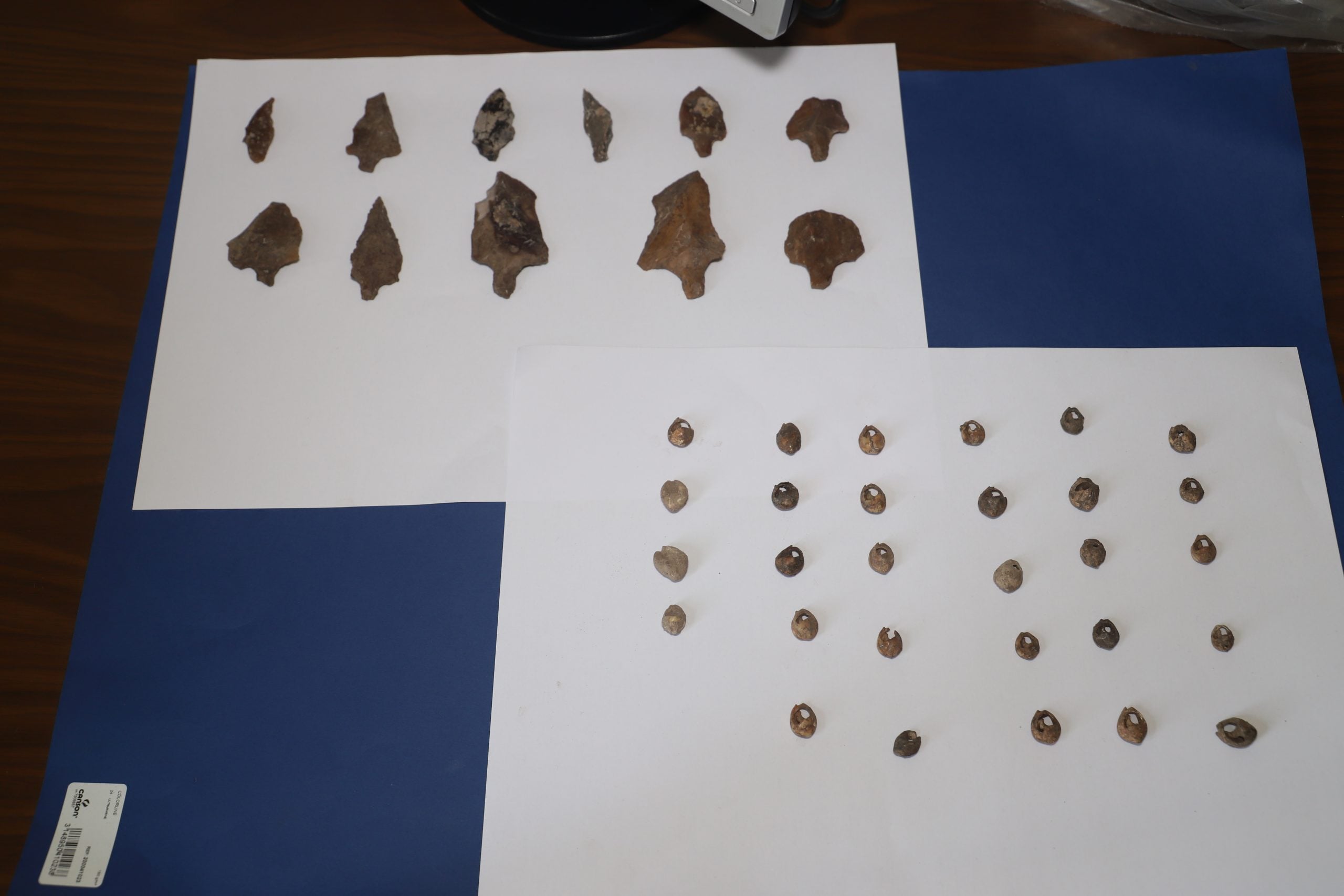
Moroccan archaeologists and professors from the National Institute of Archeology and Heritage (INSAP), and others from the University of Arizona in the United States of America found 32 marine pieces made of a type of seashell called Tritia gibbosula, formerly known as Nassarius gibbosulus, dated between 142 thousand and 150 thousand years.
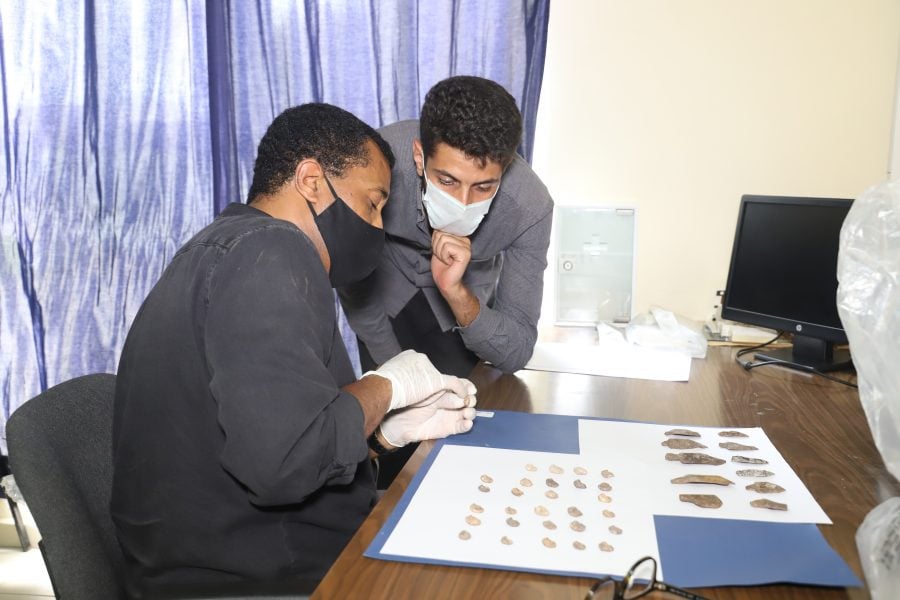
Abdeljalil Bouzokar, professor in INSAP and the head of the international team that led the research, sitting in his office, in a blue navy shirt, observing closely through his wire-rim glasses, the oldest opponents in the world, while his two young students standing behind him watching carefully the meeting of the different generations that gathered in the room: 142 thousand years seashells, a professor in his fifties, and a group of young journalists witnessing the historical moments under the flashes of a professional high technology camera, which was produced in the late 2010’s.
Bouzokat cut off the solemn moment of “the historical gathering” to explain to Hespress Eng, the nature of the new discovery “I prefer not to call the newly discovered shells jewelry because the concept of jewelry didn’t exist back then,” he continued,” these opponents were most likely used by humans as necklaces: not necessarily to beautify, but as a symbolic form of communication between them, as they started to use their bodies as a communication support.”
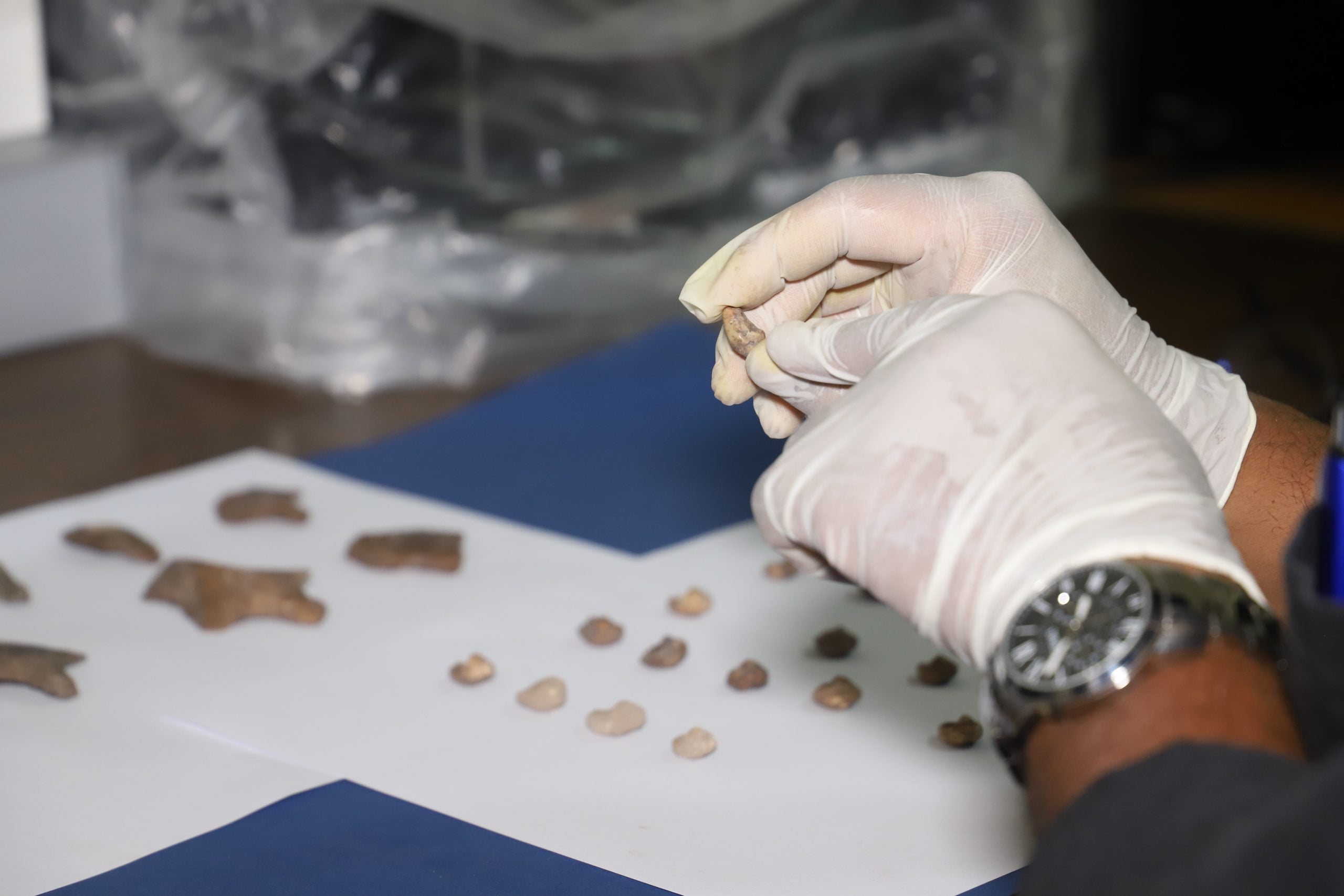
In Bizmoun Cave, on the surface of many of the discovered shells, traces of induction and luster appear as a result of friction between them, which indicates that they were suspended and in continuous motion, according to the international team’s study.
Such types of seashells were previously discovered in archaeological sites in Algeria and in South Africa about 76,000 years ago, as well as in five different other places in Morocco. The importance of the new discovery that will enrich the Moroccan archaeological treasury is that the recent results showed that this symbolic behavior was presented in Bizmoun Cave by thousands of years compared to previous discoveries, to be considered the first behavior of its kind known to man during the ancient geological period known as the Pleistocene.
“I don’t want to assume historical concepts here, but the discovery of the same type of shells, shaped in the same way, in three different far points in Africa, suggests the hypothesis that it was a center, a common point that connected this triangle,” said Bouzokar
He stressed that there’s no place for coincidence to justify this similarity, suggesting that the old inhabitants of Africa shared a form of communication, as well as a migratory stream. “Symbolism was always an important part of humanity’s history, especially in this part when “writing” was not invented yet. This discovery will enable us of knowing more about the origin of language and communication in the pre-history period,” said Bouzoukar.
The seashells lasted for a long time thanks to their natural form, as well as the red soil that the old inhabitants, apparently used to color the pieces and preserve them as it is rich with iron oxide. Bouzoukar confirmed that the components, now, will be preserved according to professional scientific measures to ensure the safety of this historical treasure.
The research, which started in 2014, was carried out in the Bzsmoun Cave in Essaouira under the supervision of Abdeljalil Bouzoukar, from the National Institute of Archeology and Heritage in Morocco, Stephen Cohn, from the University of Arizona in the United States of America, and Philip Fernandez, from the Prehistoric Laboratory in the Mediterranean Sea Europe-Africa in France.
The international team witnessed the participation of researchers from other institutions, from Morocco, Hassan II University of Casablanca – Mohammedia, and the National Center for Energy, Nuclear Sciences and Technologies; From the United States of America the Department of Anthropology at Harvard University, from Germany the Max Planck Institute for Evolutionary Anthropology in Leipzig and the University of Tübingen, from Spain the University of Las Palmas, and from England the University of Sheffield.
Bouzoukar commented, “I tend not to nationalize scientific discoveries,” he added, with a smile adorning his face” Back then, there were no countries or borders as we know them now, thus, we use countries names just as geographical references (…) this discovery doesn’t belong just to Morocco but to the humanity as all.”




add your comment
Terms of publication : Not to offend the writer, people, sacred things, or attack religions or the divine self, and refrain from racist incitement and insults.