
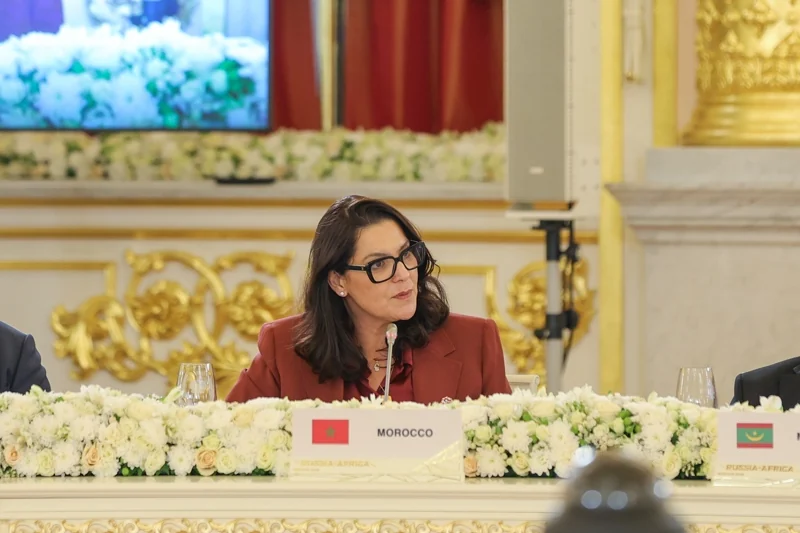
Morocco decided to maintain the Maghreb Europe Gas Pipeline (GME), whose contract expires on October 31, said the CEO of the National Office of Hydrocarbons and Mines (ONHYM), Amina Benkhadra, according to MAP.
“It is our will, as we expressed it verbally and in writing, publicly and in private discussions, always with the same clarity and the same consistency”, Benkhadra stated in response to rumors spread on social media claiming that Morocco decided to block the supply of Spain at the end of the contract.
The GME, in service for the past 25 years, “is a great tool for win-win cooperation and an example of a structuring and mutually beneficial regional project”, said Benkhadra.
“This gas pipeline was built by Spain to allow Algerian gas to reach Europe through Morocco, under optimal security conditions”, she explained, adding that this service is provided by staff and the Moroccan management of the company Metragaz, which is welcomed by all European stakeholders.
Benkhadra also announced that access will be free and prices will be transparent and non-discriminatory, noting that this installation is now amortized, the prices will be more competitive than any other competing means of transport.
The ONHYM CEO also confirmed the important discovery of an oil field off Agadir, “the geological work and the interpretations of the 2D and 3D seismic data, but also the old wells carried out in the area, made it possible to identify several prospects, specifying that the potential resources are evaluated by Europa Oil & Gas at 2 billion barrels.” she confirmed.
“To prove this, specific additional work must be carried out, including additional drilling”, she added.
“We would have to carry out these wells before any communication, but our partners, often foreign oil companies listed on the stock exchange, are obliged to make public announcements at different stages of their discoveries and we cannot prevent them from doing so,” she explained.
For Benkhadra, the reduction of energy dependence can be ensured by the development of fossil resources, as Morocco is working on this by developing renewable energies with the increased exploitation of its resources including hydroelectric, solar, and wind turbines, following the instructions of King Mohammed VI.
In this sense, she indicated that several areas off Rabat-Sale, Essaouira, Agadir, Tarfaya, and Boujdour have shown active petroleum systems, calling for continued efforts, and especially drilling wells.
Benkhadra said that the future Gas Code, which incorporates the principles applied in Europe, provides for the separation of production, distribution, and transport activities, announcing in this context the future creation in Morocco of a Network of National Transport.
“Our supervisory authority asked us to set up a subsidiary which will be in charge of the development of the transport network and the strategic storage of natural gas,” she said.
“Once created, the new structure will focus on developing the national gas network and securing supplies to the country. The arrangements for the creation of the Transmission System Operator are in the process of being put in place”, she continued.
Previously, the CEO of the National Office of Hydrocarbons and Mines (ONHYM) denied on Thursday, August 19, that Morocco will have a lot to lose if the contract for this gas pipeline is not renewed.
Indeed, by not renewing the contract of the Maghreb-Europe gas pipeline, Morocco risks losing two main advantages including the 7% toll which represents around 200 £ million per year, and the quantity of gas from which it draws profit due to transit through the pipeline.



add your comment
Terms of publication : Not to offend the writer, people, sacred things, or attack religions or the divine self, and refrain from racist incitement and insults.