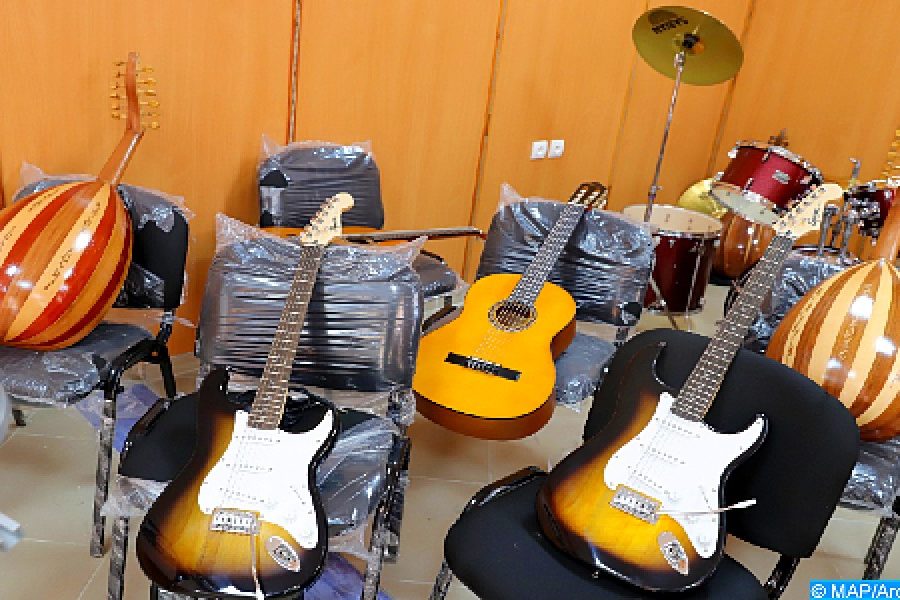
American singer and oud player Jennifer Grout is probably best known for her performances of Oum Kalthoum songs in near flawless Arabic on Arabs Got Talent. However, her talents, honed by her classical western music training and her experiences through world-wide travel, are so much more eclectic.
Not only does Grout sing classical western opera in several languages, but she also sings traditional Moroccan Amazigh music in Tamazight, Moroccan chaabi music in Moroccan darija, traditional Islamic songs in classical Arabic, and now Gnawa music from North Africa.
Grout spoke with MAP for this interview.
Q. Tell me a little about your background, where you grew up, and your music studies.
A: I grew up in Boston, Massachussetts. My parents are both musicians, so I’ve been around music my whole life. I studied violin, piano, and classical voice from a very young age, but I always loved singing best. I went on to get my bachelor’s degree in classical singing at McGill University in Montreal, and during that time I began exploring different styles, such as Medieval, North African, and of course Arabic/”Tarab” singing.
Q: You’re an American who has embraced not only the music of North Africa and the Middle East, but also the languages and the prevalent religion of the region, Islam. What took you there?
A: I traveled to Morocco in 2012 upon completing my studies, and I fell in love with it as soon as I stepped off the plane! That summer backpacking through Morocco was one of the most incredible, magical, and life-changing experiences of my life, and I had this ongoing desire to break down any cultural barriers. I wanted to deeply understand this mysterious place which was now occupying my heart.
I think that religion is extremely intertwined with culture, language, and the way we grow up perceiving the world in general—although many people try to separate the two. I feel that I wouldn’t have been able to fully grasp the culture and language I was embracing, until I dove into the religion that helped shape them. I’d been fascinated by the culture, and Islam was equally fascinating and attractive to me.
My personality compels me to want to experience everything to the maximum level possible. So at one point I ended up getting so deep into Islam that I sort of abandoned all of my “culture” if that makes sense. I even quit music entirely for a brief period! This was a bit traumatic, as music has been a huge part of my life since I was young.
But in the end, I feel I definitely gained a deeper understanding of what I was seeking. I’d like to think that I’ve achieved at least some balance in terms of spirituality, however difficult the path was.
Q: You sing songs of Oum Kalthoum, one of the most revered singers in the Arab world whose music is not easy to sing, as I know from being a singer myself who fell in love with and learned an Oum Kalthoum song at age 17. What drew you to her music?
A: Oh, that’s amazing that you learned an Oum Kalthoum song! When I first discovered her, I was completely obsessed! Sometimes classical singing in my opinion can be very rigid and limiting, and especially in structured settings there is so much focus on the “learning,” and virtuosity for the sake of virtuosity.
But Oum Kalthoum sang with such dignified freedom, and raw emotion expressed through mastery of the voice. Tarab singers in general aimed to bring people to a state of ecstasy with their singing, and Oum Kalthoum certainly brought millions of people there! There will definitely never be anyone like her again.
Q: The pandemic stopped many artists from performing over the last year and half, but it doesn’t seem to have stopped you from experimenting, collaborating, and producing music. Tell me about that.
A: Right before the pandemic hit, I had a bunch of performances scheduled and felt like my career was finally picking up after having been at a standstill for some time. When all of them were cancelled, I was initially extremely depressed. But now I see it as the best thing that could have happened to me.
I had ample time to really look inward, feel my emotions without any distraction, and channel those pure emotions into music. I’ve spent most of my career as an artist learning by way of imitation, immersing myself in the expression of others’ compositions and sounds. But now I have experienced the joy of being able to create something that’s entirely my own.
I also had the pleasure recently of collaborating with some musicians in Marrakech. “Gnawa” music is something I have wanted to sing since the first time I heard it, but it had always seemed so out of reach. Being able to learn not only some songs, but also study the musical structure and learn about the history of it, was also a great experience and took the mystery out of something which had previously eluded me. Gnawa music has had a huge influence upon my original music, and I hope to continue to learn more about it in the future.
Q: What artistic projects are in the works or on the horizon and what aspirations do you have for the future?
A: Well, I have composed probably over 20 songs in the past two years, and now it’s simply a matter of recording and releasing them!
I think a lot of artists who want to remain independent struggle these days with getting their music out there, as the industry has changed so much, and we constantly have to try to find the balance between our “art” and the “business” of art. My hope is that before the summer is over, I will have released at least one single!
My music is definitely not commercial, and I honestly have no idea how people will react to it. But my goal is to get at least one album’s worth of songs finished and released within the next year. I think it’s the type of music which can be appreciated by a very diverse audience. It has a message of love, vulnerability, and deep understanding, and I hope to be able to share it with the world.







add your comment
Terms of publication : Not to offend the writer, people, sacred things, or attack religions or the divine self, and refrain from racist incitement and insults.