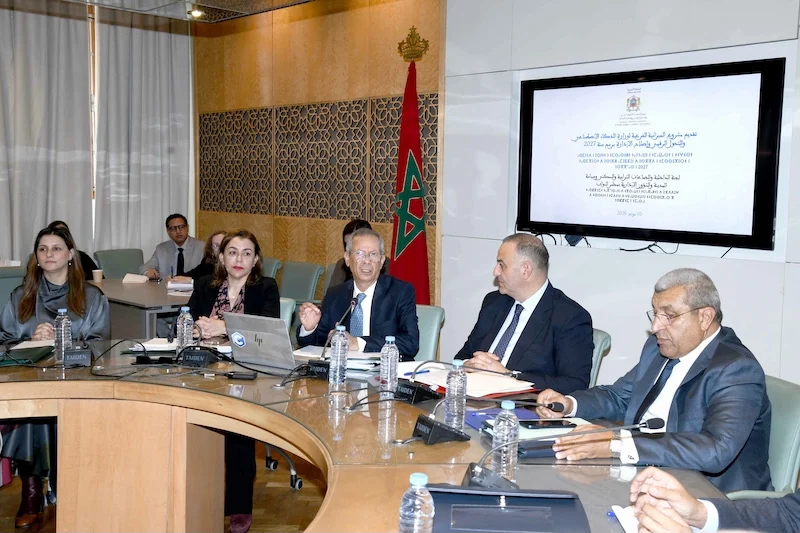
Morocco has begun developing an official framework to regulate artificial intelligence (AI) and expand public access to the technology, Digital Transition and Administrative Reform Minister Ahmed Reda Chami said Tuesday, warning that leaving its use outside institutional oversight could expose users to significant risks.
Speaking before the House of Representatives’ Committee on Interior, Territorial Communities, Housing, Urban Policy and Administrative Affairs during a presentation of his ministry’s proposed 2027 budget, Chami said banning AI tools would be the most dangerous option, as people would continue using them without guidance or regulation.
The minister stressed the need for a clear legal and institutional framework that facilitates access to AI while ensuring its responsible use. He said the approach should be built on cooperation between public administration and the private sector, rather than relying exclusively on government-led development.
Chami also highlighted the role of Morocco’s private-sector expertise in building a national AI ecosystem, arguing that local companies should be given greater access to public procurement opportunities and a clearer framework for contributing to growing demand in the sector.
He called for greater participation by startups, warning against concentrating public contracts within government institutions and public-sector entities. The current level of private-sector participation remains insufficient, he said, calling for practical measures and stronger initiatives to improve Morocco’s AI capabilities.
Morocco AI 2030 roadmap
Chami announced the launch of the “Morocco AI 2030” roadmap, built around three strategic pillars and 10 structural programs covering sovereignty and trust, innovation and competitiveness, and impact, adoption and international outreach.
The roadmap includes projects focused on infrastructure, data centers and sovereign cloud services, data and software factories, the development of national skills, and a platform designed to serve citizens and public administration.
The minister also announced the activation of four institutes within the Jazari Institutes network, following the convening of their general assemblies. The move marks a shift from institutional establishment and organizational planning towards operational implementation.
The four institutes are Jazari Root, the Jazari Institute for Education and Technological Innovation, the Jazari Industry X.0 Institute and the Jazari Smart Cities Institute.
Chami said the institutional framework for the institutes had been completed through the approval of their founding agreements and the publication of the relevant decisions.
Building sovereign data and AI services
The roadmap also includes projects to structure, enrich and connect around 2,800 administrative procedures, alongside the analysis of nearly 10,000 legal texts to identify procedures and requirements not yet covered by existing services.
Work has also covered editions of Morocco’s Official Gazette published between 1913 and 2026, representing approximately 400,000 pages and 4.5 million paragraphs.
The government has additionally structured the Adala legal database, which contains around 90,000 legal texts and 330,000 links between them.
As part of efforts to develop a national content base for AI systems, Chami said projects had collected and processed around 300 million text units and 150 gigabytes of documents, creating an initial repository of approximately 85,000 public documents.
Other initiatives include preparing 10,000 hours of Moroccan Darija audio recordings with high-accuracy transcription, assembling around one million pairs of document images and corresponding text, and delivering a platform dedicated to data labeling and correction.
The minister also outlined several services being developed in a sovereign digital environment.
These include the Idarati service, designed to guide citizens through administrative procedures, requirements and necessary documents, as well as a document-processing suite offering format conversion, document management and automated reading.
Other tools include a meeting assistant providing multilingual transcription, minutes and reports, with support for Moroccan Darija and a review process before outputs are approved.
A legal research service is also being developed, combining a search engine for the Official Gazette, a knowledge database and shared research tools drawing on the Adala legal repository.







add your comment
Terms of publication : Not to offend the writer, people, sacred things, or attack religions or the divine self, and refrain from racist incitement and insults.