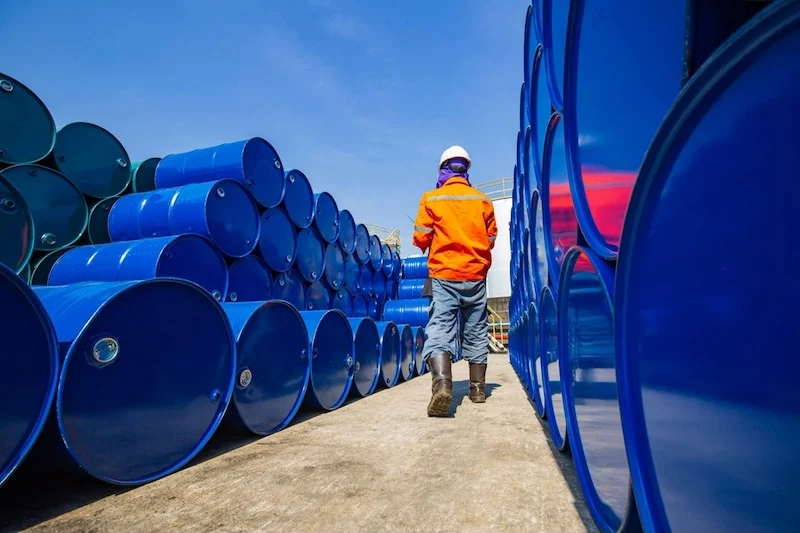
Morocco’s fiscal outlook for 2027 could face renewed pressure if international oil prices remain elevated, as the government’s draft Finance Bill assumes Brent crude will fall to $75 a barrel next year, down from an expected average of $87 in 2026 and a level of $114 recorded on October 27, according to an analysis by investment management firm Marogest.
The government’s benchmark implies a 14% decline compared with the projected 2026 average and a 34% drop from the late-October level cited in the report. The gap raises questions about the budget’s ability to absorb further energy price shocks, particularly as the government has allocated MAD 19.4 billion ($1.9 billion) to subsidize basic goods in 2027, compared with approximately MAD 21.8 billion in appropriations for 2026.
In its assessment of the 2027 draft budget, Marogest, which specializes in managing collective investment schemes in transferable securities (OPCVMs), warned that the government’s assumption of a rapid decline in oil prices could prove vulnerable. Sustained high prices could require additional budget allocations, particularly to cover subsidies for butane gas and support for transport professionals.
The government has assumed a reference price of $600 per ton for butane gas in 2027, compared with $730 per ton in October. Meanwhile, allocations for support to transport professionals had reached MAD 2.5 billion by the end of September 2026.
The difference between the government’s $75 benchmark for Brent and the $114 level recorded at the end of October amounts to $39 a barrel, or approximately 52% above the budget assumption. If sustained, such a gap could significantly alter public spending projections and affect Morocco’s external balances, the report said.
The risks extend beyond direct government expenditure to transport and production costs, consumer prices and the country’s energy import bill, as well as demand for foreign currency. These pressures come as the government aims to limit the budget deficit to 3% of gross domestic product in 2027, equivalent to MAD 58.7 billion.
Subsidy spending under pressure
Morocco’s subsidy expenditure has fluctuated sharply in recent years, reaching MAD 41.8 billion in 2022 amid the global energy shock, before declining to MAD 30.1 billion in 2023, MAD 25.3 billion in 2024 and MAD 17.7 billion in 2025, according to figures cited by Marogest.
The downward trend reversed in 2026, when the government increased the appropriations initially set aside for the compensation fund from approximately MAD 13.9 billion to MAD 21.8 billion. The revision followed the release of an additional MAD 8 billion in May to cover rising subsidy costs, particularly for butane gas.
Marogest said the adjustment exposed the limitations of the initial spending estimates in a volatile energy market. The MAD 19.4 billion allocated for 2027 could also come under pressure if international prices fail to fall to the levels assumed in the draft budget.
Butane gas accounted for the largest share of subsidy spending during the first eight months of 2026, with its cost reaching approximately MAD 9 billion. Subsidies for sugar amounted to MAD 2 billion, while support for flour and soft wheat stood at around MAD 800 million.
The report put the average reference price for butane gas at $611 per ton between January and August 2026, rising to $730 in October. The government’s $600-per-ton assumption for 2027 is therefore around 21.7% below the October price.
The report also put the subsidy cost for a 12-kilogram household gas cylinder at approximately MAD 61.8, up 15.7% year over year. It did not specify the precise period to which that figure referred.
Marogest warned that sustained increases in butane prices could require additional funding beyond the planned allocation. The scale of any increase would depend on international prices, domestic consumption and developments in energy markets.
Inflation and trade deficit risks
The report also highlighted the indirect effects of higher oil prices on public finances. Although Morocco liberalized diesel and gasoline prices in December 2015, ending direct subsidies for the two fuels through the compensation fund, fluctuations in their prices continue to affect the wider economy and government spending.
Higher fuel prices feed directly into pump prices before raising the cost of transporting goods and passengers. These increases can then be passed on to consumers through higher prices for products and services, adding to inflationary pressures and weighing on household purchasing power.
The government has used direct support payments for transport professionals to cushion the impact of higher fuel costs. Allocations for the scheme had reached MAD 2.5 billion by the end of September, according to the report.
Marogest said such spending illustrates how the state continues to absorb part of the economic and social cost of rising oil prices, even though diesel and gasoline are no longer directly subsidized. Further increases in fuel prices could prompt additional spending if existing support programs are renewed or expanded.
Higher oil prices could also increase the cost of energy imports. Morocco’s energy import bill reached MAD 68.6 billion in the first half of 2026, and sustained price pressures could raise import costs, widen the trade deficit and increase the economy’s need for foreign currency to finance external transactions.
These risks coincide with differing projections for Morocco’s economic performance in 2027. The government expects growth of 3.7% and inflation of 1.5%, while Bank Al-Maghrib estimates cited in the report put economic growth at 2.9%.
The government is also counting on tax revenue rising 15.6% to MAD 423.5 billion, alongside projected nominal GDP growth of 5.5%. This makes the fiscal outlook dependent on the economy generating the expected revenue while keeping expenditure under control.
Corporate tax receipts are projected to reach MAD 124.8 billion in 2027, an increase of 32.2% compared with the initial forecast in the 2026 Finance Law. However, Marogest estimates that the actual increase could be between 10% and 14% if measured against expected collections for 2026, which the firm puts at between MAD 109 billion and MAD 114 billion.
The report noted that corporate tax has become an increasingly important source of budget revenue. However, higher energy costs could weigh on the profit margins of businesses in some sectors, potentially affecting their tax contributions.
The government aims to keep the 2027 budget deficit at MAD 58.7 billion while securing MAD 60 billion in external financing. Total financing requirements, including the deficit and debt repayments, are projected to reach MAD 165.7 billion.
Under the assumptions set out in the draft budget, domestic financing needs could amount to MAD 105.7 billion, equivalent to raising around MAD 8.8 billion a month through Treasury bond issuances, provided that the planned external financing is secured in full.
Those requirements could increase if tax revenue falls short of projections or external financing comes in below expectations, Marogest warned.
The firm’s assessment identifies the projected decline in oil prices to $75 a barrel as a key vulnerability in the government’s 2027 macroeconomic assumptions. Any sustained deviation from that benchmark could affect subsidy expenditure, inflation, the trade balance and the cost of financing the budget deficit.






add your comment
Terms of publication : Not to offend the writer, people, sacred things, or attack religions or the divine self, and refrain from racist incitement and insults.