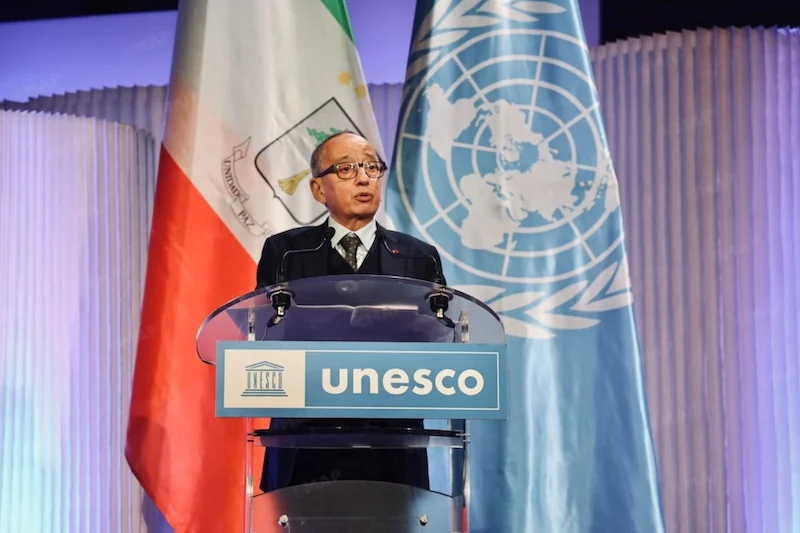
Moroccan researcher and scientist Adnane Remmal was awarded the 2026 UNESCO-Equatorial Guinea International Prize for Research in Life Sciences on Friday evening in Paris, in recognition of his pioneering work in combating antimicrobial resistance, marking a new scientific achievement for Moroccan expertise on the international stage.
The award ceremony was held at the headquarters of the United Nations Educational, Scientific and Cultural Organization (UNESCO), in the presence of the organisation’s Director-General, Khaled El-Enany, alongside diplomats and researchers, as part of the 10th edition of the international prize.
Remmal, a professor at Sidi Mohamed Ben Abdellah University in Fez, received the distinction for research that led, among other achievements, to the development of an innovative medical treatment known as OLIPEN. The formulation combines an antibiotic with an active ingredient extracted from natural essential oils, with the aim of restoring the effectiveness of antibiotics against drug-resistant bacteria.
The innovation has received approval for clinical use, offering new treatment prospects for patients suffering from drug-resistant infections in Morocco. Hundreds of thousands of patients have already benefited from it, according to Remmal, who spoke to Morocco’s official news agency, MAP.
Remmal’s research extends beyond human medicine. He has also developed natural alternatives to antibiotics for livestock farming, as part of an approach aimed at curbing the excessive use of these drugs while promoting food safety and sustainable production.
Speaking on the occasion, the Moroccan scientist expressed his gratitude to UNESCO and Equatorial Guinea for the recognition, describing antimicrobial resistance as one of the greatest health challenges of the modern era.
He characterised it as a “silent threat” that transcends borders, threatening not only public health but also human development, food security and global equity.
Remmal explained that his approach relies on combining a conventional antibiotic with a natural molecule that acts as a resistance breaker, helping restore the effectiveness of existing treatments rather than relying exclusively on the development of new pharmaceutical compounds. This approach could significantly reduce the time and costs associated with research and development.
The Moroccan researcher shared the award with Chinese neuroscientist Nancy Yuk-Yu Ip, president of the Hong Kong University of Science and Technology, who was recognised for her research into brain functions and Alzheimer’s disease, and Spanish professor Carlos Martín Montañés of the University of Zaragoza, honoured for his contributions to the development of a tuberculosis vaccine.
The prize carries a total value of $300,000, to be divided equally among the three laureates. Each recipient also receives a symbolic statuette created by Equatorial Guinean artist Leandro Mbomio Nsue.
The jury for this year’s edition was chaired by Moroccan nuclear physicist Rajaâ Cherkaoui El Moursli, who underscored the importance of strengthening investment in scientific research, supporting young African researchers and consolidating scientific partnerships between countries of the Global South.
The distinction represents international recognition of a Moroccan scientific career that has successfully translated academic research into an innovation with practical medical applications, at a time when healthcare systems worldwide are facing the growing challenge of bacterial resistance to antibiotics.




add your comment
Terms of publication : Not to offend the writer, people, sacred things, or attack religions or the divine self, and refrain from racist incitement and insults.