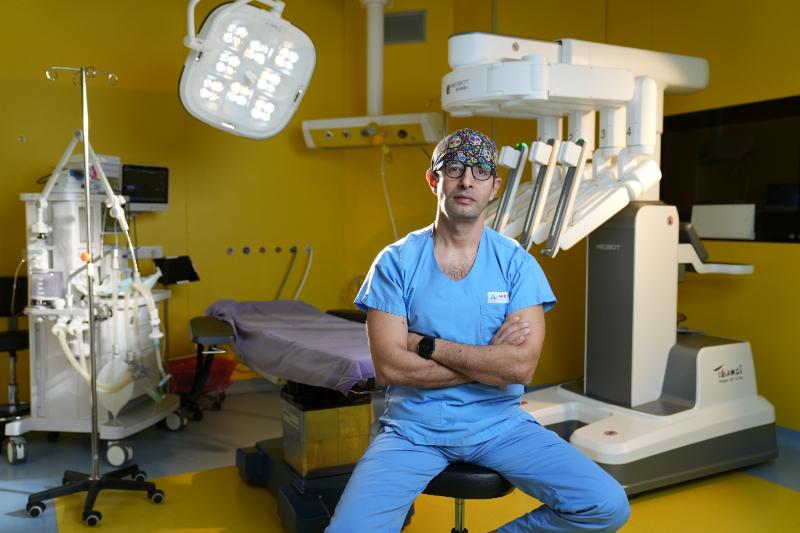
Between technological breakthroughs, the preservation of sexual and urinary function, and national ambitions, Professor Adil Ouzzane, urologist-andrologist and Director of the Robotic Surgery Program at the AKDITAL Group, offers new insights into this medical revolution in Morocco.
Far from the common misconception that machines perform operations on their own, the reality of robotic surgery remains, above all, a human endeavour. It is the surgeon’s experience, combined with the responsiveness of the entire operating-room team, that gives this cutting-edge technology its value. The robot replaces neither the doctor nor conventional surgical techniques; rather, it extends the surgeon’s capabilities, enabling remarkable precision in situations where every millimetre counts.
Although robotic surgery was introduced in Morocco only recently, primarily in the field of urology, it has already been the subject of a study involving 132 robot-assisted prostatectomies (surgical removal of the prostate to treat cancer), conducted by Professor Adil Ouzzane and published in the Journal of Robotic Surgery.
An expert in robotic and minimally invasive surgery of the prostate and urinary tract, Professor Adil Ouzzane explains how robotic surgery is performed in the operating room and how it has improved the lives of numerous patients.
With more than 1,500 procedures performed since 2008, the surgeon presents particularly encouraging results from the first 132 robot-assisted prostatectomies carried out within the AKDITAL Group, with urinary control recovery rates reaching up to 98% at six months.
- In practical terms, what does it look like from your perspective when you are looking into the console or operating the robot?
“When I am seated at the robotic console, I have a magnified, extremely precise three-dimensional image of the area I am operating on in front of me. It is a little like being immersed inside the patient’s body, with a much more detailed view than what we can see with the naked eye.
I can clearly distinguish the small blood vessels, nerves and different tissues. My hands control miniaturised instruments that reproduce my movements with a very high degree of precision.
Above all, one thing must be understood: it is not the robot that performs the operation; it is the surgeon. The robot makes no decisions and performs no movements autonomously. It is a tool that enables the surgeon to see better and perform particularly precise movements, especially in anatomical areas that are difficult to access.”
- Does the sense of touch change compared with conventional surgery? How do you compensate for the absence of direct contact with the tissues?
“That is indeed an important difference. With the robotic systems we use, we do not directly feel the resistance of the tissues as we do during open surgery.
However, we benefit from exceptional visual quality. The magnified three-dimensional image allows us to observe very fine details, particularly how tissues respond when we manipulate them.
With experience, the surgeon develops what is known as a visual perception of forces. They learn to assess the tension exerted on tissues simply by observing how they behave.
This is a specific skill that forms an integral part of robotic surgery training. The robot provides remarkable precision, but that precision is only valuable when accompanied by a thorough knowledge of anatomy and genuine surgical experience.”
- What specific training must the surgical team and operating-room nurses undergo before they can use this system?
“Robotic surgery is not simply a matter of installing a robot in an operating room. It requires the training of an entire team.
The surgeon must complete a specific training pathway combining theoretical instruction, simulation, practical training and supervised procedures before being able to operate independently.
But training does not concern the surgeon alone. Operating-room nurses, anaesthetists and the entire team must learn to work with this technology, position the patient correctly, prepare the instruments and respond to the various situations that may arise during the procedure.
It is truly a collective effort. The quality of a robotic surgery programme depends as much on the surgeon’s competence as on the coordination and experience of the entire team. At the AKDITAL Group, our ambition is precisely to develop this collective expertise, with particular emphasis on training and patient safety.”
- What happens in the event of a technical problem or power outage during the procedure?
“Patient safety is obviously our absolute priority. Robotic surgery systems are covered by specific maintenance contracts, with regular technical inspections and preventive maintenance designed to significantly reduce the risk of equipment failure.
We also follow a safety philosophy comparable to that of aviation: before every procedure, and particularly before the patient is anaesthetised, we carry out systematic checks of the equipment and ensure that everything is functioning properly.
Operating rooms are also equipped with emergency power supply systems, including generators, and the robots have mechanisms to manage certain power interruptions.
Finally, the entire surgical team is trained to respond in the event of a technical incident. If necessary, we can stop using the robot and continue the procedure using another surgical technique.
The principle is simple: safety never depends on a single machine, but on an entire system involving regularly inspected equipment and a thoroughly prepared team.”
- If this technology offers such a high degree of precision, why does conventional surgery remain indispensable in certain cases? And in which cases do you recommend robot-assisted surgery?
“Robotic surgery should certainly not be presented as a universal solution. It is an important technological advancement, but it does not replace all other surgical techniques.
The choice depends above all on the disease, its stage, the patient’s anatomy, and their medical and surgical history.
In urology, robotic surgery is particularly valuable for certain complex procedures, notably the surgical treatment of prostate cancer, certain kidney operations and reconstructive procedures involving the urinary tract. It makes it possible to perform highly precise movements in sometimes narrow anatomical spaces while limiting the invasiveness of the procedure.
However, in certain situations, open surgery or conventional laparoscopy remain entirely appropriate, or even preferable. Genuine progress does not mean operating on every patient with a robot. It means being able to offer each patient the technique best suited to their individual circumstances.”
- You conducted a study involving 132 robot-assisted prostatectomies (surgical removal of the prostate to treat cancer). Prostate surgery often worries men for two reasons: urinary leakage and sexual function. How does the robot’s precision help protect these essential functions?
“This is indeed one of the major concerns for men who need to undergo surgery for prostate cancer. Naturally, they want to be cured of their cancer, but they also want to preserve their urinary continence and sexual life.
The prostate is located in a particularly complex anatomical region, in direct proximity to the structures involved in urinary control and erections. Robotic surgery gives us an enlarged three-dimensional view and remarkable instrument precision, allowing us to work with a very high degree of finesse.
However, I want to emphasise one essential point: the robot is a tool, however high-performing it may be. What truly makes the difference is the surgeon’s expertise, their in-depth knowledge of anatomy and the surgical technique they employ.
I have been performing robotic surgery since 2008 and have carried out more than 1,500 robot-assisted procedures over the course of my career. This experience, combined with our research, scientific publications and collaborations with international teams, has enabled us to progressively refine our techniques.
In particular, whenever cancer treatment allows, we prioritise maximum preservation of the anatomical structures surrounding the prostate that play an essential role in urinary continence and erectile function.
Regarding erectile function, this preservation obviously depends on the characteristics of the cancer. When the disease is diagnosed early, nerve preservation is oncologically feasible, and the patient has favourable conditions, particularly in terms of age and sexual function before surgery, we can achieve excellent functional outcomes.
Our philosophy is therefore to seek the best possible cancer outcomes while preserving the patient’s quality of life to the greatest extent possible. This commitment guides both our clinical practice and our research.”
- Your study shows that more than nine out of ten patients regain normal urinary control in just three months. Does this mean a faster return to normal life than before?
“Yes, and this is precisely one of the most encouraging aspects of our results. In our initial series, more than 90% of patients had regained satisfactory urinary continence by the third month after surgery. This is a particularly important result when we consider how significantly urinary problems can affect quality of life after prostate surgery.
However, it is important to understand that these results come from an initial analysis. We are currently continuing to assess our patients and update our data.
With a longer follow-up period, our data, which are currently being updated, suggest a continence rate of around 97% to 98% at six months. Persistent incontinence has thus become rare and may, in particular, be associated with individual factors, such as certain medical conditions in the patient’s history or pre-existing functional disorders.
These results are not simply attributable to the use of the robot. Above all, they are the outcome of extensive surgical experience and a surgical technique refined over the years, with the constant aim of better preserving the anatomical structures responsible for continence.
We are also working to update our results concerning the recovery of erectile function, with very encouraging outcomes among patients for whom nerve preservation is possible. Our objective is not merely to treat the cancer effectively, but also to enable patients to return to their normal daily lives as quickly as possible.”
- What does the success of these first 132 operations represent for the future of medicine and surgery in Morocco and Africa?
“These initial procedures and the results we have published represent an important milestone, but I believe they must be viewed within a much broader perspective.
Robotic surgery is not simply a technological innovation introduced into a medical facility. It is a fully fledged discipline that requires years of experience, demanding training, rigorous organisation and continuous evaluation of outcomes.
Having started practising robotic surgery in 2008, I have been able to measure just how much this discipline has evolved, both technologically and in terms of surgical techniques. Today, our ambition is to put this experience at the service of the development of robotic surgery in Morocco.
The results we are achieving show that we can develop world-class surgery locally while actively contributing to scientific research and exchanges with international teams.
At the AKDITAL Group, we want to go beyond acquiring surgical robots. Our aim is to establish sustainable programmes, train teams, develop national expertise and progressively make these techniques accessible to more patients.
I am convinced that Morocco has the human and medical expertise needed to become an important player in the development of robotic surgery in Africa. True success is measured not only by the number of procedures performed, but also by our ability to sustainably improve patient outcomes, pass on our expertise and advance surgical practice in our country.



add your comment
Terms of publication : Not to offend the writer, people, sacred things, or attack religions or the divine self, and refrain from racist incitement and insults.