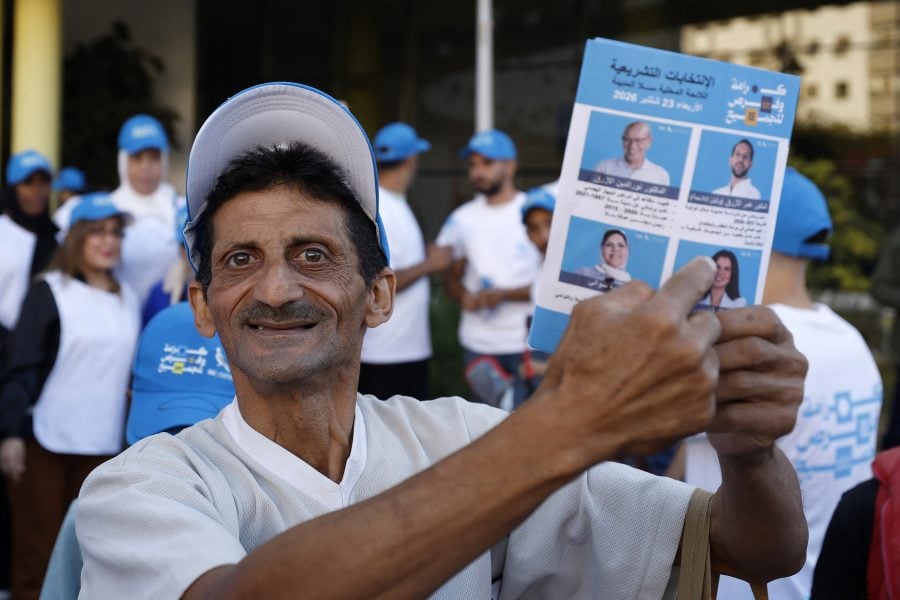
This year, for the first time, every regional seat in Morocco’s Parliament is reserved for women, 1,783 candidates, the full list, closed to men entirely.
A party that fills that list has met its legal obligation to women in one move. Nothing requires it to do the same on the local lists next to it, where parties choose freely and name recognition, local ties and years of legwork decide who wins. So the reason to back a woman locally, the funding, the groundwork, the years spent building a name voters recognize on their own, mostly disappears once the regional list is filled.
That’s the test this year runs at full scale: the biggest quota Morocco has ever fielded, set against everything it leaves untouched: which party chose to invest locally anyway, who actually filled the protected seats, and what voters make of how they got there.
What parties do when women are optional
Women head just 121 of the 1,615 local lists filed for the September 23 election, or 7.5%, even as every candidate in the regional contest is a woman.
That 7.5% is the highest share in more than two decades, but the rise has been slow. Women headed 2.64% of local lists in 2002, 3% in 2007, 4.13% in 2011, 4.27% in 2016 and 6.58% in 2021.
That national number hides real differences between parties, some barely moved the needle, others trying harder than most. Hespress English examined local-list nominations from six parties spanning the political spectrum, the Party of Progress and Socialism (PPS), Istiqlal, PJD, PAM, the Popular Movement, and the Left Alliance, whose lists cover most local constituencies, and compared this year’s figures with the 2021 results. RNI did not respond to a request for its local-list data.
Istiqlal put women at the head of just two of the 88 local lists identified on its official website. At the other end of the sample, the Left Alliance, made up of FGD and PSU, fielded nine women at the head of 73 local lists, the highest share among the six formations examined.
The imbalance was already visible in 2021. FGD and PSU together fielded nine female local-list leaders, PPS seven, PAM six, PJD five, the Popular Movement two and Istiqlal one.
“Some parties have focused on placing strong female leaders on regional lists to secure seats, which has somewhat drained local constituencies of qualified women who could go head-to-head with established local figures,” El Goute from PJD said.
But the picture is a bit different for the left alliance, made up of the Federation of the Democratic Left (FGD) and the Unified Socialist Party (PSU), which takes a more progressive approach.
The coalition bet on more women in open races, putting 9 women at the head of their 73 local lists, the highest share among the six parties.
Comparing 2026 data to 2021, the pattern for local lists remains much the same: a large share of the top spots goes to men, while women, when quotas aren’t imposed, are given few chances to lead.
In 2021, the two parties that now make up the Left Alliance (FGD and PSU) trusted women to lead nine local lists in total. Istiqlal, however, was hesitant once again, putting just one woman at the head of its tickets.
Even across Morocco’s regions, the story remains the same.
Regions like Dakhla-Oued Ed-Dahab and Laayoune-Sakia El Hamra present no female list leaders, as per the selected parties, leaving open competition entirely to men.
Meanwhile, Casablanca-Settat and Fes-Meknes lead with seven female-led candidate lists each, including prominent political figures like Nabila Mounib, Fatima Tamni, Rim Chabat, Najwa Koukous, and Amina Maelainine, whose established presence in the political sphere could give them a stronger chance in their races.

Political scientist Mounia Bennani-Chraïbi documented one reason under Morocco’s earlier quota system. Once women had a protected national list, some male party elites treated them as having already received their “due,” while local competition remained overwhelmingly male.
Aicha El Goute, a PJD lawmaker, told Hespress English she sees the same logic in 2026.
“Most party leaders treated regional lists as a legal requirement to fulfill their obligation toward women’s empowerment,” she said, describing the quota as an “unspoken male justification” for keeping women away from the top of local lists.
She said parties also move stronger female politicians into the protected race, “which has somewhat drained local constituencies of qualified women who could go head-to-head with established local figures.”
Women sent repeatedly through protected lists get fewer chances to prove they can win open races and their weaker record there can then give parties another reason to keep sending them back to the protected route.
Who gets through when women are required
Research on Moroccan candidate selection has long shown the importance of local notability, social ties and established networks, and the 2026 nominations show how those networks can survive inside a women-only race.
PAM said it used a committee to assess candidates on political and organizational experience, field presence, communication skills and party commitment, while PPS interviewed prospective candidates before its leadership approved the final list heads. At the same time, Hespress reported internal disputes over those nominations, including disagreements over competence and political standing, as well as efforts by some party leaders to secure nominations for relatives.
In Beni Mellal-Khenifra, RNI chose Aya Addal, daughter of former MP Mohamed Addal; PAM nominated Sara Amhzoun, whose mother won a regional seat in 2021; Istiqlal selected Hala Zakrani, daughter of sitting MP Mohamed Zakrani; and the Popular Movement chose Rim Serrar, daughter of MP Said Serrar, according to Hespress AR reporting.
A 2025 study by Barnett, Blackman and Shalaby interviewed quota-elected women directly. One, elected in 2016, said she felt treated as a “second-class MP” by male colleagues from the moment she entered Parliament.
Earlier interview-based research summarized by Georgetown’s Institute for Women, Peace and Security found that women MPs reported being steered toward lower-status committees tied to “women’s issues,” while some had to push for assignments to finance or foreign affairs.
Several described the quota as a ceiling rather than a door, meaning it got them in, but made winning a seat through an ordinary constituency harder. Of the 67 women who served in Morocco’s 2011-2016 legislature, 91% did not return for the next one, a turnover rate researchers linked partly to how difficult it remained for women to move from protected seats into open constituencies.
A 2025 nationally representative experiment with 927 Moroccans found another cost attached to that route. Quota-elected women were somewhat more likely than women elected outside the quota to be seen as “pawns” of their parties, not less capable, but less independent from the political leadership that helped put them in office.



add your comment
Terms of publication : Not to offend the writer, people, sacred things, or attack religions or the divine self, and refrain from racist incitement and insults.