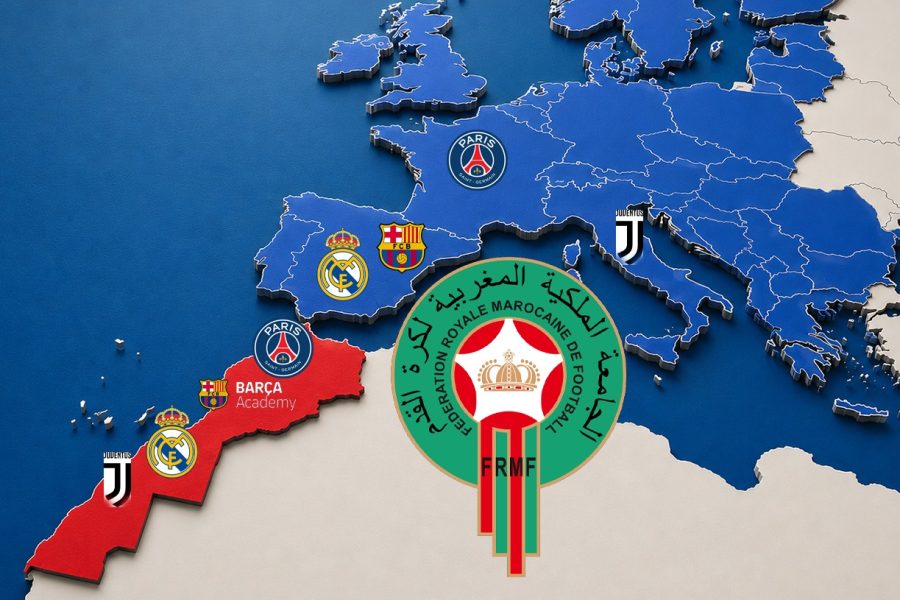
Morocco’s Royal Moroccan Football Federation (FRMF) has banned the establishment of football academies and schools using the names of foreign clubs, as part of a broader effort to regulate the country’s growing private youth football sector.
The decision follows studies aimed at developing a national framework governing the organization and management of private football academies and schools, according to the federation.
The restrictions apply to academies and schools whose partnerships, affiliations or other links with foreign clubs could facilitate, directly or indirectly, the scouting and recruitment of young Moroccan players.
Why is the FRMF imposing the restrictions?
Several football academies in Morocco have established ties with European clubs and used their names as part of their branding and recruitment strategies.
Such associations can appeal to young players and their families because of the reputation of major European clubs and the perception that enrollment could provide a pathway to professional football abroad.
Badreddine Idrissi, president of the Moroccan Association of Sports Press, welcomed the decision, describing it as part of an effort to address what he called the deterioration of standards in Moroccan football.
“Some people claim to represent major European clubs and set up football schools here in an attempt to attract children, without respecting the standards required for high-level training,” Idrissi told Hespress English.
He said the number of academies, training centers and football schools carrying the names of European clubs has increased rapidly in recent years.
Idrissi said he has long supported the creation of football schools operating under Moroccan names, including those honoring Moroccan football figures.
He described the FRMF’s decision as part of a broader effort to establish national standards for youth development.
“There are even associations with no connection to the sports sector that announce the creation of football schools without following any standards, despite the fact that the federation is responsible for regulating and overseeing football in all its forms,” he said.
Cooperation with foreign clubs can continue
The new restrictions do not necessarily mean that Moroccan football is seeking to sever ties with European clubs.
Instead, officials and football experts say the focus is on distinguishing between technical cooperation with foreign clubs and academies that operate directly under a foreign club’s name.
Abdellah Mrabet Dajidi, general secretary of Ittihad Tanger, said Moroccan football can continue benefiting from the expertise of major European football systems without allowing foreign brands to become the primary attraction for young players and their families.
“The Moroccan approach is imported, but it is adapted to our needs — a system that respects the specific characteristics of our country and our football environment,” he said.
Dajidi said partnerships with foreign clubs can remain valuable when they focus on exchanging expertise and improving training methods.
Such cooperation could include Moroccan coaches traveling abroad for training and foreign coaches visiting Morocco to share expertise on youth development.
“Nobody is preventing clubs from sharing their expertise,” he said, pointing to Ittihad Tanger’s exchanges with foreign clubs as an example.
“The key difference is whether a foreign club is contributing its expertise or simply lending its name to an academy,” he said.
Dajidi described the FRMF’s decision as “a smart step,” arguing that foreign clubs can continue cooperating with Moroccan academies without necessarily operating schools under their own names.
The commercial appeal of foreign club names
The debate also highlights the commercial value of major European football brands.
An academy carrying the name of a prominent European club can attract young players and their parents, particularly families hoping their children will eventually pursue professional careers abroad.
But Dajidi warned that the use of foreign club names can create expectations that do not necessarily correspond to the training or opportunities actually provided.
“There is not much added value in simply putting a foreign club’s name on an academy. In many cases, it becomes purely commercial,” he said.
The concern is that parents may interpret a foreign club’s name as an indication of a formal pathway to that club, even when the academy operates independently in Morocco.
The new framework could therefore seek to ensure that youth development is based on transparent sporting standards rather than primarily on the commercial appeal of foreign brands.
Foreign expertise remains possible
The restrictions do not necessarily prevent Moroccan academies from working with foreign clubs through coaching exchanges, technical programs, training camps and other forms of cooperation.
Under such a model, academies could benefit from European expertise while remaining subject to Moroccan regulations and retaining responsibility for the development of their players.
The broader objective is therefore not simply to remove foreign names from academy signs, but to establish clearer standards for the rapidly expanding private football sector.
That could include requirements related to coaching qualifications, training structures, player development and the protection of young players and their families.
Foreign academies face uncertainty
Major academies, including Paris Saint-Germain Morocco, declined to comment on the FRMF’s decision. Other foreign clubs and academies contacted for comment could not be reached.
The limited response leaves questions over how existing partnerships between Moroccan academies and foreign clubs will be affected by the new framework.
It also remains unclear whether foreign clubs with established relationships in Morocco will seek to restructure those partnerships or maintain them under new arrangements.
For Moroccan academies whose branding and recruitment strategies are closely tied to foreign club names, the impact could be more immediate. They may have to change their names and branding while maintaining technical cooperation with foreign partners, provided those arrangements comply with the federation’s regulations.
How the FRMF distinguishes between legitimate international cooperation and the use of foreign club brands will therefore be key to the implementation of the new rules.
Ultimately, the federation’s move reflects a broader attempt to bring Morocco’s expanding private football academy sector under a clearer national framework while preserving access to international expertise and putting greater emphasis on the structured development of young Moroccan players.




add your comment
Terms of publication : Not to offend the writer, people, sacred things, or attack religions or the divine self, and refrain from racist incitement and insults.