
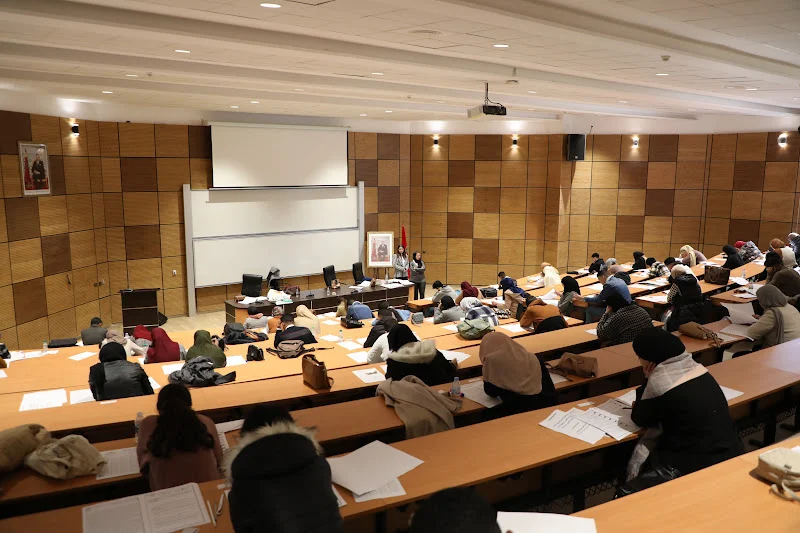
Artificial intelligence has become a staple of university life for many Moroccan students, helping them conduct research, summarize documents, generate ideas and better understand complex concepts. But while AI is becoming increasingly embedded in students’ academic routines, universities vary widely in how they approach the technology, raising questions about whether students are being adequately prepared to use it responsibly.
Interviews with students from the Higher Institute of Information and Communication (ISIC), Mohammed V University, ENCG Casablanca and Al Akhawayn University suggest AI has become an everyday study tool, even as institutional guidance remains inconsistent.
“I use AI tools at least once a day for my studies,” said Yasmine, a journalism student at ISIC. “They make research easier and save me a lot of time.”
Another ISIC student, Hajar, said she relies on AI daily to quickly find sources and explanations. Both students said they had taken courses on AI and digital literacy, where professors discussed the technology’s benefits while emphasizing its limitations and ethical risks.
The experience is different at Mohammed V University.
Amine, a student there, said neither the university nor his professors had provided guidance on AI use.
“They believe that AI is cheating,” he said, adding that although there are no formal AI policies, students risk failing assignments if professors determine AI-generated work amounts to plagiarism.
Maroua, a student at ENCG Casablanca, said she uses ChatGPT to explain lessons, summarize documents and organize ideas but has received no formal AI training beyond reminders to avoid plagiarism.
At Al Akhawayn University, Amir said students have access to resources on writing effective AI prompts, although he believes many professors are still adapting to the rapid pace of technological change.
Despite their different academic environments, all of the students interviewed said they verify AI-generated information before using it by consulting reliable sources, comparing responses with course materials or asking AI tools to provide references.
Their experiences mirror the findings of a recent study by ISIC professor Hatim Boumhaouad, which examined how journalism students use generative AI.
The research found that students primarily use ChatGPT to brainstorm ideas, identify sources, summarize texts and draft assignments. At the same time, many expressed concerns about misinformation, plagiarism and overreliance on AI, emphasizing the need for stronger AI literacy and ethical guidance.
The study also found that students who received digital literacy training were more likely to critically evaluate AI-generated content rather than accept it at face value.
At the national level, Morocco’s PACTE ESRI 2030 strategy promotes digital transformation, digital skills and online learning. However, it does not explicitly address AI literacy or provide guidance on the responsible use of generative AI in higher education.
Elsewhere, some universities have already begun integrating AI literacy into their curricula. In the United States, St. Bonaventure University will require all first-year students to complete an AI literacy module covering prompt writing, academic integrity, data privacy and algorithmic bias.
The Moroccan students interviewed said universities should adopt similar initiatives. While they view AI as a valuable tool that saves time and supports learning, they also stressed the importance of understanding its limitations, verifying its outputs and avoiding excessive dependence on the technology.
As AI becomes increasingly embedded in higher education, the question for Moroccan universities may no longer be whether students use AI, but whether they are being equipped to use it critically, ethically and effectively.



add your comment
Terms of publication : Not to offend the writer, people, sacred things, or attack religions or the divine self, and refrain from racist incitement and insults.