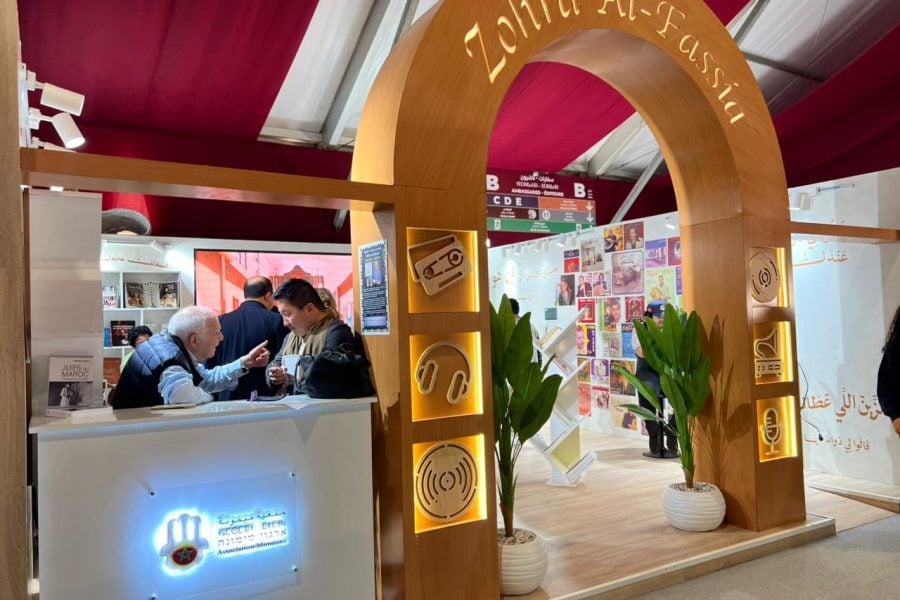
Moroccan Jewish musical heritage is taking center stage at SIEL 2026, as the Mimouna Association—founded in 2007 by Muslim students—marks its fourth participation in the event.
This year’s pavilion is dedicated to the late Zohra El Fassia, a pioneering Moroccan Jewish singer from Sefrou, who was among the first in Morocco to record albums during the colonial period.
“This year, we are paying tribute to El Fassia, who performed a wide repertoire, including Andalusian, Gharnati and Aita music—many of which are still played at weddings today, though many people don’t know she is the voice behind them,” Abdou El Kaoukabi, head of the educational program at the Mimouna Association, told Hespress English.
The stand is decorated with Arabic lyrics from well-known Moroccan songs such as “Sidi Hbibi Fin Houa,” “Zin Li 3tak Lah,” and “Dour Biha Ya Chibani.”

It also features a dedicated section with photos of Moroccan Jewish artists, including Albert Suissa, Samy El Maghribi and Maxime Karoutchi, among others.
The space includes two tablets with headphones, where visitors can listen to original recordings of Moroccan Jewish music and compare them with versions still played today, discovering the artists behind the songs.
“Many visitors, especially young people, recognize the music but don’t know it comes from Moroccan Jewish artists,” El Kaoukabi said.
The stand also pays tribute to the Azoulay brothers, who owned a recording studio where many artists recorded their work.
“Through their studio, they recorded many artists, helping preserve much of this musical heritage,” he added.
El Kaoukabi emphasized that Moroccan Jewish heritage should be represented at SIEL, just like Amazigh, Hassani and other Moroccan cultural expressions.






add your comment
Terms of publication : Not to offend the writer, people, sacred things, or attack religions or the divine self, and refrain from racist incitement and insults.