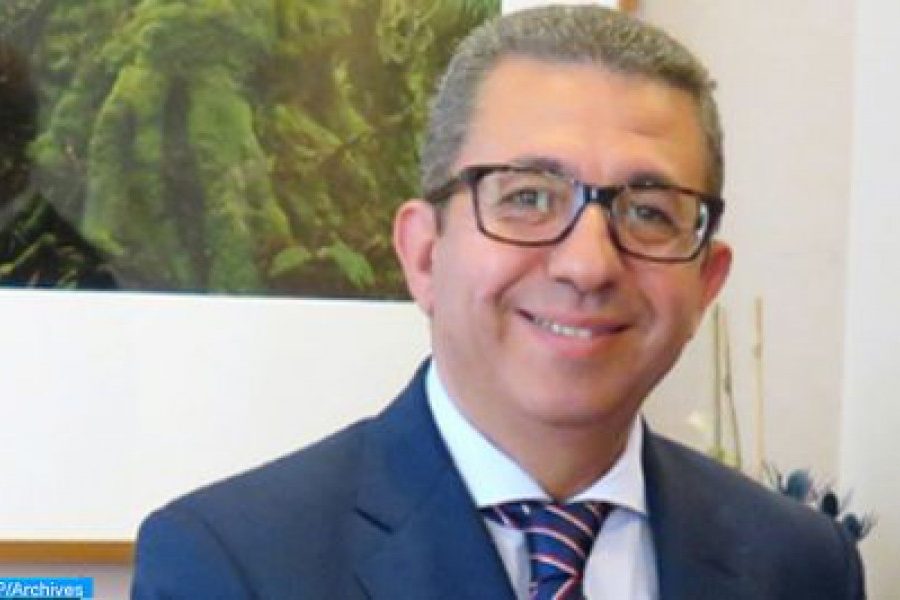
The gradual and endogenous reform process initiated under the leadership of HM King Mohammed VI has enabled Morocco, despite a difficult international context, to consolidate its democratic system and strengthen its institutions, thanks to the Sovereign’s vision for a plural and open democratic society, said Morocco’s ambassador to Australia, Karim Medrek.
Speaking at a virtual meeting with students of the Australian National University enrolled in an internship program in partnership with the Australian National Internship Program (ANIP), the diplomat shed light on Morocco’s foreign policy as well as on the adaptation of the diplomatic world to the current sanitary situation caused by the global expansion of COVID-19.
The ambassador, who also discussed with the students their research projects on Morocco, underlined that the Kingdom has created its own specific model.
Morocco is distinguished by its pro-active approach, its solidarity as well as its unwavering commitment to the promotion of dialogue and peace, he said, stressing that His Majesty King Mohammed VI has made an irreversible choice: that of building a modern democratic state, open to the world and respectful of the universal values of human rights.
Regarding the adaptation of diplomatic life to the current sanitary situation, Medrek noted that diplomats become, de facto, multi-functional players. As the diplomat must have great adaptability and versatility when facing the tasks assigned, the Ambassador considers that the current diplomatic action is therefore based on tools relying on the understanding of the complexity of the contemporary world, he said.
In terms of foreign policy, the Ambassador underlined that Morocco opted for a triptych which is the maintenance of peace, the development of cooperation and the promotion of universal values.
According to him, multilateral diplomacy is primordial and Morocco has proven to be a reliable partner and a strong supporter of cooperation as a means of development in an era of globalized issues.
It is worth recalling, in this sense, that the Kingdom is committed to bringing solutions to a number of issues such as the fight against terrorism. In this respect, the Ambassador underlined that Morocco, under the leadership of His Majesty the King, has adopted a multidimensional strategy to counter-terrorism and combat religious extremism which is based not only on security cooperation, but also on social values, political reforms, economic development and religious education characterized with the virtues of moderation.
The national counterterrorism strategy aims, according to the Ambassador, to combat this global scourge through concrete political, institutional, economic, social, cultural, educational and religious measures aimed at combating extremism, exclusion, precariousness and illiteracy through human development and the strengthening of the rule of law.
The Ambassador recalled, in this regard, Morocco’s efforts at the international level to fight terrorism by underlining that the Kingdom co-chairs the Global Counterterrorism Forum (GCTF).
On the issue of migration, the ambassador shed light on Morocco’s national policy which has consisted in regularizing the situation of about 50.000 people in two phases between 2014 and 2017.
In this respect, the Ambassador underlined that Morocco was the first country in the region to develop a legal migration policy, offering migrants from African brotherly countries the possibility to stay with permanent residency and to live in dignity.
This migration policy has four main objectives, notably the management of migration flows while respecting human rights principles, the establishment of an appropriate institutional framework, the facilitation of the integration of regular immigrants as well as the upgrading of the regulatory framework, he explained.
The Ambassador also hailed Morocco’s efforts at the international level in the field of Migration, by drawing on Morocco’s contribution to the African Agenda of Migration, as His Majesty King Mohammed VI has suggested, in this regard, to set up an African Migration Observatory which will be headquartered in Rabat, as well as by evoking Morocco’s organisation of the United Nations Conference on Migration which was the occasion to adopt the global compact for a safe and orderly Migration.
Besides, Medrek noted that Morocco emerged, during the last decade, as one of the leading countries in the field of sustainable development and ecological transition. The choice of making of Morocco a champion in terms of renewable energy has not been dictated by provisional urgencies, but rather by a clear vision under the leadership of HM the King who considers climate action as one of the Kingdom’s priorities, he underlined.






add your comment
Terms of publication : Not to offend the writer, people, sacred things, or attack religions or the divine self, and refrain from racist incitement and insults.