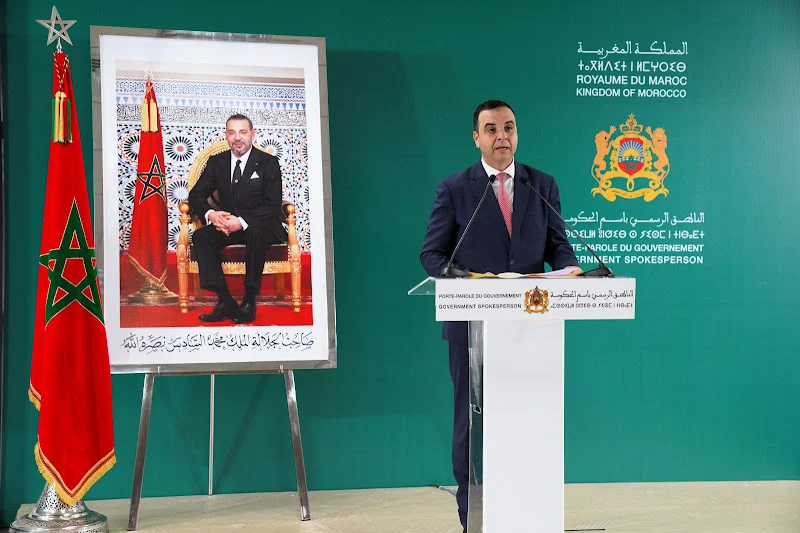
The Moroccan government is closely monitoring the impact of heavy rainfall in northern parts of the country, particularly in the city of Ksar el-Kebir, government spokesman Mustapha Baitas said Thursday.
Speaking at the government’s weekly news conference, Baitas said an interministerial meeting will be held Friday under the chairmanship of Interior Minister Abdelouafi Laftit to coordinate response measures and mobilize all necessary resources.
Baitas said Morocco has experienced significant rainfall over the past month and a half, with nationwide precipitation reaching 138.5 millimeters, representing a surplus of more than 142 percent compared with the same period last year.
Snowfall has also been substantial, with snow currently covering more than 55,400 square kilometers across the country at peak levels, he said. The locally snow-covered area stands at about 42,696 square kilometers, with snow depth ranging from one to two meters in mountainous areas above 2,500 meters.
Water inflows into Morocco’s dams have increased sharply, Baitas said. From Sept. 1, 2025, through Jan. 28, 2026, reservoirs received a total of about 5.83 billion cubic meters of water. More than 5.4 billion cubic meters of that volume was recorded between Dec. 12 and Jan. 28 alone, accounting for nearly 93 percent of total inflows during the period.
The total volume represents a 35 percent increase over the annual average and a rise of 330 percent compared with the same period last year, he said. As a result, national dam fill levels climbed from 31.1 percent in mid-December to more than 55.25 percent by Jan. 28, with total reserves reaching 9.26 billion cubic meters, the highest level recorded since July 2019.
By comparison, dam fill levels stood at about 27 percent at the same time last year. Several major dams have reached fill rates of 80 percent, while others have discharged excess water after reaching full capacity, Baitas added.
On port policy, Baitas said Morocco’s National Ports Strategy 2030 provides a clear framework aimed at developing efficient and sustainable ports that support national economic competitiveness. He said the strategy seeks to position ports as key drivers of territorial development and strengthen Morocco’s role as a strategic logistics hub on both the Atlantic and Mediterranean coasts.
The strategy involves port infrastructure investments exceeding 75 billion dirhams ($7.5 billion) by 2030, he said. Projects include new ports such as Safi, Nador West Med, expected to open by the end of this year, and Dakhla, which is about 50 percent complete. Additional projects include a new phosphate port in Laayoune and the expansion of Safi’s port under the supervision of the state-owned phosphate group OCP.
Major expansion and rehabilitation works are also under way at several existing ports, including Casablanca, Tangier Med, Jorf Lasfar, Agadir and others. Baitas said projects integrating ports into their urban environments have already been completed in Al Hoceima and Tangier, with similar efforts ongoing in Casablanca.
Thanks to these investments, Morocco’s total port handling capacity has reached about 350 million tons per year and is expected to rise to 450 million tons by 2030, he said.





add your comment
Terms of publication : Not to offend the writer, people, sacred things, or attack religions or the divine self, and refrain from racist incitement and insults.