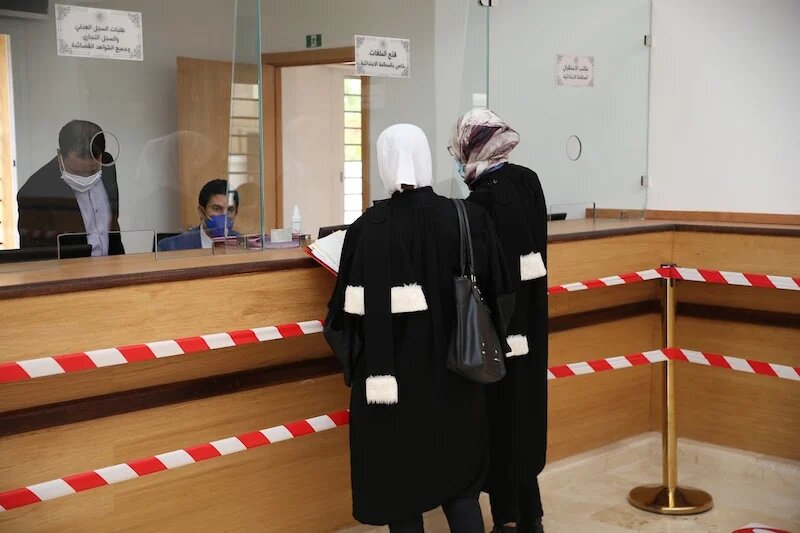
Morocco’s Justice Ministry has proposed stricter entry requirements for the legal profession under Draft Law No. 66.23 regulating the practice of law, a move that has fueled growing controversy with bar associations.
According to the draft bill, candidates seeking admission to the Institute for Legal Training would be required to hold a master’s degree or a specialized master’s degree in legal sciences from a Moroccan faculty of law, or an equivalent diploma recognized by the state. Eligible qualifications also include advanced or specialized postgraduate diplomas in legal studies.
Article 5 of the draft law maintains existing nationality requirements, stipulating that applicants must be Moroccan nationals or citizens of countries that have reciprocity agreements with Morocco allowing mutual practice of the legal profession. Candidates must be at least 22 years old and no older than 40 on the date of the entrance examination.
The bill further requires applicants to enjoy full civil rights and to have no final criminal convictions for acts deemed incompatible with honor, integrity, or good conduct, even if rehabilitation has been granted. It also excludes individuals who have been subject to final disciplinary sanctions such as removal, dismissal, revocation of authorization, or compulsory retirement for reasons related to professional ethics.
Additional conditions include the absence of a final court ruling declaring the loss of commercial capacity, compliance with any binding professional obligations toward public administrations or institutions, proof of physical fitness to practice law, and a regular status with respect to compulsory military service.
Candidates must also successfully pass the competitive entrance examination to the training institute, complete the required training and internship period, and pass the final professional examination.
Under Article 6, applicants who pass the entrance exam acquire the status of institute trainees and must complete one year of basic theoretical training. They are then required to apply for registration on the list of trainee lawyers with one of Morocco’s bar associations within three months of the publication of the list of graduates on the Justice Ministry’s website. Failure to do so results in rejection of the application unless a legitimate reason is demonstrated.
Article 7 sets the duration of the traineeship at 24 months under the supervision of the relevant bar association. This period includes 20 months in a law office designated by the bar president and four months of practical training in a field related to legal practice within a public administration, public institution, or state-owned enterprise.
The draft law allows for an extension of the traineeship in cases of justified interruption, for a duration equal to the interruption, by decision of the bar council, with notification to the Justice Ministry. Upon completion, trainee lawyers must sit for a final examination and, if successful, obtain a certificate of professional qualification to practice law.
In the event of failure in the final exam, the bill provides for a one-time extension of the traineeship for up to one additional year, by decision of the government authority in charge of justice, after which the candidate must retake the exam.



add your comment
Terms of publication : Not to offend the writer, people, sacred things, or attack religions or the divine self, and refrain from racist incitement and insults.