
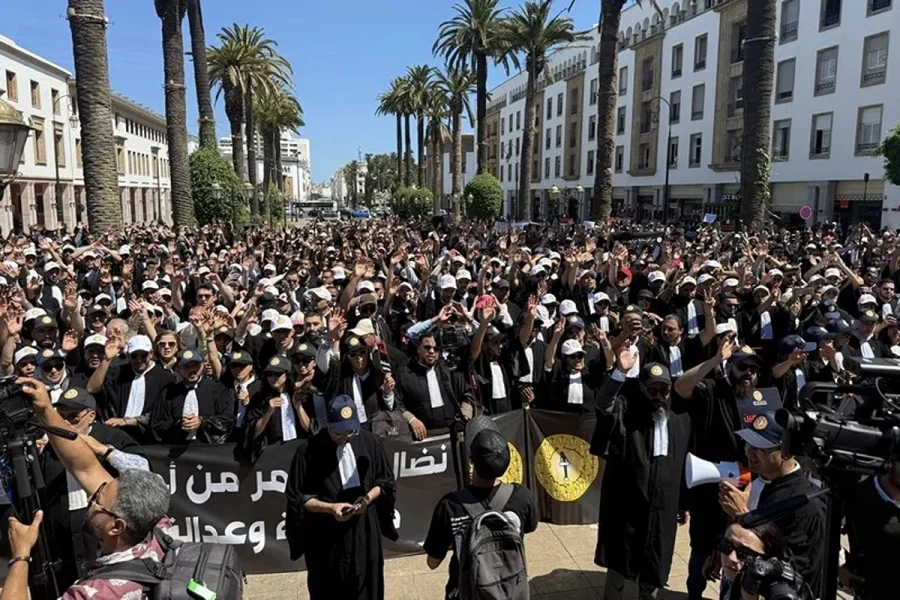
The appearance of several prominent lawyers at the Casablanca Court of Appeal despite an ongoing strike over a new law governing the profession has sparked debate within Morocco’s legal community over possible divisions within the protest movement.
Several well-known figures in the legal profession appeared at the court Tuesday, coinciding with the end of the judicial vacation. They included former Justice and Freedoms Minister Mustapha Ramid, former Casablanca Bar presidents Mohamed Chahbi and Abdellah Drimech, as well as members of the Casablanca Bar Council.
Some lawyers are also reportedly submitting written pleadings on behalf of their clients, particularly those specializing in commercial and administrative cases, while lawyers handling criminal cases continue to observe the work stoppage.
Mohamed Zayani, president of the Association of Bar Associations of Morocco, denied that the profession was divided, saying lawyers were respecting the decision adopted days earlier at an extraordinary meeting of the association’s council.
Zayani told Hespress AR that the country’s bar associations remain united, with all 17 associations nationwide maintaining positions consistent with the decision adopted by the national association.
Addressing calls to end the strike, Zayani said disagreement was inherent to the legal profession.
“The legal profession is built on freedom and differences of opinion,” he said, adding that lawyers had the right to disagree with the association’s position and exercise their own judgment.
He said individual dissent would not undermine the collective action, arguing that the position of professional institutions was more significant than individual opinions.
“The issue is what the institutions concerned decide, not individual opinions, which we accept and which do not represent the prevailing view among lawyers,” Zayani said. “The association remains united, with its bar presidents and lawyers.”
Regarding reports that some lawyers were submitting pleadings and otherwise working despite the strike, Zayani said bar leaders recognized that individual cases could require specific considerations.
“There is no evidence that these lawyers are doing so,” he said. “But if that is the case, it would be an exception, and if someone wants to work, the professional institutions will not prevent them.”
He acknowledged that no strike could achieve complete participation, saying, “A strike anywhere in the world cannot be 100% successful.”
The lawyers’ protest is centered on objections to the legislation governing the legal profession, with bar associations maintaining pressure for changes to provisions they consider problematic.


add your comment
Terms of publication : Not to offend the writer, people, sacred things, or attack religions or the divine self, and refrain from racist incitement and insults.