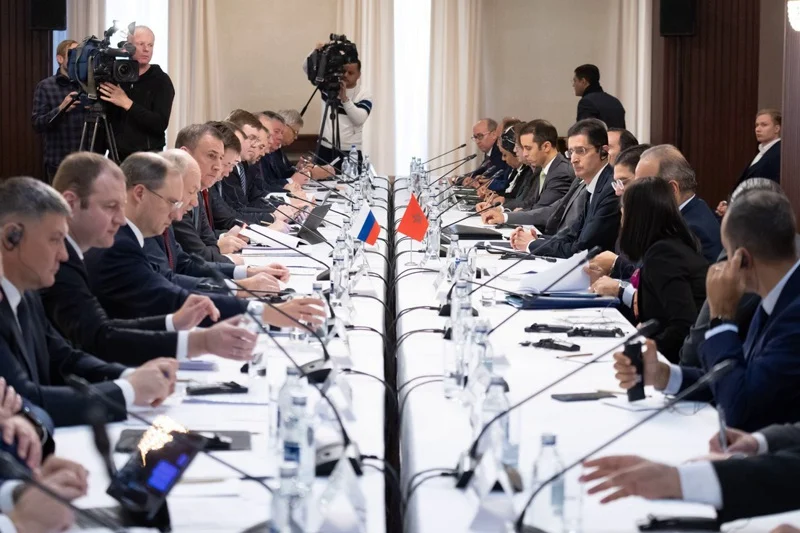
Morocco’s foreign policy is quietly rewriting how the world sees it, no longer as a regional player defending a border, but as a country defining its very identity through the Sahara, says a Russian study published on October 21 in the Comparative Politics journal of Moscow State University for International Relations.
The research’s author, Timur Kadyermambetov, says that the Sahara question has become “the backbone of Morocco’s political self-image,” turning it from a diplomatic file into a symbol of national existence.
According to Kadyermambetov, the Sahara isn’t simply a border issue for Morocco, it’s part of the country’s political identity and a cornerstone of its legitimacy both at home and abroad.
The study says that defending the Sahara has shaped Morocco’s sense of sovereignty and unity, turning it into what the author calls a “foundational element of statehood.”
The researcher links this transformation to the Moroccan leadership’s growing awareness of identity as a diplomatic tool. Over centuries, Morocco has developed a strong sense of continuity and stability centered around the monarchy, which has guided both domestic and foreign policy.
This long historical evolution, he says, forged a deep attachment to national unity that makes the Sahara question “non-negotiable.”
Kadyermambetov points to Morocco’s return to the African Union in 2017 as a turning point. After walking out of the Organization of African Unity in 1984 over the admission of the so-called Sahrawi republic, Morocco rejoined the continental body from a stronger position and began convincing several African nations to back its sovereignty claims.
This success, he writes, shows how Morocco used “multi-dimensional diplomacy” to assert its narrative on the Sahara through partnerships rather than confrontation.
The paper also explores Morocco’s use of soft power, from religious cooperation to cultural exchange, to expand its influence.
Through initiatives like training African imams and promoting a moderate brand of Islam, Morocco has built what it calls “spiritual security,” deepening its African ties while reinforcing its position on the Sahara.
Relations with Algeria remain, however, the biggest external challenge. The study describes them as “a rivalry rooted in history,” tracing back to the 1963 Sand War and fueled by Algiers’ ongoing support for the Polisario Front.
For Morocco, the researcher notes, Algeria has become synonymous with a constant regional threat, something that still defines Morocco’s security mindset.
On the European front, both Spain and France have recently voiced clear support for Morocco’s autonomy plan for the Sahara.
Spain’s 2022 endorsement and France’s renewed backing in 2024, including public remarks by President Emmanuel Macron during his visit to Rabat, are seen as proof of Morocco’s diplomatic shift from conflict language to partnership logic.
The United States also plays a key role. The study recalls that Washington’s recognition of Morocco’s sovereignty over the Sahara in 2020, under Donald Trump, was a strategic milestone.
Kadyermambetov concludes that Morocco has developed what he calls a “national style of foreign policy,” a mix of flexibility, pragmatism, and symbolic depth.

add your comment
Terms of publication : Not to offend the writer, people, sacred things, or attack religions or the divine self, and refrain from racist incitement and insults.