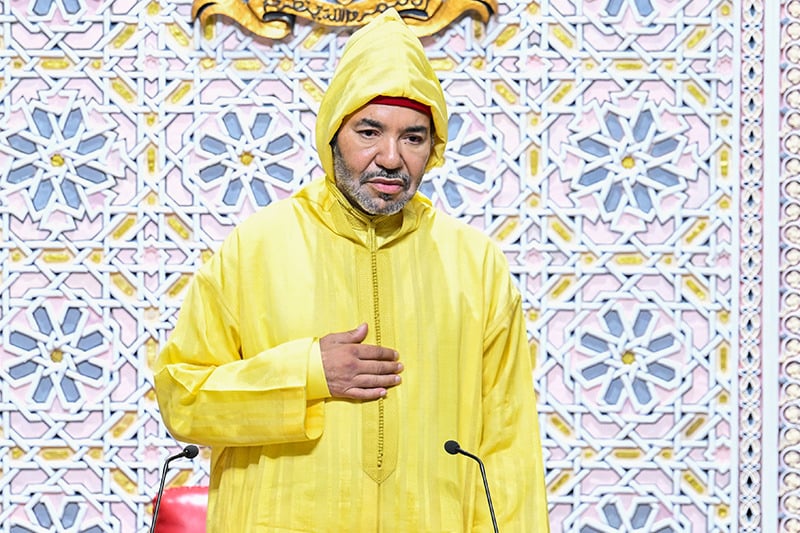
King Mohammed VI used his address to Parliament to redraw the boundaries of political responsibility in Morocco.
“This matter is not the responsibility of the government alone,” he said, shifting accountability from a single administration to the entire political system, Parliament, parties, local councils, and civil society, signaling that Morocco’s chronic policy failures stem less from leadership than from structure.
The King said responsibility for Morocco’s problems does not rest with the government alone, a remark that implicitly widened the circle of blame within Morocco’s political system.
The King’s call for shared responsibility echoed findings already laid out in the country’s own oversight reports. In its recent work, the Court of Accounts has linked delays and uneven execution in multi-actor programs to overlapping jurisdictions and weak coordination between ministries and regional councils.
That diagnosis echoes the New Development Model, the royal commission blueprint released in 2021, which warns that public action in Morocco is hampered by fragmentation, weak coordination, and lack of institutional convergence. The report calls for greater coherence, accountability, and a more integrated role for all actors.
This idea of “shared responsibility” has been building for years in royal speeches. I 2017, Mohammed VI pressed for rigorous accountability, invoking the Constitution and calling it a collective responsibility of government, parliament, parties and other institutions.
By 2021, he was tying reforms to credible institutions and the New Development Model, casting delivery as a system-wide duty rather than a task for a single administration.
The October 2025 address pushes that idea into managerial territory, urging lawmakers to “shed light on initiatives taken by public authorities” and “accompany citizens,” expanding responsibility from policy creation to performance, communication, and civic education.
It’s a framework already shaping the Generalization of Social Protection, which since its launched in 2021, has enrolled over 23 million Moroccans in compulsory health insurance, a massive achievement on paper. Yet service quality lags. A 2024 Health Ministry report cited “administrative misalignment” between central and regional offices and persistent staff shortages in hampering success.
Similar coordination challenges have slowed progress in education, territorial planning, and infrastructure maintenance, where responsibilities overlap among ministries, regional councils, and state-owned enterprises.
In his 2025 Throne Day address, King Mohammed VI called for a decisive move away from “traditional approaches” toward what he termed integrated regional development.
This would see light through “next-generation local development programs” built on a results first approach would require shared data systems, budget rules that reward joint projects, and performance reviews that cross ministerial lines.
It would also require Parliament to monitor outcomes with the same intensity it brings to drafting laws, and for local councils to see coordinationa s a way to claim tangible wins, civil society to audit progress, and media to cover the efficiency of public services rather than just partisan politics.




add your comment
Terms of publication : Not to offend the writer, people, sacred things, or attack religions or the divine self, and refrain from racist incitement and insults.