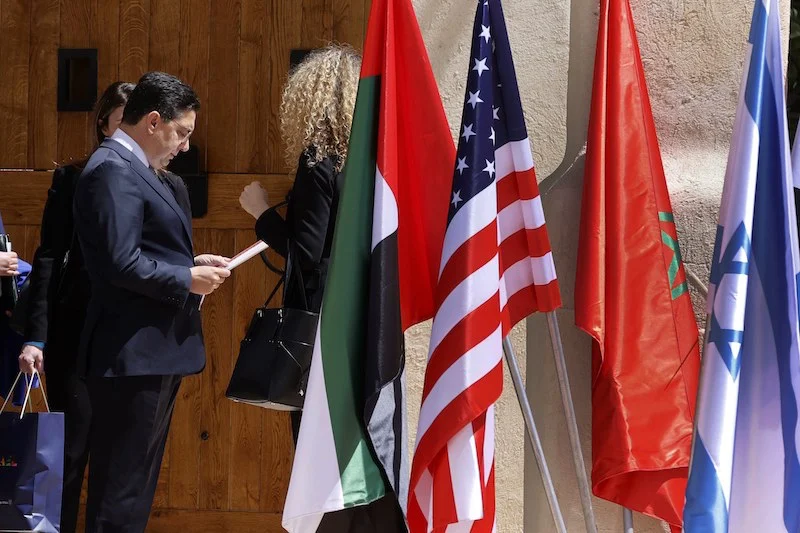
The final statement of the Emergency Arab-Islamic Summit in Doha has prompted debate over the future of Arab states’ ties with Israel, especially among countries that maintain diplomatic and cooperative agreements with it.
The summit came days after an Israeli airstrike in Doha, which added pressure on Arab states to reconsider their relations with Israel.
Participants emphasized collective security and the shared fate of Arab and Islamic nations. They expressed full solidarity with Qatar, supported its measures in response to the attack, and strongly condemned what they described as Israel’s unlawful and cowardly aggression.
The statement rejected Israel’s attempts to impose a new reality in the region and condemned its threats to target Qatar again, dismissing any justification for its actions.
These developments have fueled speculation over whether Morocco might reassess its ties with Israel.
Khalid Chayat, professor of international relations at Mohammed I University in Oujda, said Morocco is unlikely to abandon its trilateral agreement with the United States and Israel. He argued the deal serves Morocco’s enduring strategic interests and has strengthened its position, particularly on national issues such as the Sahara.
“Morocco cannot sacrifice the agreement for uncertain outcomes,” Chayat said, adding that the Arab framework envisioned as a guarantor of unity “does not exist in practice.”
He also criticized divisions in the Arab world, pointing to Algeria’s position on the Sahara as an example of states undermining one another.
Chayat stressed that normalization with Israel could only end once the Arab world establishes the conditions for true integration — economic, political, social and technological — which he described as “the only real alternative to any other vision.” He cautioned against viewing agreements with Israel as the root of the problem, calling them instead an outcome of today’s geopolitical realities.
Abdelhafid Al Younsi, professor of political science and international relations, pointed to Israel’s actions in Gaza, including mass killings, forced displacement, deliberate starvation and ongoing settlement expansion in the West Bank. He also cited repeated incursions, the Hebraization of Jerusalem, threats to Al-Aqsa Mosque and attacks on the sovereignty of Arab and Islamic states.
He argued these developments clearly demand a reassessment of how Israel is confronted.
Al Younsi added that Morocco’s ties to the Abraham Accords, the Sahara dispute and its relationship with the United States make decisive action unlikely, describing the situation as “a clear lack of will to confront a state led by a war criminal indicted by the International Criminal Court.”






add your comment
Terms of publication : Not to offend the writer, people, sacred things, or attack religions or the divine self, and refrain from racist incitement and insults.