
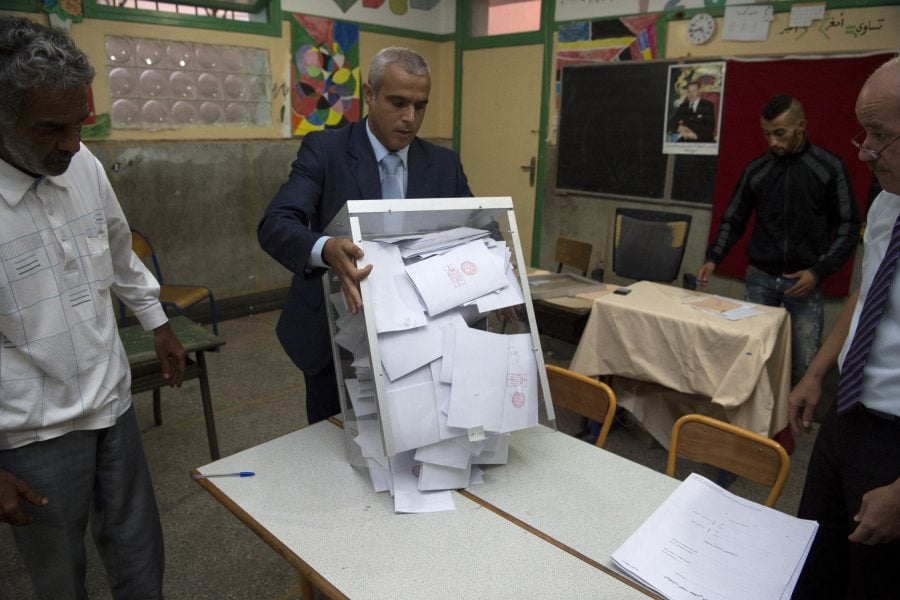
As Morocco prepares for its next legislative elections, political parties are once again split over who should oversee the process, with some pushing for an independent electoral authority and others backing the Interior Ministry’s traditional role.
Left-wing parties, including the Federation of the Democratic Left and the Unified Socialist Party, have called for creating an independent body to supervise the elections.
By contrast, the Party of Progress and Socialism supports keeping the Interior Ministry in charge, but alongside a committee of political parties at both national and regional levels.
The Justice and Development Party acknowledged the ministry’s central role but noted that its past supervision “has not been free of shortcomings.”
Analysts say proposals for an independent body face significant obstacles in Morocco, where the Interior Ministry has managed elections for decades and maintains unmatched logistical and territorial reach.
Ridouane Aamimi, a professor of administrative law at Mohammed V University in Rabat, said the debate is “healthy but must be more rational.” He argued the Interior Ministry remains best equipped “technically, logistically and in the field” to ensure electoral integrity.
Still, Aamimi pointed out that other institutions also play a role, including the judiciary, which oversees voter lists and rules on disputes, and the National Human Rights Council, which monitors transparency. He said parties should be given stronger tools to track and monitor the process “at every stage” to preserve neutrality.
Hafid Zahri, a political analyst, said calls for an independent body resurface before every election, mostly from leftist groups. He suggested some demands amount to “political posturing,” given broad recognition of the Interior Ministry’s capacity to manage the vote.
“The creation of a fully independent electoral authority would be very difficult,” Zahri said, citing the ministry’s dominance and the lack of consensus among parties over how such a body would be formed.
Observers note that while the monarchy’s oversight continues to serve as a guarantee of legitimacy, debates on digitization, transparency and access to electoral data are expected to intensify in the run-up to the vote.



add your comment
Terms of publication : Not to offend the writer, people, sacred things, or attack religions or the divine self, and refrain from racist incitement and insults.