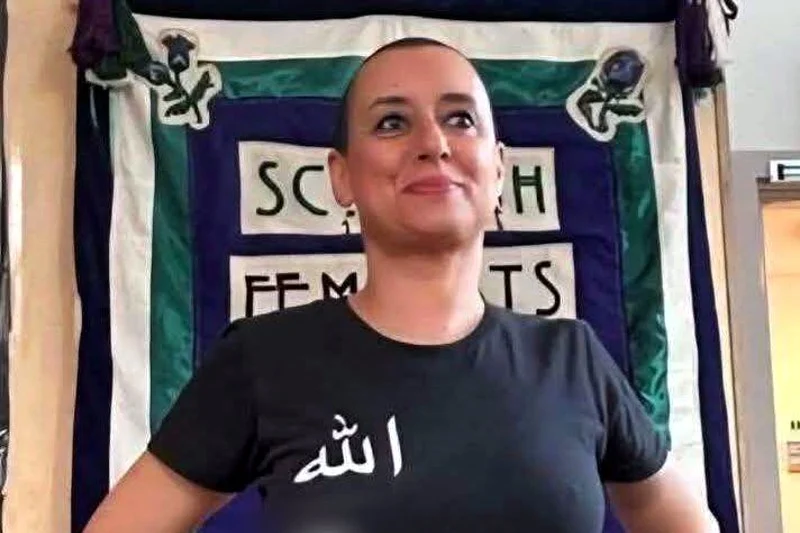
The arrest of Moroccan activist Ibtissam Lachgar has ignited a nationwide debate over freedom of expression and legal limits to blasphemy, after she posted an image on social media wearing a T-shirt with phrases deemed offensive to God, along with a caption reportedly insulting Islam.
Lachgar’s post, which featured language describing God as “queer,” drew widespread backlash and prompted a swift response from the authorities. The General Prosecutor’s Office ordered a judicial investigation, leading to her arrest by the National Judicial Police Brigade.
Former Justice Minister Mustapha Ramid criticized the act in a Facebook post, saying: “I’m not one to support excessive scrutiny or witch hunts… but this was not a slip of the tongue or accidental expression, it was a deliberate, premeditated insult to the divine.”
He added that Morocco has laws and institutions to protect sacred beliefs, and tolerance is not due to those who knowingly choose to defame.
However, several human rights organizations pushed back, calling for Lachgar’s immediate release and urging respect for the right to free expression and a fair trial. The Moroccan Association for Human Rights (AMDH) emphasized that the act should be viewed from a purely rights-based lens.
“According to international human rights treaties, individuals can express their opinions through writing, images, or other means, especially when the content does not incite hatred, discrimination, or violence against specific groups,” AMDH President Souad Brahma told Hespress AR.
Brahma pointed out that while Moroccan law, specifically Article 267 of the Penal Code, penalizes insults to Islam, the monarchy, or calls against national unity, the concept of “blasphemy” remains vague and subject to wide interpretation.
Under Article 267, such offenses are punishable by six months to two years in prison and fines ranging from MAD 20,000 to MAD 200,000. Penalties increase to five years and MAD 500,000 if the act is committed publicly or through digital or mass media.
Legal expert Sabri Rhou questioned the legal basis of the arrest, noting that current Moroccan criminal law does not explicitly criminalize blasphemy or insults against God, unlike a new draft penal code still under discussion. “Will the prosecution rely on a broad interpretation of incitement to religious hatred?” he asked.
Meanwhile, former Moroccan League for Human Rights president Abdelrazak Bougnbour argued that Lachgar’s actions exceed the boundaries of protected speech, calling the post “provocative” and “deeply offensive to both the divine and Moroccan society.”
He added that while freedom of expression is important, it should not extend to undermining collective religious values in a predominantly Muslim society. “This was not a legitimate opinion but a calculated provocation,” he said.
Bougnbour suggested the arrest may even have shielded Lachgar from potential public retaliation, saying: “The authorities acted to protect her from possible assault, which could have escalated into a more serious issue.”




add your comment
Terms of publication : Not to offend the writer, people, sacred things, or attack religions or the divine self, and refrain from racist incitement and insults.