
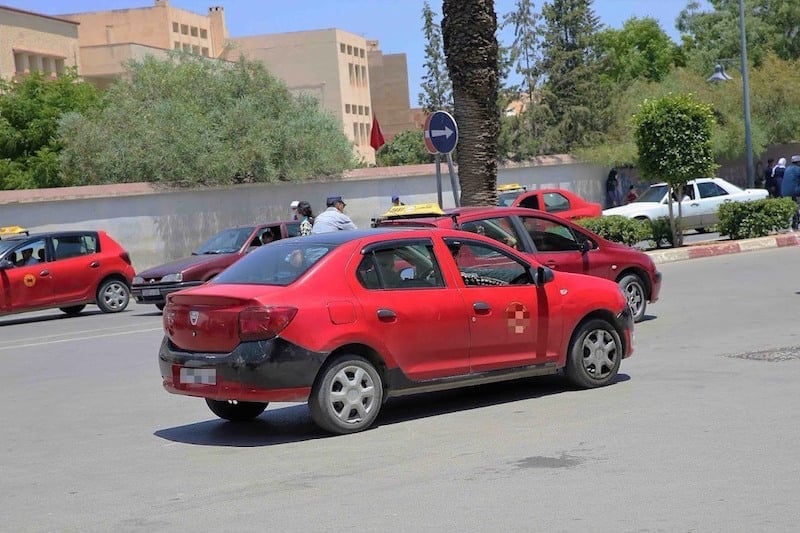
New model contracts recently signed between taxi license holders and professional operators have ignited controversy in Morocco’s transport sector, particularly over the agreed-upon monthly rental fees.
According to the terms of these contracts, monthly rental amounts range from 4,000 to 7,000 dirhams. While some stakeholders welcomed the formalization of these agreements as a way to improve income for license holders, others voiced concern that the costs place an unfair burden on drivers.
Mohamed Beniakoub, president of the Ismailia Taxi Association in Meknes, which represents license holders, described the development as a positive step toward socioeconomic empowerment.
“Reaching a stage where exploitation contracts include rent ranging from 4,000 to 7,000 dirhams is a very good outcome,” Beniakoub told Hespress AR. “It helps support the social standing of this group.”
He added that setting rental fees at this level would encourage license owners to regularize their tax and social security obligations. “They would be required to pay income tax and make contributions to the National Social Security Fund (CNSS), in line with the national push for expanded social protection,” he said.
Beniakoub also noted that the adoption of transparent, formal contracts reduces reliance on unofficial and opaque practices that previously dominated the sector, such as cash “sweeteners” paid under the table to reduce rental amounts.
“We must move toward a framework where signed contracts are clear and respected, especially regarding renewal terms after the legally stipulated period,” he said, adding that Moroccan courts are already reviewing an increasing number of disputes over such agreements.
But not everyone sees the changes as beneficial.
Mohamed Mchakhakh, national secretary of the Taxi Drivers’ Union under the National Labor Union of Morocco (UNTM), said many drivers simply cannot afford to pay rental fees exceeding 4,000 dirhams.
“Agreeing to such high rent means subjecting oneself to enormous social pressure,” Mchakhakh said. “Drivers are forced to work long hours to meet these obligations, not only the rent, but also ongoing maintenance and other operating costs.”
He added that rental rates vary by city and business activity levels. In some areas, rates start as low as 2,000 dirhams and can rise to 4,000 dirhams, especially for small taxis. “Even those figures are already too high,” he said.
The union leader warned that excessive rental fees could degrade service quality for the public. “This directly threatens the public service mandate that taxi drivers are legally required to uphold,” he said.
Mchakhakh also criticized how taxi licenses are being turned into private income streams. “After being processed through administrative channels, these authorizations have effectively become a form of rentier privilege,” he said.






add your comment
Terms of publication : Not to offend the writer, people, sacred things, or attack religions or the divine self, and refrain from racist incitement and insults.