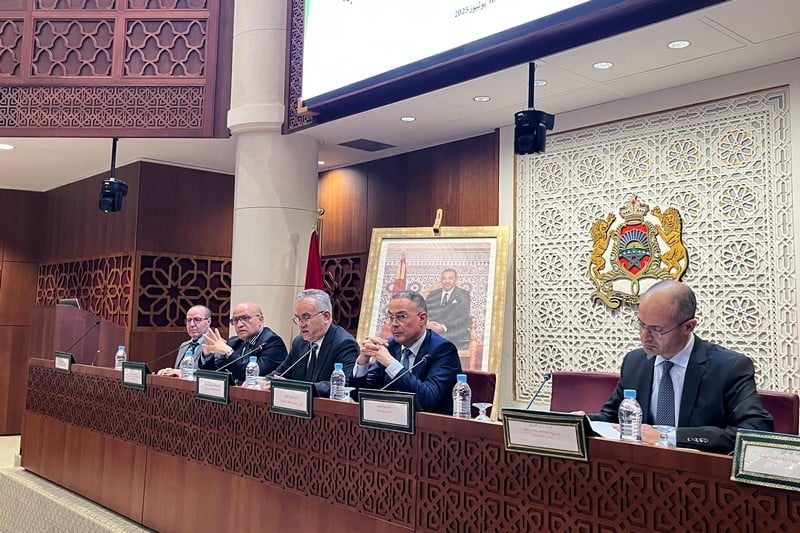
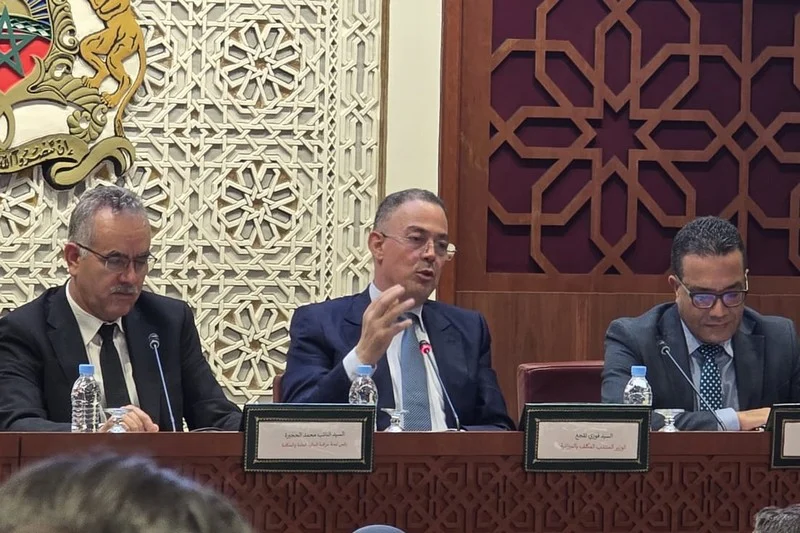
Faouzi Lekjaa, the Moroccan minister delegate to the Minister of Economy and Finance in charge of the budget, emphasized Wednesday that effective oversight of public finances is a “shared responsibility” that requires clarity and engagement from both the executive and legislative branches.
Speaking at a policy forum organized by the House of Representatives’ Committee on Public Finance and Governance, in partnership with the Ministry of Budget and the Court of Auditors, Lekjaa called for greater scientific and technical expertise to support Parliament in financial deliberations.
“Parliament must be equipped with substantial expertise throughout all phases of public finance discussions,” he said, advocating for earlier and more meaningful parliamentary involvement in shaping fiscal policies.
The event, focused on “the clearance bill and questions of transparency and accountability,” served as a platform to preview major reforms. Lekjaa announced that in October, the government will submit a draft revision of Morocco’s Organic Law on Finance Laws (LOF).
The amendment aims to strengthen financial transparency by reducing the time between annual budget approval and the corresponding clearance laws, which finalize and audit how funds were spent.
Structural Link Between Budget and Clearance Laws
Lekjaa described the clearance bill as a “practical execution” of the annual finance law, noting that it often lags by several years. In some cases, he said, it has been presented with delays of up to eight years. “This gap must be closed,” he stated, adding that the presentation of the 2023 clearance bill in February 2025 marked a “significant improvement,” with supporting documents offering comprehensive data and analysis.
The minister stressed that oversight is a cornerstone of democratic financial management and urged reform of the legal framework governing clearance bills. He proposed that Parliament be involved earlier in the budget process, starting in March, when over 18,000 finance ministry staff begin preparing the draft law, to enhance legislative scrutiny and enrich debate.
More Participatory, Transparent Budgeting
To build trust and improve governance, Lekjaa proposed establishing participatory checkpoints during key stages of the budget cycle. This would allow lawmakers to engage with the budget more substantively and objectively. He also called for an overhaul of how budget-related reports are structured, arguing for more focused and accessible content to better support oversight and evaluation of government performance.
Lekjaa also advocated expanding the use of supplementary finance laws, which are currently reserved for exceptional circumstances like the COVID-19 pandemic, to allow greater flexibility in adapting to changing conditions. He emphasized the need to boost the quality of public finance discussions in Parliament by incorporating independent experts and neutral financial analysts.
Accountability and Institutional Oversight
During his remarks, Lekjaa highlighted Morocco’s conscious decision to subject itself to institutional accountability mechanisms, including annual general account audits. He praised the Court of Auditors and the Finance Inspectorate as pillars of democratic oversight and called for increased support for these institutions.
The event also featured input from Dr. Hassan Al-Arfi, a public finance expert and professor at Mohammed V University in Rabat, who presented a methodological analysis of the clearance law from both financial and political perspectives. Yassine Naciri Bensghir, head of the Court of Auditors’ second chamber on financial sectors, outlined the institution’s approach to preparing its annual report on budget implementation.
Legislative Approval and Forward Outlook
Just a day prior, the House of Representatives approved the 2023 clearance bill (Law No. 07.25) with 82 votes in favor and 31 against, underscoring the political divide surrounding fiscal transparency.
The study day concluded with a call to expand collaboration between Parliament and academia. Lawmakers and finance experts agreed that building a more open, data-driven, and participatory budgeting system is essential to deepening democracy and delivering on Morocco’s fiscal policy goals.





add your comment
Terms of publication : Not to offend the writer, people, sacred things, or attack religions or the divine self, and refrain from racist incitement and insults.