
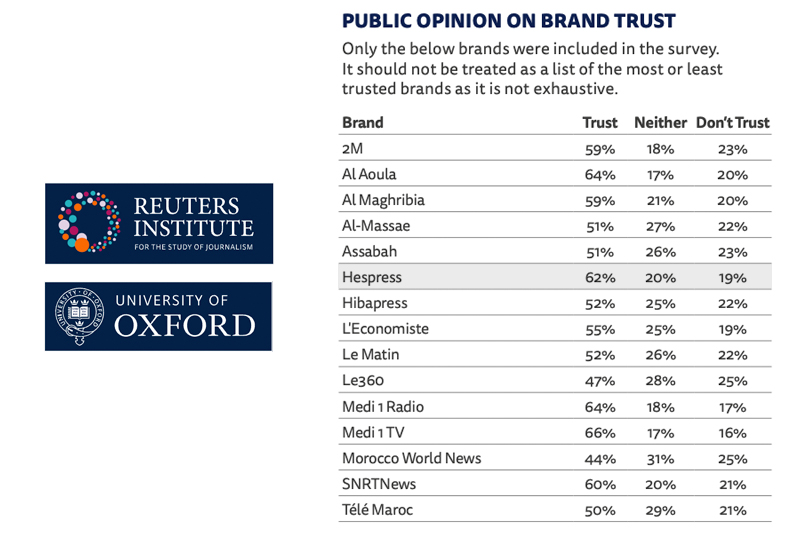
Hespress has emerged as the most trusted news outlet in Morocco, with 62% of Moroccans expressing confidence in its reporting, according to the Digital News Report 2025 released by the Reuters Institute for the Study of Journalism.
The report highlights a growing reliance on digital platforms for news consumption across Morocco, with 49% of Moroccans turning to YouTube and 24% to TikTok for weekly news updates, figures that far surpass those of traditional print newspapers or broadcast television. This trend places Morocco among the world’s leading consumers of news via social media, alongside countries such as Thailand and Nigeria.
The report, based on survey responses from 100,000 people in 48 countries, confirms Hespress’s leading position in Morocco’s digital news space. Weekly access to Hespress content reached 45%, with users visiting the site at least three times per week. This puts it well ahead of local competitor 2M’s website (28%) and the Al Jazeera news site (25%).

The Reuters Institute, affiliated with the University of Oxford, notes an ongoing “major shift” in how audiences consume news globally, marked by the decline of traditional media and the rise of social networks and video platforms. In Morocco, this shift has affected even established digital news outlets, which now face growing competition from social media influencers seen as more accessible and better suited to mobile content consumption.
Despite this competitive landscape, Hespress has managed to maintain high levels of public trust, alongside national public broadcasters like 2M, Medi1 TV, and Al Aoula.
However, the report warns of growing concern over misinformation: 47% of Moroccans cited influencers as their top source of false or misleading information, followed by political figures and the media itself. This has sparked debate on how to rebuild trust and adapt content formats for younger audiences, including the use of short videos and podcasts.
The report also reveals that 83% of Moroccans rely on smartphones as their primary source of news, followed by 65% using computers, 42% television, 26% radio, and only 12% newspapers. AI tools such as chatbots are gaining popularity, particularly among the youth. While only 7% of the general population uses them weekly for news, this rises to 15% among those under 25.
Reuters researchers emphasize that Moroccan media must find ways to integrate artificial intelligence tools, such as instant translation, summarization, and interactive fact-checking, while safeguarding the credibility and integrity of their content.
Meanwhile, 75% of Moroccan users reported watching news videos weekly, driven largely by YouTube’s wide reach. Globally, 55% of audiences prefer reading news, compared to 31% who prefer watching, and 15% who favor listening. Younger audiences, however, are increasingly gravitating toward video and audio content, prompting calls for Moroccan media to rethink their resource allocation between text, video, and podcast formats.
The report also points to recent positive developments in Morocco’s media environment, notably the release of three imprisoned journalists, Omar Radi, Soulaiman Raissouni, and Taoufik Bouachrine, under a royal pardon in July 2024. The releases were seen as a sign of potential political and media liberalization.
Bouachrine, in particular, has re-emerged as a digital political commentator with his new YouTube program “Talk on Politics”, where he advocates for sweeping political reforms. His case reflects the broader trend of journalists turning to digital platforms as spaces for freer expression amid shifting regulatory and media landscapes.





add your comment
Terms of publication : Not to offend the writer, people, sacred things, or attack religions or the divine self, and refrain from racist incitement and insults.