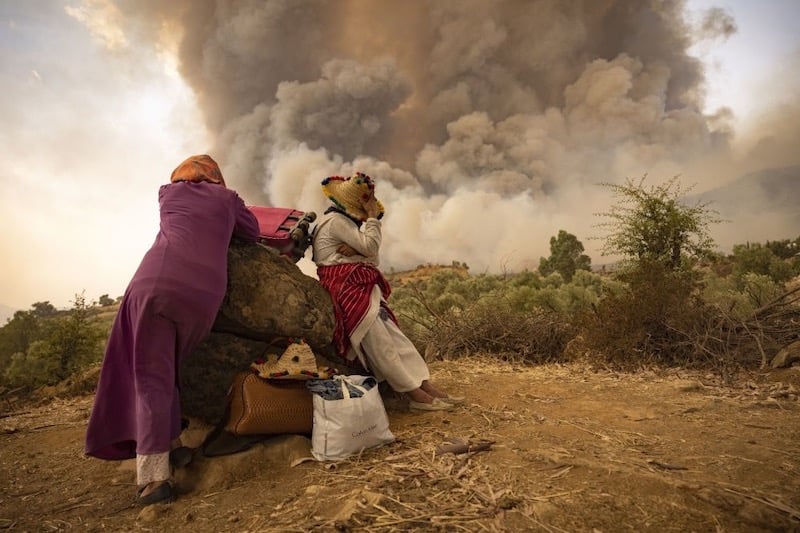
A team of Master’s students in Data Science and Big Data at Hassan II University in Casablanca has designed an artificial intelligence-powered system that predicts wildfire risks and offers smart solutions for agricultural management.
Unveiled at the “AI for All–ESSOR” event hosted by the Faculty of Ben Msik, the students’ project comes as countries around the globe increasingly turn to AI to confront climate change and mitigate disaster impacts.
The predictive system was developed by students Salma Salama, Salah-Eddine Khaldouni, and Nouhail Hajjaoui. It uses historical weather data — including temperature, humidity, wind speed, and rainfall — alongside real-time satellite imagery from NASA’s FIRMS (MODIS & VIIRS systems) to forecast fire outbreaks.
By applying machine learning algorithms such as logistic regression, the system provides early warnings to authorities, aiming to reduce agricultural and environmental losses. The team said the tool is designed to be practical and user-friendly for deployment in the field.
The project, supervised by professors Habib Ben Lemhar, Oussama Kaich, and Zakaria Fakir, uses real-world datasets and machine learning platforms to simulate and test predictions. In future implementations, the students propose integrating IoT sensors to collect real-time ground data.
The wildfire alert system is just one part of a broader initiative to apply AI solutions to agriculture. According to a technical report shared with local media outlet Hespress, the project also tackles crop selection, livestock feed management, and crop yield forecasting — all areas where small and medium-scale farmers face critical challenges.
To address crop selection, the team used random forest algorithms to analyze local climate and soil data, offering tailored recommendations to help farmers boost productivity and reduce resource waste.
For livestock feed optimization, the students built a dataset of local forage types and used classification algorithms to guide farmers in choosing the most suitable feed for their specific environments — reducing costs and improving animal health.
In a final component, the team focused on forecasting yields for sensitive crops such as tomatoes and oranges. They employed regression models and Long Short-Term Memory (LSTM) neural networks to analyze climate patterns and farming history, allowing for more accurate predictions of future harvests.
The student-led project underscores the growing role of AI in sustainable agriculture and disaster prevention, offering scalable solutions for one of Morocco’s most climate-vulnerable sectors.






add your comment
Terms of publication : Not to offend the writer, people, sacred things, or attack religions or the divine self, and refrain from racist incitement and insults.