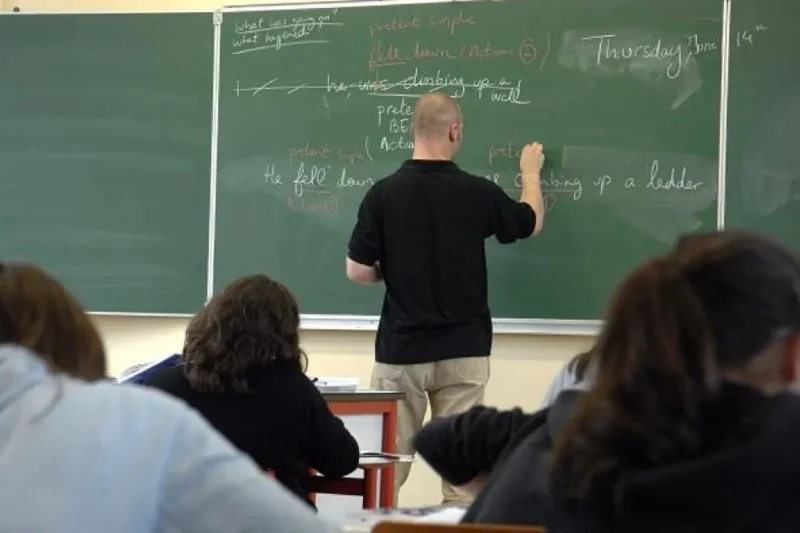
English in Morocco is gaining steady ground, especially among youth and urban elites, according to a new language use survey released this week by research group Sunergia.
The report, based on data collected in September 2024, reveals a shifting linguistic landscape shaped by age, class, and access to education, where English is quietly rising alongside a complex mix of Darija, French, classical Arabic, and Amazigh.
Currently, 9% of Moroccans speak English fluently, but the figure jumps to 17% among those under 34 and 22% among upper-income groups.
In urban areas, 12% report fluency. English is also emerging in professional contexts, used orally and in writing by about 7% of respondents.
Its growth is fueled by the expansion of English-language university programs, demand in international job markets, and widespread exposure to online content and media.
Darija remains Morocco’s dominant language, spoken by 100% of the population and considered the mother tongue by 94%. It’s used in nearly all personal conversations (94%) and most professional interactions (69%), but its written use is more limited (39%). Despite this ubiquity, Darija still lacks official recognition.
Classical Arabic, although the country’s formal language and central to education and administration, is spoken fluently by just 29% of Moroccans, more commonly among youth, urban dwellers, and affluent groups. Its role in written communication remains minor.
Amazigh is spoken by 25% of the population and retains a stable intergenerational presence, particularly in the South and rural regions. It is largely used in oral, personal settings and stands as a strong marker of cultural identity.
French is still widely present, spoken fluently by 19% of Moroccans. Its usage forms a U-shaped curve by age, prevalent among youth under 34 (24%) and those aged 55–64 (18%), but lower among the 35–54 group (14%).
Socioeconomic gaps are stark: 43% of upper-class respondents speak French fluently, compared to just 6% of lower-income groups. French dominates written professional communication (32%) and remains significant in formal environments.
Spanish and German are each spoken by only 1% of the population, remaining marginal despite geographic and academic ties.
The report also highlights a divide between spoken and written use. Darija dominates oral exchanges, while French leads in writing. Classical Arabic and Amazigh remain largely confined to personal use. English is still emerging but gaining a foothold in professional spaces.
In terms of language profiles, 45% of Moroccans are monolingual (all in Darija), 34% are bilingual, most commonly in Darija and Amazigh, and 14% are trilingual, often combining Darija, Arabic, and French.
A growing number of young Moroccans, especially those aged 18–24, combine Darija, French, and English.
Seven percent are polyglots, speaking four or more languages, mainly among educated, urban youth.




add your comment
Terms of publication : Not to offend the writer, people, sacred things, or attack religions or the divine self, and refrain from racist incitement and insults.