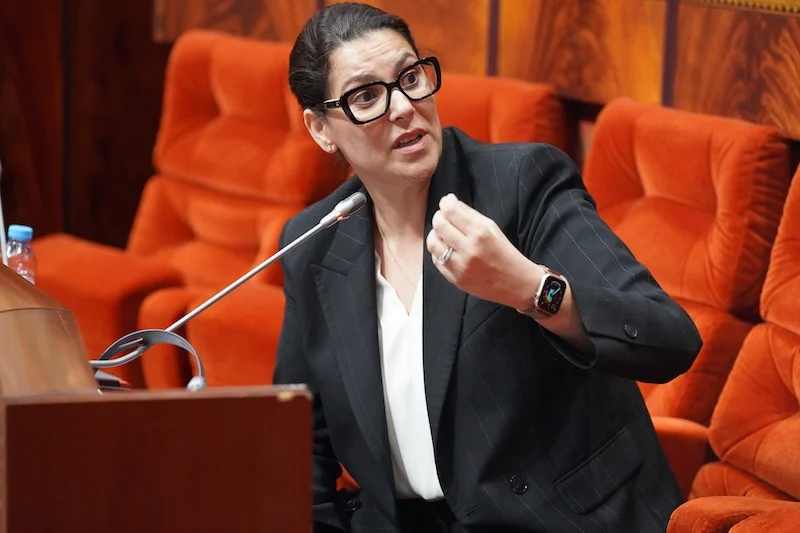
Morocco’s Minister of National Land Planning, Urban Planning, Housing, and Urban Policy, Fatima-Zahra Mansouri, announced Monday that more than 48,000 people have benefited from the government’s social housing support program, part of a broader strategy to ease housing access and stimulate investment.
Speaking during a parliamentary session, Mansouri revealed that the program had received 128,528 applications, including 22% submitted by Moroccan expatriates. So far, MAD 3.8 billion ($380 million) in aid has been disbursed.
She detailed that 54% of beneficiaries received MAD 70,000 ($7,000) in support, while 46% were granted MAD 100,000 ($10,000)—an amount covering roughly one-third of housing acquisition costs.
Mansouri linked the program’s impact to a surge in construction activity, noting an 11.64% rise in cement consumption in February 2025 compared to the same period last year, and a 2% increase in housing-related loans. Small and medium-sized enterprises accounted for over 80% of the activity, she said.
Geographically, beneficiaries were concentrated in Casablanca-Settat (35%), Fes-Meknes (31%), and Rabat-Salé-Kénitra (12%).
Legal Reforms in Rural Planning
Addressing complications related to construction permits in rural areas, Mansouri announced that her ministry, in collaboration with the Interior Ministry, is revising Law 12.90 on urban planning to better reflect the needs of rural communities. The update—currently under government review—includes new legislation tailored for rural zones and amendments to Law 25.90 on land subdivisions.
Since the issuance of a joint directive to simplify rural construction procedures, 68,600 permit applications have been processed, with 36,931 approvals. Over 70% of the applications involved plots smaller than 1,000 square meters.
Still, Mansouri emphasized that building designs remain mandatory in rural zones, citing data that show 55% of permit rejections stem from technical issues.
Opposition lawmakers, however, pushed for broader exemptions and simplified procedures, especially in mountainous areas such as Imilchil and Anzi, where residents often lack land deeds and face difficulty obtaining administrative certificates.
Boosting Investment Through Urban Planning
In response to questions about investment incentives, Mansouri highlighted progress in urban planning approvals, which play a critical role in fostering investor confidence. Since the start of the current legislative term, 346 planning documents and 236 urban development blueprints—including 41 for major cities—have been approved, compared to just five in the previous term.
She also cited the approval of 107 development master plans and the allocation of over 120,000 hectares for urbanization, with 55,800 hectares earmarked for economic activities and 61,900 for housing.
Urban agencies have reviewed 611,000 urban development projects since the beginning of the term, approving more than 340,000, Mansouri said.








add your comment
Terms of publication : Not to offend the writer, people, sacred things, or attack religions or the divine self, and refrain from racist incitement and insults.