
Morocco’s Head of Government Fatima Zahra Mansouri has pledged to combat monopolies and exploitative intermediaries, strengthen oversight of public procurement and expand social support as part of her government’s program.
Presenting the government program in Parliament on Monday, Mansouri said the government would coordinate with the Competition Council to introduce targeted mechanisms to tackle anti-competitive practices. It will also establish procedures to examine public contracts and investigate collusion in tendering processes.
Public procurement will be used to support domestic production and economic integration, with companies awarded public contracts legally required to allocate 30% of their contract value to Moroccan small and medium-sized enterprises, she said.
Social support and cost-of-living measures
Mansouri said the government would address the rising cost of living through a strategy focused on increasing household incomes, tackling the causes of price increases, expanding social protection and improving public services.
The government plans to introduce automatic social compensation for eligible households equivalent to their monthly electricity bill, provided the bill does not exceed MAD 100 for their primary residence. The mechanism would not require beneficiaries to submit paper applications or travel to government offices, she said.
The government will also gradually reform income tax to increase workers’ net earnings and encourage formal employment.
To bring food prices to more affordable levels, the government plans to develop supply strategies for essential products and bring producers closer to consumers through regional companies and professional collection and marketing organizations operating under a unified set of specifications.
It will also reform meat and fish distribution channels and regulate the relationship between exports and domestic market supply through transparent, stable rules, Mansouri said.
Family policy, equality and social protection
Mansouri said the government’s term would be guided by the protection of Morocco’s shared national identity, solidarity across social groups, generations and regions, and the preservation of the family as a foundation of social stability.
The government will continue implementing the Family Code reform in line with the guidance of the King in his capacity as Commander of the Faithful, she said.
It will also pursue an integrated policy for children, young people and older people, with measures to protect women and children and safeguard the rights of people with disabilities.
Mansouri added that the government would strengthen constitutional institutions responsible for human rights, equality and parity, while adopting a comprehensive policy to empower women and reduce discrimination.
Amazigh language, access to information and cultural policy
The government will work to protect personal data, renew its partnership with civil society and simplify authorization procedures for associations, while implementing the right of access to information, Mansouri said.
To advance the official status of the Amazigh language, the government plans to establish a dedicated fund with an allocation of MAD 2 billion, alongside a permanent ministerial committee under the head of government.
The committee will monitor the integration of Amazigh into education, public administration, the judiciary, the media and public-sector employment. Coverage indicators will be published in an annual report, she said.
The government also intends to preserve Morocco’s heritage and expand access to culture according to the principle of equitable regional access, while increasing the cultural sector’s contribution to development, tourism appeal and sustainability.
Mansouri additionally pledged to introduce an inclusive policy for Moroccans living abroad, aimed at encouraging their civic participation and maintaining communication with them in ways that respond to their needs.
Territorial integrity and the Moroccan Sahara
Mansouri reaffirmed the government’s commitment to defending Morocco’s territorial integrity, promoting the autonomy initiative under Moroccan sovereignty and accelerating development in the country’s southern provinces.
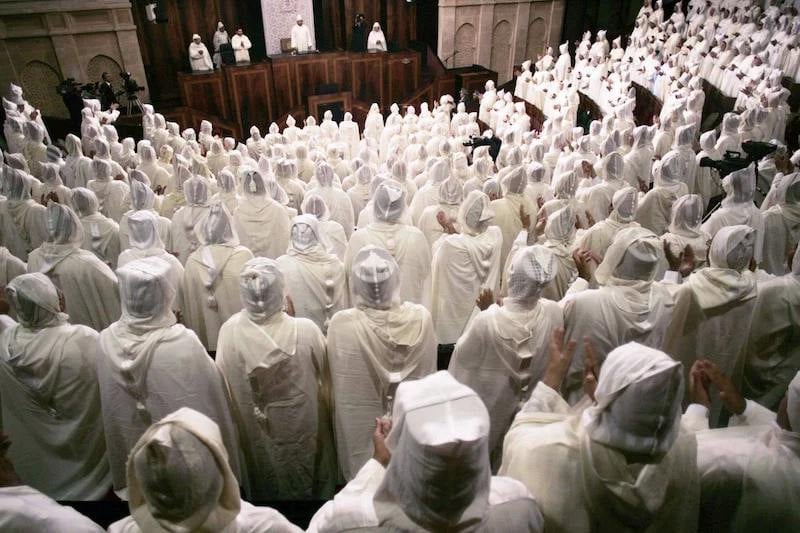
Presenting the 2026-2031 government program before a joint plenary session of both chambers of Parliament, in accordance with Article 88 of the Constitution, Mansouri said the program was grounded in Morocco’s national constants, including moderate Islam, constitutional, democratic, parliamentary and social monarchy, national and territorial unity, and the democratic choice, while preserving cultural and linguistic diversity, rights and freedoms, and equal opportunities.
Western Sahara remains at the forefront of Morocco’s national priorities, Mansouri said, linking the government’s position to what she described as the decisive significance of United Nations Security Council Resolution 2797, adopted on Oct. 31, 2025.
The government will continue defending Morocco’s sovereignty, territorial integrity and interests, while mobilizing support for the autonomy initiative under Moroccan sovereignty, she said. It will also accelerate development in the southern provinces, which Mansouri described as a gateway to Morocco’s African hinterland and Atlantic sphere.
On the Palestinian issue, Mansouri said the government would maintain Morocco’s established position on Palestine and Al-Quds, reaffirming its commitment to a peaceful settlement based on the two-state solution to achieve a just and lasting peace.
She said these efforts would continue under the leadership of King Mohammed VI, in his capacity as Commander of the Faithful and chairman of the Al-Quds Committee. Mansouri concluded that royal directives would remain the primary reference guiding government action.




add your comment
Terms of publication : Not to offend the writer, people, sacred things, or attack religions or the divine self, and refrain from racist incitement and insults.