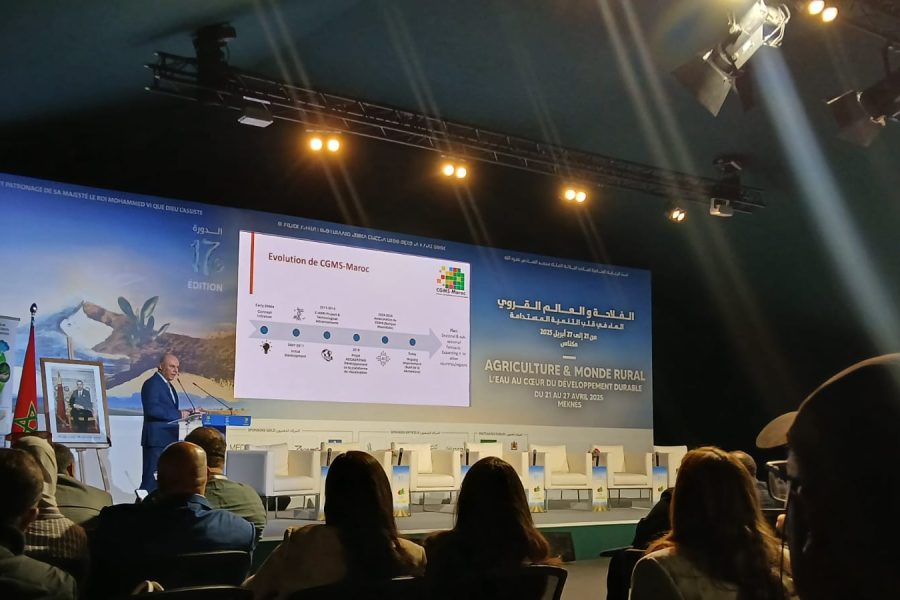
As Morocco grapples with one of the worst drought periods in recent memory, a high-profile panel at the 2025 International Agricultural Fair (SIAM) in Meknès sent a clear warning: climate change is no longer a future threat—it’s a present crisis reshaping the country’s agricultural landscape.
The Friday morning session, titled “Climate Services and Agriculture: Issues, Uses and Perspectives for Morocco,” drew a standing-room-only crowd of experts, government officials, and farmers eager to address the growing challenges of extreme weather and prolonged drought.
“We are now in our seventh year of drought,” said Abdelfattah Sahibi, Secretary General at the Ministry of Equipment and Water. “The last three years were the hottest on record in Morocco. Climate change is no longer a theory—it’s redrawing our agricultural maps and putting pressure on our food security.”
Sahibi emphasized that weather forecasting has evolved from a support tool to a strategic necessity. He pointed to the recent rollout of the Crop Growth Monitoring System (CGMS) as a key innovation helping farmers adapt in real time. Developed through a partnership between the meteorological office and the Ministry of Agriculture, CGMS combines satellite imagery, crop-weather models, and AI to monitor drought conditions and predict yields.
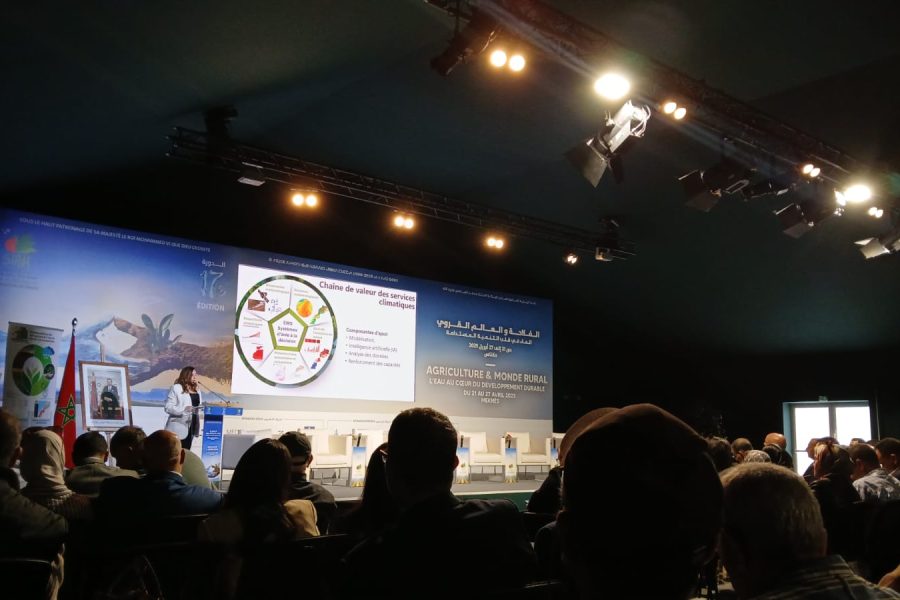
“We’re no longer just reacting—we’re trying to stay one step ahead,” he said.
For Rachid Benali, president of Morocco’s leading agricultural federation COMADER, the climate volatility is hitting where it hurts most—on the farm. “We live by the weather,” he said. “Last year, we were set for a record olive harvest, but five days of ‘Chergui’ winds wiped it out. That’s how fragile it is.”
Benali described the increasing difficulty in planning and planting due to temperature swings and erratic rainfall. “Two days ago it was -1°C. Today, it’s 20°C. That kind of change destroys crops,” he added.
Meryem Aouri, an expert in climate data management, backed up those concerns with sobering statistics. “Between 1961 and 1990, only 13% of years had rainfall deficits over 20%. In the past three decades, that figure has jumped to 43%,” she said. “This is a structural shift.”
The CGMS program, launched in the early 2010s and refined through collaboration between INRA, Hassan II Agronomy and Veterinary Institute, Maroc Météo, and the Ministry’s Statistics Department, was a focal point of the panel. The system enables precise crop monitoring using cutting-edge data science, helping not only farmers but also scientists and policymakers make informed, timely decisions.
As Morocco’s food production is increasingly threatened by rising temperatures and shrinking water reserves, the panel concluded with a unanimous message: climate resilience must become central to the country’s agricultural strategy—or the consequences will be severe.






add your comment
Terms of publication : Not to offend the writer, people, sacred things, or attack religions or the divine self, and refrain from racist incitement and insults.