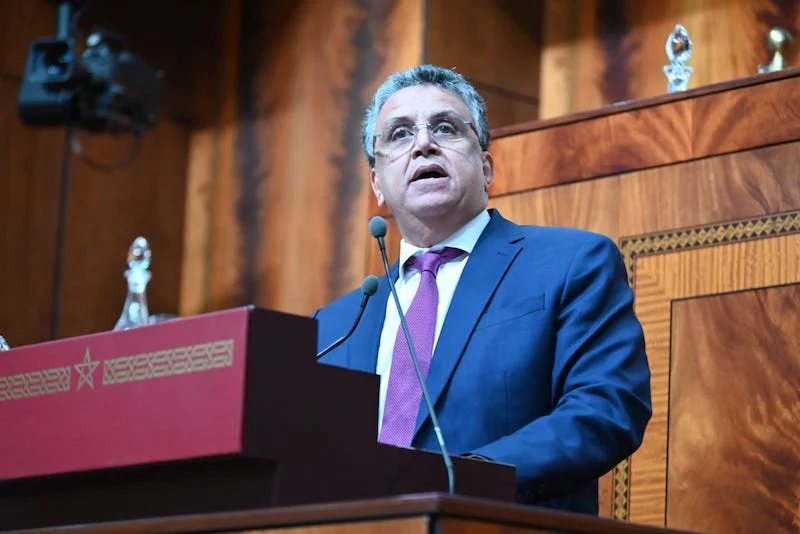
Justice Minister Abdellatif Ouahbi expressed frustration over a conservative faction within the government that opposes legal reforms, including changes to the Family Code and the Penal Code, Assabah reported.
Speaking at a symposium organized by the Progress and Socialism Party on Thursday in Rabat, Ouahbi emphasized that “legislation is fundamentally a political decision, forcing ministers to choose: either they stir the hornet’s nest by pushing for change, ignore reforms to avoid problems or engage in hypocrisy by staying silent.”
Assabah reported that Ouahbi stressed legislation is not solely the minister’s responsibility—it involves other ministers, institutions, and government bodies. He acknowledged that a minister’s vision often clashes with state realities, leading to heated debates over legal reforms where he sometimes wins and sometimes loses. In the end, he said, compromise is often necessary to move forward.
The Minister pointed out that lawmaking is shaped by the balance of power in society, due to the existence of conservatives and progressives. _“_Even within the government, there is a conservative current, while the progressives struggle. This divide is equally evident in the opposition.”
He questioned whether progressives support the minister and answered himself: they do not. Despite facing harsh criticism, Ouahbi stressed that “he has still submitted 47 legal proposals to update outdated laws that are no longer appropriate.”
The minister explained that the Family Code reform remains a back-and-forth battle between conservatives and progressives, much like the draft Penal Code, which has been stalled due to debates over abolishing the death penalty and modifying religious-related laws—particularly those criminalizing consensual relationships.
Ouahbi dismissed the controversy over Article 3 of the Criminal Procedure Code as “a truth used to serve a false agenda.” He argued that there were restrictions on malicious complaints filed by associations, which he described as mere denunciations related to embezzlement and misappropriation.
In 2024 alone, he revealed, 259 such reports were filed, resulting in 132 investigations, with five currently on trial, eight under investigation, final decisions rendered in two cases, and 12 dismissed.
Defending local elected officials, Ouahbi criticized how anonymous complaints, often written in cafés, can drag politicians into lengthy legal battles.
He noted that an official under investigation can spend four years entangled in police inquiries, and in some cases, up to eight years in court. By the time they are acquitted, their political reputation is ruined. But he made clear that he was not shielding corrupt officials who were genuinely guilty of financial misconduct.
Ouahbi also revealed that the number of criminal cases in the courts has surged from 324,000 in 2002 to 10 million over the past 22 years, leading to charges against 12 million people. The prison population has reached 105,000, with 31% in pretrial detention and over 68% already convicted. Additionally, 40% remain in custody awaiting trial.








add your comment
Terms of publication : Not to offend the writer, people, sacred things, or attack religions or the divine self, and refrain from racist incitement and insults.