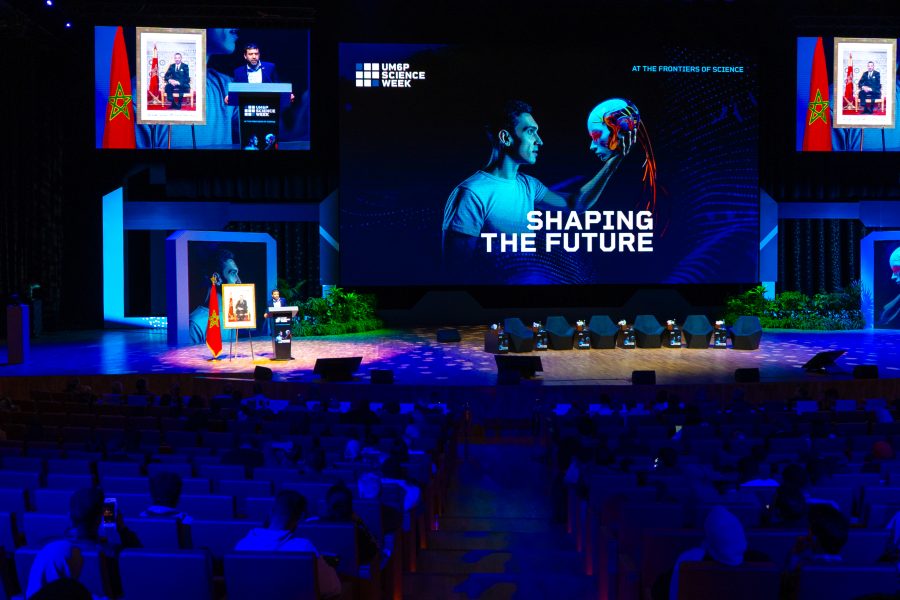
The fifth edition of Science Week, hosted by Mohammed VI Polytechnic University (UM6P) in Benguerir from February 17 to 23, 2025, under the theme “Shaping the Future,” came to an end on Friday.
With over 4,500 participants, including students from various universities, 90 international experts, 45 conferences, and 30 workshops, the event—according to a press release—tackled several key challenges, from the role of artificial intelligence in industrial transitions and scientific sovereignty in Africa to energy and mining challenges, as well as innovation in agriculture and healthcare.
Discussions on green hydrogen highlighted the importance of an integrated approach, combining local production, appropriate infrastructure, and industrialization of value chains, with experts emphasizing the need to secure investments and foster research-industry partnerships to avoid technological dependency.
The “Mining the Future” session highlighted tensions between rising demand for strategic metals and sustainable practices, with experts discussing automation trends, resource management, carbon neutrality, and CO₂ capture technologies.
The event also explored phosphorus management, emphasizing the optimization of production flows and the recycling of phosphate fertilizers.
The fifth edition of Science Week also examined AI applications in medicine, sparking debates on algorithmic biases, diagnostic reliability, and medical training. Discussions highlighted advancements in predictive medicine, AI limitations, and the need for regulation to complement human expertise.
It additionally shed light on architecture with a discussion on the Grand Stade Hassan II, set to be the world’s largest stadium, while also exploring advances in genomics, including genome mapping, gene editing, and personalized medicine.
The 2025 edition also highlighted several projects led by researchers and students, including AlgaTech, a robot designed to collect and recycle algae for producing biofuels and natural fertilizers, and Ecolink, a digital platform connecting companies and recyclers to optimize waste management.
The event featured Science Village, an immersive space where researchers, students, and the public explored technological advancements through interactive exhibits, demonstrations, and hands-on workshops.
Beyond the discussions and presentations, this edition laid the groundwork for reflecting on ongoing transformations and the need for coordinated initiatives between research, industry, and public institutions.
“Science is not an abstraction confined to laboratories or publications. It is a dynamic force, a lever that transforms our societies, economies, and ways of understanding the world,” stated Hicham El Habti, President of UM6P.
The press release announced that this vision of science as a driver of real-world transformation resonates with the theme of the 2026 edition: “Convergence(s).”
It stated that “as the boundaries between disciplines blur and synergies between research, industry, and public policy become essential, science must be seen as a crossroads of interactions—a space where knowledge and innovation intertwine to shape the future.”



add your comment
Terms of publication : Not to offend the writer, people, sacred things, or attack religions or the divine self, and refrain from racist incitement and insults.