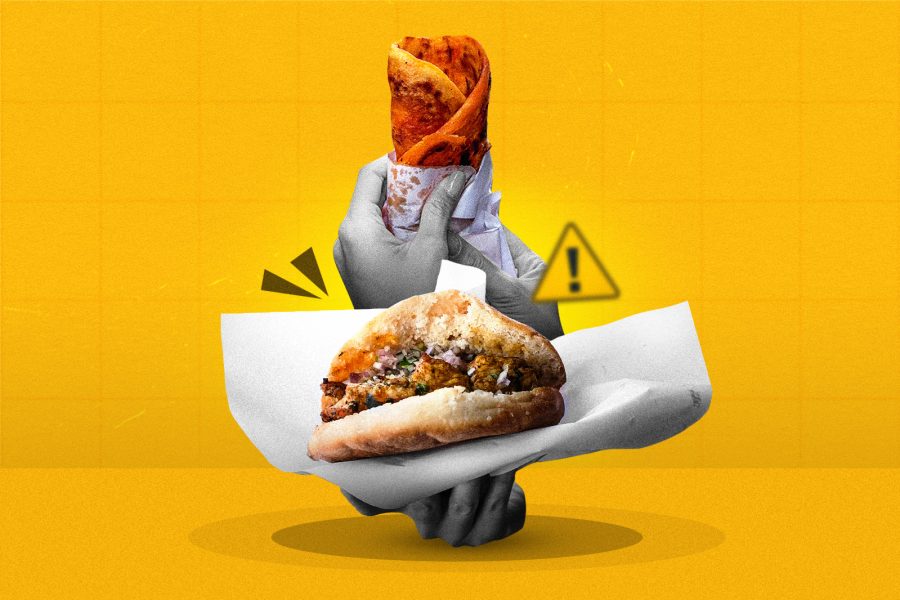
When Yasmine, a 24-year-old girl, wanted to enjoy shawarma with her friend at a popular Beni Mellal restaurant known for its Middle Eastern cuisine while preparing for her teaching entry exam, she found herself locked in a battle with stomach cramps and nausea.
Yet, despite the intense pain, she chose silence over action—no doctor visits, no reports to health authorities, and no warning to the restaurant she had trusted for years without issue.
“My stomach hasn’t been the same since. It felt like it was being ripped apart,” recalled Yasmine in a statement to Hespress English, speaking on the condition of anonymity.
She wasn’t alone in keeping quiet. Ikram, 23 years old, Meryem A., 25, and Meryem Essaidi 32, are just a few of the food poisoning victims whose testimonies were gathered by Hespress English.
Like her, they chose to suffer in silence, staying tight-lipped instead of reporting to the relevant authorities and taking action—missing the chance to prevent others from facing the same fate.
“I didn’t want to lose time on it, especially since I was focused on preparing for the teaching exam,” explained Yasmine why she didn’t report the incident.
Likewise, Meryem A., who had large red welts that bloomed on her skin after drinking a strawberry beverage from a juice shop (Mahlabha), chimed in, “I didn’t report it because I felt just too lazy, and to be honest, I’m not really in the habit of reporting things to the authorities.”
“A lot can happen when reports are made. It was reporting that led to significant actions being taken by the authorities,” underscored Leila Awad, a physician at the Anti-Poison and Pharmacovigilance Center of Morocco (CAPM), which operates under the Ministry of Health.
She was responding to what she called “too pessimistic views” on the impact of reporting—views shared by people like Essadi, 32, who didn’t report her food poisoning case, believing “it wouldn’t make a difference.”
The doctor emphasized to Hespress English that “food poisoning is often underreported” in Morocco, supporting her claims with the annual number of reports received by the Center.
While media reports suggest a noticeable rise in food poisoning cases in Morocco, the data at the Center, based on reports from hospitals and regional centers, doesn’t fully capture the reality.
“We receive nearly 1,000 cases each year, but it’s unrealistic to believe that Morocco has only that many,” argued Awad.
While data for 2024 isn’t available yet, she pointed out that in 2023, the CAPM recorded 974 cases, reflecting a 12% increase compared to 2022, when only about 500 cases were registered. “Of course, this doesn’t mean there were only 500 cases of food poisoning in Morocco, and the figures we have are just the tip of the iceberg,” emphasized the doctor.
Yet, Awad acknowledged that “the rise in reported cases is a sign of growing public awareness about food poinoning and the importance of monitoring.”
She underscored, however, “what’s really happening in Morocco is not fully known to us. We only learn about cases that reach hospitals, media reports of collective food poisoning, or extreme cases, such as deaths.”
Increased reporting of food poisoning is crucial for safeguarding public health. This was evident in Fes, where authorities seized over 9 tons of unsafe “khli3” prepared in unlicensed facilities, along with 500 kg of uninspected meat, and detained 12 people.
By documenting these cases, authorities can better monitor the practices of food establishments, ensuring compliance with essential quality standards.
This heightened awareness facilitates better tracking of sourcing and importation practices, helping to identify potential risks in the food supply chain, not to mention overall food handling standards. It can also push for stronger legislation on food safety.
Doctor Awad shared with Hespress English that the available data at the CAPM for 2023 revealed that the Tanger-Tetouan-Al Hoceima region had the highest number of food poisoning cases (28.5%), followed by Casablanca-Settat (22.4%).

“The economic pressure, primarily driven by inflation, forces many food spot owners to prioritize meeting sales targets over ensuring health and safety standards. These owners often view themselves as vendors, similar to those in supermarkets, focusing solely on numbers rather than public safety,” explained Derrouz in a statement to Hespress English.
He added that “even well-known spots have experienced cases of food poisoning, primarily due to their focus on maximizing the quantity of goods they produce or serve, often at the expense of maintaining proper safety and hygiene standards.”
From her part, Doctor Awad suggested that while it’s hard to draw definitive conclusions without deeper analysis, one possible factor behind “the rise in food poisoning cases could be the increasing cost of food and its quality. “Vendors and restaurant owners may be turning to cheaper, lower-quality ingredients,” she suggested.
Looking at the data above, where <ahref=”https://en.hespress.com/tag/tanger”>Tanger-Tetouan-Al Hoceima ranked first in food poisoning cases in 2023, the doctor suggested that “this may be due to the region’s popularity as a summer hotspot, where high temperatures and increased dining out raise the likelihood of food poisoning.”
This is evident, as tons of studies indicate that during the hot summer months, the risk of food poisoning increases because bacteria multiply more rapidly in warmer temperatures.
This interpretation also helps explain why a third of food poisoning cases occur in summer, according to a seasonal analysis of reports from the CAPM covering the period from 2007 to 2011.
The analysis suggested, “this increase may be attributed, on one hand, to the role of temperature in the spread of germs in food and water, and the increased consumption of fruits and vegetables during this time of year, and on the other hand, to poor food preservation.”
Food poisoning has always been a concern in Morocco. In fact, it remains the third most common cause of poisoning, accounting for 12.5% of all cases, according to a research paper published in 2021. A decade ago, these incidents were among the top reported poisoning cases in the country.
The study, based on data collected from the Agadir prefecture between 2015 and 2017, found that food poisoning incidents were primarily caused by meat products (31%), milk and dairy products (16.2%), fruits (14.5%), and beverages (14.2%).
The findings also revealed that the majority of food poisoning outbreaks were linked to food served either raw (47.9%) or cooked (33.1%), with 15.3% involving a combination of both. Only 1.8% of cases involved canned or previously chilled meals.
“Unfortunately, in most cases, there is no proactive monitoring; inspections only begin after reports of poisoning have already surfaced,” said Derrouz.
That’s what doctor Awad echoed, stating, “the authorities can’t take action without reports from the public.” She explained that “while regular inspections are conducted, it doesn’t mean that they will always detect violations. However, when citizens report, it means something unusual has been identified.”
For consumer goods, government spokesperson Mustapha Baitas emphasized in March 2024 that monitoring is conducted year-round. Between January 1 and March 5, 2024, 46,361 points of sale were inspected, resulting in the detection of 2,983 violations.
Of these, 545 violations were addressed with warnings, while 2,438 were documented and forwarded to the relevant courts. Baitas also revealed that 120 tons of unfit and non-compliant products had been seized and destroyed.
In February 2023, Baitas, while presenting the results of market monitoring operations from January 1st to February 22nd, 2023, unveiled that the equivalent of 400 tons of unfit or non-conforming materials had been seized and destroyed.
To strengthen monitoring and tackle the rise in food poisoning incidents, the Ministry of the Interior announced plans to establish 130 public health offices, with a budget of 10.4 billion MAD. Half of the funding will come from the Interior Ministry, as part of Morocco’s 2010-2025 action plan.
These new offices aim to address infrastructure gaps in municipalities, especially in rural areas, that lack essential public health services. The offices will be set up in collaboration with local authorities to serve 1,244 municipalities across 53 provinces currently lacking adequate health services.
Morocco has also established a national health monitoring cell and local teams, involving the Ministries of the Interior, Health, and Agriculture.
These teams are tasked with identifying and addressing food poisoning sources and collaborating with authorities at airports, ports, and border crossings to manage health risks related to smuggled food products.







add your comment
Terms of publication : Not to offend the writer, people, sacred things, or attack religions or the divine self, and refrain from racist incitement and insults.